How the MOT scheme is administered and the rules for authorised examiners, testers and testing different types of vehicles. This guide sets out the rules you have to follow to run an MOT test station.
Section A
Introduction to the MOT Testing Guide
The purpose of the MOT test, what it includes, which vehicles are tested and which are exempt, who carries out the test.
Introduction to the MOT testing guide
This document is intended to help new and existing authorised examiners, testers and other interested parties comply with the requirements for authorisation by the Secretary of State to conduct statutory tests on certain motor vehicles.
The statutory requirements are contained in the Motor Vehicles (Tests) Regulations 1981 as amended. The guide does not cover the requirements for annual testing of heavy goods vehicles (HGVs) or public service vehicles (PSVs). Neither does the guide cover the requirements for type approval nor individual vehicle approval of certain vehicles before they are first registered in Great Britain.
This guide is divided into a series of sections covering specific subject areas.
Detailed information on the technical standards and procedures of the statutory test is given in the appropriate MOT inspection manual.
Additional instruction and information is also issued to vehicle testing stations about testing and procedures, in the form of special notices (SNs). DVSA reserves the right to modify the content of this guide to reflect changes in the law or in light of experience.
Availability and maintenance of the guide
The definitive document is held electronically. The electronic documents will be periodically updated and changes will be advised by special notice.
Additional information is available at DVSA and the MOT service.
Other DVSA documentation
This guide should be used in conjunction with:
- the relevant MOT inspection manuals which are a detailed guide to the inspection for statutory MOT testing
- special notices (SNs) - these are issued periodically by DVSA to inform those involved with MOT testing about changes and to highlight areas of concern
- other documentation issued by DVSA
1. Purpose and scope of the test
The purpose of the MOT test is to ensure that cars, other light vehicles (including some light goods vehicles), private buses and motor bicycles over a prescribed age are checked at least once a year to see that they comply with roadworthiness and environmental standards – and to that end contributes to the government’s road safety strategy.
MOT test records
For every test conducted an electronic record is created. The electronic record of an MOT is the legal record of that test. The test result is lawful once the test has been recorded on the MOT testing service or a CT20 test certificate has been issued during contingency testing.
The vehicle testing station does not need to automatically issue a paper record of the test. However, a vehicle presenter may ask for a paper receipt of the test. If requested, the vehicle testing station must supply the relevant VT20 or VT30 certificate.
The MOT record is checked when a vehicle is taxed. The police and certain enforcement agencies can also access this information directly from the electronic record and may use it for on-road enforcement that a vehicle has an MOT or as part of other investigations.
The electronic test records are made available publicly online and and should be used by vehicle owners to confirm the MOT test result and details of their vehicle. This data can be used for a variety of road safety related purposes, such as helping motorists to make informed decisions when considering a car purchase, to help look after their vehicle and to ensure they get their vehicle tested on time.
Third parties may also access these records and use it for things such as checking validity of vehicle mileages or for part of car insurance considerations. The recorded accuracy of that test result and it being matched to the correct vehicle is therefore important.
Paper documentation (such as the receipt style test certificate and the failure document) may be issued on completion of a test, but these should only be considered as a view of the definitive electronic record.
The creation of that electronic record relates only to the condition of testable items at the time of the test and should not be regarded as:
- evidence of their condition at any other time
- evidence of the general mechanical condition of the vehicle
- evidence that the vehicle fully complies with all aspects of the law on vehicle construction and use
There are a number of specific circumstances when a paper certificate must be issued. See Section H. Documentation for full details.
The test is a visual inspection and does not require the dismantling of parts of the vehicle although doors, boot lids and other means of access will normally need to be opened. In the case of motor bicycles, cover panels may also need to be removed or raised to examine the vehicle structure.
MOT history check
The definitive legal MOT records for a vehicle can be viewed on the service to check the MOT history of a vehicle.
It includes:
- if the vehicle passed or failed
- the mileage recorded when it was tested
- where each test was done – you’ll need the 11-digit number from the vehicle’s log book (V5C)
- what parts failed at each test, and if any parts had minor problems
- when its next MOT is due
- if a vehicle recall is outstanding
Vehicle owners are advised to check their MOT details following their test. They can get information corrected on an MOT certificate if it’s wrong. Some errors can be corrected by the MOT garage that issued the test. Other errors will need to be corrected by DVSA.
MOT reminder service
Owners of vehicles that are registered in Scotland, England or Wales can sign up to the MOT reminder service to receive text or email reminder notifications for free.
When they sign up they’ll get a reminder:
- 1 month before their car, van or motorcycle MOT is due
- 2 months before their lorry, bus or large trailer MOT is due
A person can register a maximum of 2 vehicles on a single phone number or any number of vehicles on an email address. Subscriptions can be managed on the online service to add or remove vehicles.
2. Test classes
The vehicles subject to test under the regulations are divided into the following classes.
Class 1
Class 1 vehicles are motorcycles and motorcycle combinations up to 200cc and electrically powered solo motorcycles with not more than 4kW maximum continuous rated power and a maximum design speed up to 45km/h (28mph).
They can be category L1, L3 or L4.
Their first test will be required after 3 years.
Class 2
Class 2 vehicles are all motorcycles and motorcycle combinations, including electrically powered variants, other than those in category L1.
They can be category L3 or L4.
Their first test will be required after 3 years.
Class 3
Class 3 vehicles are 3 wheeled vehicles not more than 450kg unladen weight (excluding motor bicycles with side cars).
3 wheeled vehicles more than 450kg unladen are in class 4.
They can be category L2e or L5e.
Their first test will be required after 3 years.
Class 4
Class 4 vehicles can be:
- cars, passenger vehicles, motor caravans, private hire vehicles, motor tricycles, quadricycles and dual purpose vehicles in all cases with up to eight passenger seats
- goods vehicles not exceeding 3,000kg design gross weight (DGW)
- taxis and ambulances with up to eight passenger seats
- passenger vehicles, ambulances, motor caravans and dual purpose vehicles with nine to twelve passenger seats
Cars, passenger vehicles, motor caravans, private hire vehicles, motor tricycles, quadricycles and dual purpose vehicles in all cases with up to eight passenger seats
They can be category L5e, L6e, L7e, M1 or N1.
Their first test will be required after 3 years.
Goods vehicles not exceeding 3,000kg design gross weight (DGW)
They will be category N1.
Their first test will be required after 3 years.
Taxis and ambulances with up to eight passenger seats
They will be category M1.
Their first test will be required after 1 year.
Passenger vehicles, ambulances, motor caravans and dual purpose vehicles with nine to twelve passenger seats
They must either:
- be fitted with no more seat belts than the minimum required because of their construction
- be identified as having been fitted with a type approved seat belt installation when built
- have been tested as class 4A, 5A or 6A (PSV) with at least the same number of seat belts as are currently fitted
They will be category M2 or M3.
Their first test will be required after 1 year.
For the purpose of calculating the seating capacity on a passenger carrying vehicle fitted with bench type seats, allow a length of 400 mm measured horizontally for each seated passenger.
Taxis included in this table are those which are not exempt from MOT testing – see Section C. Designated councils, taxis and private hire vehicles.
Please refer to the appropriate MOT inspection manual to find out the minimum number of seat belts required on a particular age and type of vehicle.
If the vehicle is electrically powered, their unladen weight must not include the weight of the batteries.
If there is doubt about the power output or the weight of the vehicle, the presenter must provide documentary evidence.
Taxis and private hire vehicles may be subject to additional local requirements.
4 x 4 pickup and crew cab type vehicles with a DGW over 3000kg up to and including 3500kg are to be considered dual purpose vehicles for test purposes where no unladen weight data is available if they meet all other criteria in either option A or option B detailed within Section 2.2 Dual purpose vehicles.
American pickup means a motor vehicle with a manufacturer’s declaration (on a plate on the vehicle) that it meets the motor vehicle safety standards applicable under the law in the United States of America or Canada(c) and is capable of carrying a driver and at least one passenger; or is capable of carrying goods in an open load bed separate from the driver/passenger compartment, with or without a removable cover; and has a gross design weight over 3,000kg but does not exceed 6,500kg.
Class 4A
The class 4A test is the normal class 4 test with the addition of a check on the installation of certain seat belts.
It’s for passenger vehicles, ambulances, motor caravans and dual purpose vehicles in all cases with nine to twelve passenger seats that are fitted with more seat belts than the minimum required because of their construction and either:
- are not identified as having been fitted with a type approved seat belt installation when built
- have not been tested as class 4A, 5A or 6A (PSV) with at least the same number of seat belts as are currently fitted
They will be category M2 or M3.
Their first test will be required after 1 year.
For the purpose of calculating the seating capacity on a passenger carrying vehicle fitted with bench type seats, allow a length of 400 mm measured horizontally for each seated passenger.
Please refer to the appropriate MOT inspection manual to find out the minimum number of seat belts required on a particular age and type of vehicle.
Class 4A tests may only be carried out at class 5 test stations.
Class 5
Class 5 vehicles are private passenger vehicles, ambulances and motor caravans, in all cases with thirteen or more passenger seats (including community and play buses, etc.) that are either:
- fitted with no more seat belts than the minimum required because of their construction
- identified as having been fitted with a type approved seat belt installation to all seats when built
- previously tested as class 5A or class 6A (PSV) with at least the same number of seat belts as are currently fitted
They will be category M2 or M3.
Their first test will be required after 1 year.
Taxis included in this table are those which are not exempt from MOT testing – see Section C. Designated councils, taxis and private hire vehicles.
Class 4A tests may only be carried out at class 5 test stations.
This guide does not cover the testing of class 6 and 6a vehicles. These vehicles are tested by DVSA testers and are carried out at DVSA testing stations and other designated premises.
Taxis and private hire vehicles may be subject to additional local requirements.
Class 5A
The class 5A test is the normal class 5 test with the addition of a check on the installation of certain seat belts.
It’s for passenger vehicles, ambulances and motor caravans all cases with thirteen or more passenger seats (including community buses, etc.) that are fitted with more seat belts than the minimum required because of their construction and either:
- are not identified as having been fitted with a type approved seat belt installation when built
- have not been tested as class 5A or class 6A (PSV) with at least the same number of seat belts as are currently fitted
They will be category M2 or M3.
Their first test will be required after 1 year.
Taxis included in this table are those which are not exempt from MOT testing – see Section C. Designated councils, taxis and private hire vehicles.
Class 4A tests may only be carried out at class 5 test stations.
This guide does not cover the testing of class 6 and 6a vehicles. These vehicles are tested by DVSA testers and are carried out at DVSA testing stations and other designated premises.
Class 6 and 6A
Class 6 and 6A vehicles are public service vehicles (PSVs).
They will be category M2 or M3.
Their first test will be required after 1 year.
If the vehicle is electrically powered, their unladen weight must not include the weight of the batteries.
Class 7
Class 7 vehicles are:
- goods vehicles over 3,000kg up to and including 3,500kg DGW – they will be category N1
- zero emission goods vehicles over 3,500kg up to and including 4,250kg DGW – they will be category N2
Their first test will be required after 3 years.
This guide does not cover the testing of class 6 and 6a vehicles. These vehicles are tested by DVSA testers and are carried out at DVSA testing stations and other designated premises.
Taxis and private hire vehicles may be subject to additional local requirements.
4 x 4 pickup and crew cab type vehicles with a DGW over 3000kg up to and including 3500kg are to be considered dual purpose vehicles for test purposes where no unladen weight data is available if they meet all other criteria in either option A or option B detailed within Section 2.2 Dual purpose vehicles.
2.1 Exemptions
Detailed legislation on vehicles exempt from the MOT is set out in the Motor Vehicles Test Regulations 1981 regulation 6 (as amended), and in the Road Traffic Act 1988 Section 189.
Examples of vehicles exempted from MOT testing include:
- those constructed or first registered more than 40 years ago and not substantially modified
- track laying vehicles
- vehicles constructed or adapted to form part of an articulated combination
- works trucks
- trailers
- pedestrian controlled mechanically propelled vehicles
- electrically powered pedal cycles
Pick up vehicles with a fifth wheel should not be considered an articulated vehicle and should be tested as normal.
Legislation also exempts vehicles used in particular ways, for example travelling to and from test, or particular places, such as on some islands, from the need to have a valid MOT test certificate.
Trailers constructed or adapted for the carriage of goods or burden with an unladen weight of more than 1,020kg and vehicles forming part of an articulated combination are subject to HGV plating and testing.
Even when a vehicle is not required to have a test certificate it must still be maintained in a roadworthy condition.
2.2 Dual purpose vehicles
A dual purpose vehicle is one that:
- is constructed or adapted for the carriage of both passengers and goods or burden of any description
- has an unladen weight (ULW) not exceeding 2,040kg
- is constructed as defined in either option A or option B below
Option A
The vehicle is so constructed or adapted so that the driving power of the engine, is, or by the use of the appropriate controls can be, transmitted to all the wheels of the vehicle.
Option B
The vehicle is permanently fitted with a rigid roof, with or without a sliding panel.
The area to the rear of the driver’s seat must be:
- permanently fitted with at least one row of transverse seats (fixed or folding) for two or more passengers, and those seats must be properly sprung or cushioned and provided with upholstered backrests, attached either to the seats or to a side or the floor of the vehicle
- lit on each side and at the rear by a window or windows of glass or other transparent material having an aggregate area of not less than 1,850cm² on each side and not less than 770cm² at the rear
The distance between the rearmost part of the steering wheel and the backrests of the row of transverse seats satisfying the requirements specified above, (or, if there is more than one such row of seats, the distance between the rearmost part of the steering wheel and the backrests of the rearmost such row) must, when the seats are ready for use, be not less than one third of the distance between the rearmost part of the steering wheel and the rearmost part of the floor of the vehicle.
2.3 Motor caravans
A motor caravan is “a motor vehicle (not being a living van) which is constructed or adapted for the carriage of passengers and their effects and which contains, as permanently installed equipment, the facilities which are reasonably necessary for enabling the vehicle to provide mobile living accommodation for its users”.
Motor caravans are not classed as goods vehicles for MOT test purposes and are therefore in class 4 or 5 depending on their seating capacity but regardless of their size or weight.
2.4 Living vans
A living van is “a vehicle, whether mechanically propelled or not, which is used for living accommodation by one or more persons and which is also used for the carriage of goods or burden which are not needed by such one or more persons for the purpose of their residence in the vehicle”.
Living vans may be type approved as either:
- passenger vehicles (M1, M2 or M3)
- goods vehicles (N1, N2 or N3)
Living vans approved as passenger vehicles must be tested as class 4 or class 5 depending on their seating capacity.
Living vans approved as N1 goods vehicles, are in either class 4 or 7 depending on their design gross weight (DGW).
Living vans approved as N2 or N3 goods vehicles (DGW over 3500kg) are subject to HGV plating and testing.
2.5 Play buses
A play bus is a motor vehicle which was originally constructed to carry more than 12 passengers but which has been adapted primarily for the carriage of playthings for children.
2.6 Ambulance
An ambulance is a motor vehicle which is specially designed and constructed (and not merely adapted) for carrying, as equipment permanently fixed to the vehicle, equipment used for medical, dental, or other health purposes and is used primarily for the carriage of persons suffering from illness, injury or disability.
2.7 Tricycles
A motor tricycle is a three wheeled vehicle with wheels symmetrically arranged, a maximum speed over 45km/h, or engine size over 50cc.
If the motor tricycle has an unladen weight not more than 450kg it is a class 3 test.
If the unladen weight is more than 450kg it is a class 4 test.
2.8 Quadricycles
A light quadricycle is a four wheeled vehicle with:
- a maximum unladen weight of 425kg
- a maximum speed of 45km/h
- not over 50cc for an internal combustion engine or 4kW for any other engine or electric motor
Sub classification category L6e-BP / L6e-BU is a vehicle equipped with:
- a maximum of two seating positions, including the seating position for the driver and enclosed driving and passenger compartment
- access by a maximum of three sides
- a maximum continuous rated or net power of 6kW
- the vehicle type-approval number recorded on the manufacturer’s plate (L6e-BP / L6e-BU)
A heavy quadricycle (L7e) is a four-wheeled vehicle with:
- a maximum unladen weight of 450kg (600kg for goods vehicles)
- a design speed of over 45km/h
- over 50cc for internal combustion engines, and a net engine power not over 15kW
- payload not over 1000kg if designed for goods
2.9 Moped
A moped is a vehicle with:
- a maximum speed of 45km/h
- not over 50cc for a petrol engine or 4kW for any other engine or electric motor
3. Who carries out MOT tests?
The testing of vehicles is conducted principally at commercial garages (authorised examiners) and by some local authorities (designated councils). These are authorised, or designated as appropriate, by DVSA, and known as vehicle testing stations (VTSs).
VTSs and their staff are subject to inspections by DVSA to ensure that testing is properly carried out. Test equipment used must be approved by DVSA.
MOT tests are carried out by testers who are specifically trained and approved. They record test results on the MOT database and sign official test documents.
VTSs may only test those classes and types of vehicle that they are authorised to test and which are of a size and weight that can be accommodated on the authorised test equipment.
DVSA staff may also carry out tests.
Section B
Authorised Examiners
How to become an authorised examiner, what training you'll need, why your authorisation might cease, the facilities, equipment and security you need to carry out MOT tests, your responsibilities as a tester.
1. Application and authorisation
Any individual person, persons in partnership or company may apply to DVSA via an application for MOT authorisation form (VT01) to become an authorised examiner (AE), authorised to carry out MOT testing of specified vehicle classes as set out in Section A. Introduction.
DVSA publishes information about about authorised vehicle testing stations (VTSs). This includes your trading name, address and phone number to assist the public in finding a VTS in their area.
DVSA will provide information when requested under the Freedom of Information Act. Personal information will not be included in these requests.
Information regarding an AE, VTS or its staff may also be supplied in response to a request from other enforcement agencies, for example the police and HM Revenue and Customs.
An application to become an AE or gain approval for a VTS may be made separately or jointly and must show compliance with the conditions set out in the requirements for authorisation. Further information is available on how to become an MOT station, and should be read in conjunction with this guide.
Final authorisation to carry out MOT testing will be granted only to applicants who can satisfy DVSA that they are of good repute and that their premises, equipment and personnel meet the required standards.
Applying to become an authorised examiner
The application to become an AE must come from the legal entity that will be in full control of the testing operation. This will either be:
- a company
- a partnership
- a sole trader
If a company is in control of the testing operation
In the case of a company, the AE would be the company itself, not the directors or company management staff regardless of who owns the company and who its directors are. The application is to be signed by any person duly authorised by the company to do so.
Written confirmation that the person is duly authorised signed by an ‘officer of the company’ is required (see Abbreviations and definitions).
The directors must be recorded on the company’s register at Companies House.
If a partnership is in control of the testing operation
In the case of a partnership the AE would be the partnership itself, for example the partnership of F Bloggs and A N Other.
The application is to be signed by a person duly authorised by the partnership to do so.
Confirmation that the person is duly authorised in the form of a statement to that effect signed by each of the partners will normally be required together with a copy of the current partnership agreement.
If a sole trader is in control of the testing operation
In the case of a sole trader the AE would be the person making the application, who must sign it.
Any authorisation by DVSA allows only the legal entity authorised to provide the testing service. If a company is reconstituted in a way that leads to a new company registration and number being issued then it will be regarded as a new entity and a new authorisation is needed.
If, in a partnership, a partner leaves or joins, the partnership becomes a new entity, so again a new authorisation is needed, as it is in the case of a sole trader who takes on a partner or forms a company (see also Transfer of records following cessation or disciplinary action).
Application outcomes
Applications will be considered by DVSA following appropriate enquiries and inspections. Applicants will be informed in writing as to the outcome of DVSA’s considerations, which will be either:
- authorisation granted
- approval in principle (AIP)
- intention to refuse
Authorisation granted
This will always have a standard set of conditions but may be subject to additional conditions specified in the authorisation. Standard conditions include compliance with the requirements of the MOT testing guide and the appropriate inspection manuals, as amended from time to time; and special notices.
Approval in principle (AIP) given
This will list items to be complied with before authorisation is granted and will include a time limit after which the AIP will expire. Where the applicant is not prepared to comply with an item, or items, listed they must notify DVSA as soon as is possible, and before the expiry date of the AIP. The application will then be dealt with as in intention to refuse.
Intention to refuse notified
If DVSA, on behalf of the Secretary of State, intends to refuse an application (the legal term is ‘is minded to refuse’), the applicant will be sent a letter. This will give the reason(s) why DVSA intends to refuse the application. The applicant may, within 14 days of the date of the letter, appeal against the refusal.Details of how to do this will be included in the letter.
This process follows the same procedures as an appeal against disciplinary action see Section I8. Appeals against cessation. If an appeal is received within the deadline, it will be considered, and the applicant told of the outcome in due course. If no appeal is received, a further letter will be sent after the 14 days to confirm the refusal.
2. Training
A DVSA approved MOT Managers course that covers testing responsibilities, administrative arrangements, quality systems, disciplinary and appeal processes must be attended for each AE by:
- an AE Principal for the AE
- the AE Designated Manager for that AE
The course is designed to help the AE and AEDM to fully understand their responsibilities and role within the MOT Service.
Authorisations granted before 1 April 1995, that have not been subject to change, do not require their AEDM to have attended the MOT Managers Course. Appendix 1 gives more detail on the AEDM training requirements.
3. Cessation of authorisation and other changes to businesses
Your authorisation can cease by means of:
- voluntary cessation
- automatic cessation
- cessation for disciplinary reasons
Voluntary cessation
An AE may voluntarily cease to be authorised or close an MOT centre at any time by notifying DVSA in writing.
To surrender your AE authorisation or close an MOT centre you must either be:
- the sole trader
- a partner in a partnership with permission to make the request
- the limited company director (AEP)
- someone acting on behalf of the company with permission to make the request
You must fill in the online form to tell DVSA you’re closing an MOT centre.
Once the AE authorisation has ceased or centre has closed, DVSA will:
- refund any unused MOT slots
- remove any roles assigned to this authorised examiner or MOT centre from the MOT testing service
Automatic cessation
An authorisation ceases automatically if:
- the authorised legal entity is no longer in control of the testing operation at the VTS
- the AE is a sole trader who dies, is adjudged bankrupt (or, in Scotland, has their estate sequestered), or becomes a patient within the meaning of Part VIII of the Mental Health Act 1983 (or, in Scotland, becomes incapable of managing their own affair)
- the AE is a partnership and this is then dissolved (see also other changes to business)
- the AE is a company which is no longer trading or operating (for example, dissolved or dormant), or is no longer in control of the authorised site(s) - in some cases, this could also result in disciplinary action
- no tests have been conducted for a period of 12 consecutive months or more under the AE’s authorisation
An AE must notify DVSA if any of the above changes to the business occurs. Testing must stop immediately if any of the above circumstances occurs until DVSA confirms it can recommence.
Any test carried out after the effective date of the change will have been carried out improperly – this may adversely affect the authorisation of a reconstituted business.
To minimise any disruption to a business that wishes to continue trading following any such changes, AEs should notify DVSA in advance when any of the above changes are planned allowing any necessary applications for new authorisations to be processed before the change takes place. An authorisation cannot automatically be transferred with a business.
Cessation for disciplinary reasons
DVSA, on behalf of the Secretary of State (see Section F. The Driver and Vehicle Standards Agency), has the discretionary power to take disciplinary action against an AE, including cessation of the authorisation.
Failure to adhere to the requirements for authorisation may result in disciplinary action against the AE or the tester. Section I. Discipline explains the disciplinary and appeal processes.
If the AE is a sole trader
When the AE is a sole trader, the responsibility for taking action to ensure that the authorisation is operated in accordance with the Secretary of State’s requirements and the penalties for failure to do so falls on that person.
If the AE is a company
In the case of a company, the responsibility for taking action to ensure that the authorisation is operated in accordance with the Secretary of State’s requirements and the penalties for failure to do so falls on:
- all the officers of the company (see Abbreviations and definitions)
- any other person duly authorised by the company to sign applications and other similar documents relating to the authorisation
If the AE is a partnership
In the case of a partnership, the responsibility for taking action to ensure that the authorisation is operated in accordance with the Secretary of State’s requirements and the penalties for failure to do so falls on:
- each partner
- any other person duly authorised by the partnership to sign applications and other similar documents relating to the authorisation
Transfer of records following cessation or disciplinary action
Where the constitution or administration of a business changes, and the individual AE or one or more partners or directors or officers of a company continue under the new entity, any records, including those of disciplinary matters, will continue to be regarded as relevant to the reconstituted business. Similarly, if any individual AE, partner or director or officer of a company takes up an equivalent role with another AE, any existing records (again including disciplinary ones) will be regarded as relevant to the new AE.
Where disciplinary action results in a 2 or 5-year cessation of all sites held by the AE, any individual, partner or officer of a company is not permitted to hold any role within an AE and/or Vehicle Testing Station for the cessation period.
Independence of new AEs
Where the authorisation of the AE has ceased, for disciplinary reasons as above, anyone wishing to apply for authorisation at that site(s) must be able to show that they are sufficiently independent from the former AE, partners or officers of the company.
The maximum acceptable involvement of the former AE is as landlord.
The former AE, including the AEDM and any individuals who were directly accountable in the cessation of the previous authorisation shall not be involved in any way with the management or responsibility of any authorisation.
The spouse, partner, family members of the former AE, including the AEDM and any individuals who were directly accountable in the cessation of the previous authorisation, would not be considered sufficiently independent.
Other changes to businesses
It is not necessary to stop testing immediately for changes other than those described in automatic cessation. DVSA must be notified and receive a full and complete application within 28 calendar days where there is any other significant changes to the control or operation of the business. Where DVSA advise an application is incomplete or unacceptable, this should be responded to promptly. Any delay could prevent businesses from carrying out testing.
Failure to notify such changes within this period may be treated as a shortcoming under Section I. Discipline and may result in the VTSs approval to test being suspended until an acceptable application has been received.
Such changes would include:
- a sole trader entering into a partnership
- any change in the partnerships constitution (where the AE is a partnership)
- any change to the directors of the company (where the AE is a company)
- any change to the person who was required to attended the MOT managers’ course - this only applies where a trained person is required under section B2. Training
- any change in trading name or court appointed supervision of the business other than that which is described as automatic cessation
- a company that continues to operate under the same registration and company number may continue testing provided that any changes to the officers of the company or change in the relationship to any parent company have been notified
It is possible for the AEDM, or other appropriate roles, to update some authorisation details directly on the MOT testing service, such as phone numbers, email address and correspondence address. Any other details must be notified to
DVSA in writing.
The AE can cease the appointment of a tester. In the case of a multi-site AE, this cessation may be from all sites, a selection of sites, or a single site. A cessation by one AE does not affect any current or future nominations by other AEs.
4. General responsibilities
Authorisations are granted in accordance with the conditions applicable to the authorisation.
These conditions include compliance with:
- the requirements for authorisation applicable at the time of authorisation
- this guide
- appropriate inspection manuals, as amended from time to time
Additional conditions may also be specified and acceptable with the written authorisation. AEs are in law fully responsible for ensuring that statutory MOT testing at their VTSs is carried out to the required standard and in the manner instructed by DVSA.
Failure to adhere to the conditions of an authorisation or notify DVSA of a change in the constitution or operation of a business or approved site may result in disciplinary action (see Section I. Discipline). For a partnership or company, all partners or directors and officers of the company are equally responsible.
Each authorisation is required to have an AEDM and a SM for each VTS, which may be the same person. See Section M. System roles and user roles.
The responsibilities of testers are set out in Section E. Tester.
AEs are held fully responsible for the actions of their staff and others acting on their behalf or with their agreement, all such staff must be adequately supervised and fully conversant with their testing duties.
Premises and equipment
Every AE must, at all times, properly maintain the premises, facilities and testing equipment at all VTSs for which they are responsible. The facilities and equipment include:
-
all facilities and equipment that were present at the time of the VTS’s approval and any additions or alternatives that have been subsequently agreed with DVSA
-
all facilities and equipment required by any mandatory upgrade introduced by DVSA
All testing equipment must be kept in good working order. Measuring apparatus must be calibrated in accordance with DVSA’s requirements. If an item of mandatory test equipment is not re-calibrated by its due date, then testing which uses that item must not continue.
Testing must stop on any class or type of vehicle as soon as any mandatory item of equipment malfunctions, in a way that could prevent a test being properly conducted on that class or type of vehicle. Testing must not be resumed until the equipment is properly repaired. If equipment fails during a test but before its use has been completed, the test must be aborted, and any fee paid returned.
Roller/plate brake testers and headlamp aim testers can be calibrated anytime during the six months following its last date of calibration. The equipment is then considered calibrated until the end of the 6th month.
For example, if an RBT is calibrated on 15 Jan 2017 – the calibration expiry is 31 July 2017. Therefore, any calibration must be carried out before 1 August 2017.
There are three exceptions to the general rule above:
-
where a roller or plate brake tester malfunctions testing may continue, for up to 2 working days from the time the defect occurred, using the DVSA approved decelerometer - only tests booked before the malfunction can be carried out under this arrangement
-
where the wheel free play detector malfunctions at an ATL or OPTL approved VTS, testing may continue for 7 calendar days from the time the defect occurred, using the conventional method with an assistant for those specific parts of the test - after that testing cannot continue
-
where an item of connected equipment is unable to connect to the MOT testing service but otherwise is performing correctly, testing may continue for up to 7 calendar days from the time the defect occurred - after that testing cannot continue for vehicles that require that equipment
For connected equipment connectivity issues only, DVSA, at their discretion may consider requests to continue testing beyond 7 calendar days, Authorised Examiners must email motadministration@dvsa.gov.uk before the initial 7-day period has expired stating the reason for the request.
All testing equipment which requires a mandatory upgrade or inspection must be completed within the requirements. Testing must stop on any class or type of vehicle as soon as the deadline for upgrade or inspection is reached. Mandatory upgrade or inspections can be introduced by DVSA, by equipment suppliers or the Health and Safety Executive. Mandatory inspections include those required on lifts and hoists covered under LOLER.
An AE must apply to DVSA for approval prior to the changes being made for:
The AE can apply using the Application for MOT Authorisation Form (VT01). Supporting drawings should be enclosed with the application.
No proposed change will be acceptable if it reduces clearances or dimensions (including those for access) below the limits specified in the requirements for authorisation or, for features approved only as ‘acceptable variations’, below their existing values.
DVSA must be notified of any changes to fixed equipment or equipment that needs to be connected (transfer results to the MOT testing service) using the ‘Change testing equipment’ link on the VTS page on the MOT testing service. Provided the notification has been given, the AE can proceed to have the equipment installed and use it. This includes upgrading to connected equipment where an API key must also be requested using the ‘Request a key’ link.
The changes will be checked by DVSA at the next visit. If the changes do not meet the requirements for authorisation approval may not be given.
The renewal of mobile testing equipment does not have to be notified to DVSA provided that the replacement is on the current DVSA approved list and will not affect the range of vehicles that can be tested.
Security
AEs are responsible for ensuring that blank MOT contingency testing (CT) certificates are not accessible at any time to unauthorised persons.
In the event of loss or theft of blank CT certificates the AE must immediately either:
The AE must send a full written account of the circumstances within one working day.
An AE may consider removing a tester from the list of testers at any of the VTS(s) within their authorisation to cover periods of extended absence. This could include for prolonged illness. This should be considered for periods in excess of 3 weeks. At the end of the period of absence the AE can reinstate the tester to the list of testers.
The AE shall take reasonable precautions to ensure that all MOT security code users which they are responsible for safeguard their authentication apps, passwords and their unique email address recorded on the user’s MOT testing service (MTS) profile.
Devices containing the authentication app, and the user’s email account must be protected and not left unsecured. Outside working hours this is still the responsibility of the MTS user.
AEs must ensure that MOT security code users do not:
-
disclose their password to anyone
-
share the authentication app or access to their MTS profile unique email account with anyone
-
write down their password
-
leave devices that contain their authentication apps in an unsecured location
Nobody, including MOT testing service administrators or DVSA staff, is authorised to ask you for your user password. Users must report any request to disclose their password (or requests to change their password to a particular value) to DVSA via the customer service centre immediately.
Contact DVSA
DVSA
The Ellipse
Padley Road
Swansea
SA1 8AN
Liability for vehicle damage
The extent of an AE’s liability for damage is set out in Regulation 14 of the Motor Vehicles (Tests) Regulations 1981 (Statutory Instrument 1981 No 1694) as amended and in part reproduced in Appendix 4: Liability for loss or damage. It describes the scope of AE’s responsibility for loss, damage or injury caused while vehicles are in their custody for MOT tests, and while the test is being carried out.
AEs must not display disclaimers of such liability in their VTSs and must ensure that no vehicle presenter is asked to sign any such disclaimer.
Convictions
AEs must notify DVSA immediately in writing of any convictions of individuals involved in the MOT service under their authorisation. This includes:
- AEPs
- AEDMs
- AEDs
- site managers
- site admin
- testers
For conviction definitions see Appendix 7: Convictions and repute.
Checks by DVSA staff
DVSA uses a risk based approach to managing the MOT service, assessing VTS sites and test standards to determine the potential risk of non-compliance. AEs can view their site’s risk rating on the MOT testing service.
A guide to manage your MOT centre sets out the standards and good practises a VTS should strive towards to be assessed as a low risk of non-compliance.
AEs must allow the:
- inspection of their testing arrangements, equipment, facilities and records
- checking of their tester’s competence
- re-examination of recently tested vehicles by DVSA staff at any time during normal working hours or that the VTS is open
AEs should always ask to see the official warrant that DVSA enforcement staff carry. If you have doubts about anyone asking to see official documents, refuse access and call the DVSA customer service centre.
AEs must ensure their staff behave with respect and consideration towards DVSA staff, their agents and the public and remove such conduct that might reasonably be expected to cause, obstruction, insecurity, discomfort, offence, humiliation or harm.
5. Testing responsibilities
Test appointments
Appointments made for vehicles without a current MOT certificate (which could not be legally driven to and from the testing station without an appointment) must be recorded in writing. The record must include the:
- vehicle’s registration mark
- date and time of the appointment
- name of the person making it
The record must be kept for at least 3 months after the date of the appointment.
Dormant sites
AEs will be expected to staff and maintain their VTSs as operational concerns. Where no tests have been conducted at a site for a consecutive period of 3 months AEDMs are required to contact DVSA (MOTAdministration@dvsa.gov.uk) detailing the reasons and any corrective action being taken. AEs may also voluntarily surrender the authorisation and close the VTS.
When no tests have been conducted for a consecutive period of 12 months, DVSA will consider this an automatic cessation of the site. DVSA will write to the AE confirming the cessation of the site. This will be a non-disciplinary cessation and AEs may re-apply at any time.
Decline to test
An AE must not carry out an MOT test on a vehicle if it is of a class or type of vehicle which they are not authorised to test, or a type of test they are not authorised to carry out. If the presenter asks for the reason in writing a CT30 may be completed and given to the presenter.
Refusal to test
Where an AE intends to refuse to test a vehicle the vehicle presenter must told straight away of any such circumstances, pointing out that consequently the test cannot be carried out. No fee may be charged for a test refused in these circumstances.
If the presenter asks for the reason in writing, the vehicle must be registered via the MOT testing service and a VT30 produced giving the reason(s).
Refer to the relevant MOT inspection manual, Introduction, for details of reasons for refusal to test.
Abandoned and aborted tests
If, once a test has been registered, it becomes clear that the test cannot be completed because of any of the circumstances set out in Appendix 3: Grounds for refusal to carry out a test, then the test must be either:
- abandoned after being completed as far as is possible and a test certificate refused because the tester considers it unsafe to continue or because it becomes apparent during the test that certain items cannot be satisfactorily inspected - an appropriate fee may be charged for the test
- aborted because a test cannot be completed due to a problem with the VTS’s testing equipment or the tester - no fee may be charged for the test
In both of the above the test is cancelled on the MOT testing service and a VT30 must be issued, stating the reason why the test was abandoned or aborted.
Viewing the test
Any individual presenting a vehicle has the right to observe the test from the approved viewing area(s). You are required to provide an adequate viewing facility for customers. Please refer to Section D. Requirements for authorisation for full details on the viewing area requirements.
Conduct of test and test standards and methods
AEs must ensure that the MOT tests are carried out without avoidable distraction or interruption and strictly in accordance with the conditions of their authorisation, which includes compliance with:
- this guide
- the requirements for authorisation
- the appropriate inspection manual
- any other instructions issued by DVSA
They must ensure that, for each test:
- the vehicle is registered on the MOT testing service at the commencement of the test
- the appropriate test result is recorded on completion
- where required, the appropriate documentation is issued before the vehicle leaves the premises
The tester who carries out the test must:
- make all assessments of any pass/fail criteria
- confirm all database entries
- sign all appropriate documentation
AEs must ensure that assistance is always available to testers for those parts of the test that require it.
Once started, a test must be completed to the maximum extent safely possible (see abandon/abort above). If a test has to be aborted because of equipment failure or because the tester is unable to continue the test (for example, if the tester becomes unwell), no fee may be charged. The reason why the test was aborted must be entered onto the system and a VT30 produced. If the tester who started the test is not available to abort the test on the MOT testing service, this can be done by another tester.
Retests (Re-examinations)
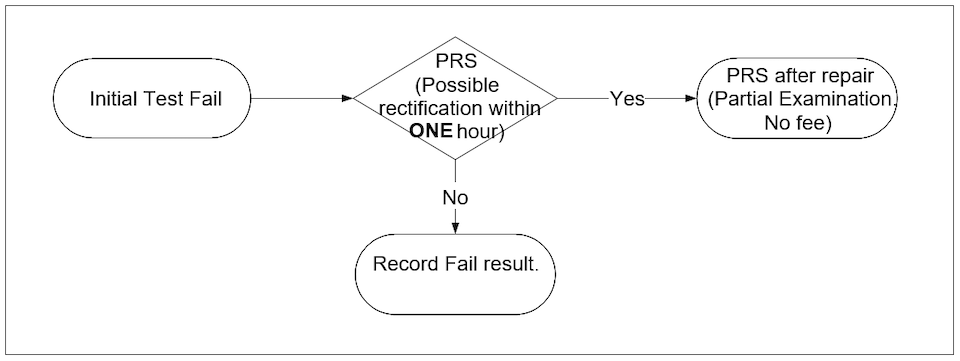
Where the vehicle fails the test and it is expected that the defect(s) can be rectified within one hour, the tester can elect to use the PRS facility (see Abbreviations and definitions. Provided the tester has completed the initial examination before any repairs are carried out and the vehicle has been retained and repaired at the VTS.
If the defects are rectified within one hour of completion of the test, the tester must then enter the results on the MOT testing service recording the defects and the pass.
If the defects cannot be rectified, for any reason, within one hour then the vehicle must be failed. PRS is a partial re-examination for which no fee can be charged and during which the tester cannot register any new tests.
A pass result must not be recorded before the vehicle satisfies all the test requirements.
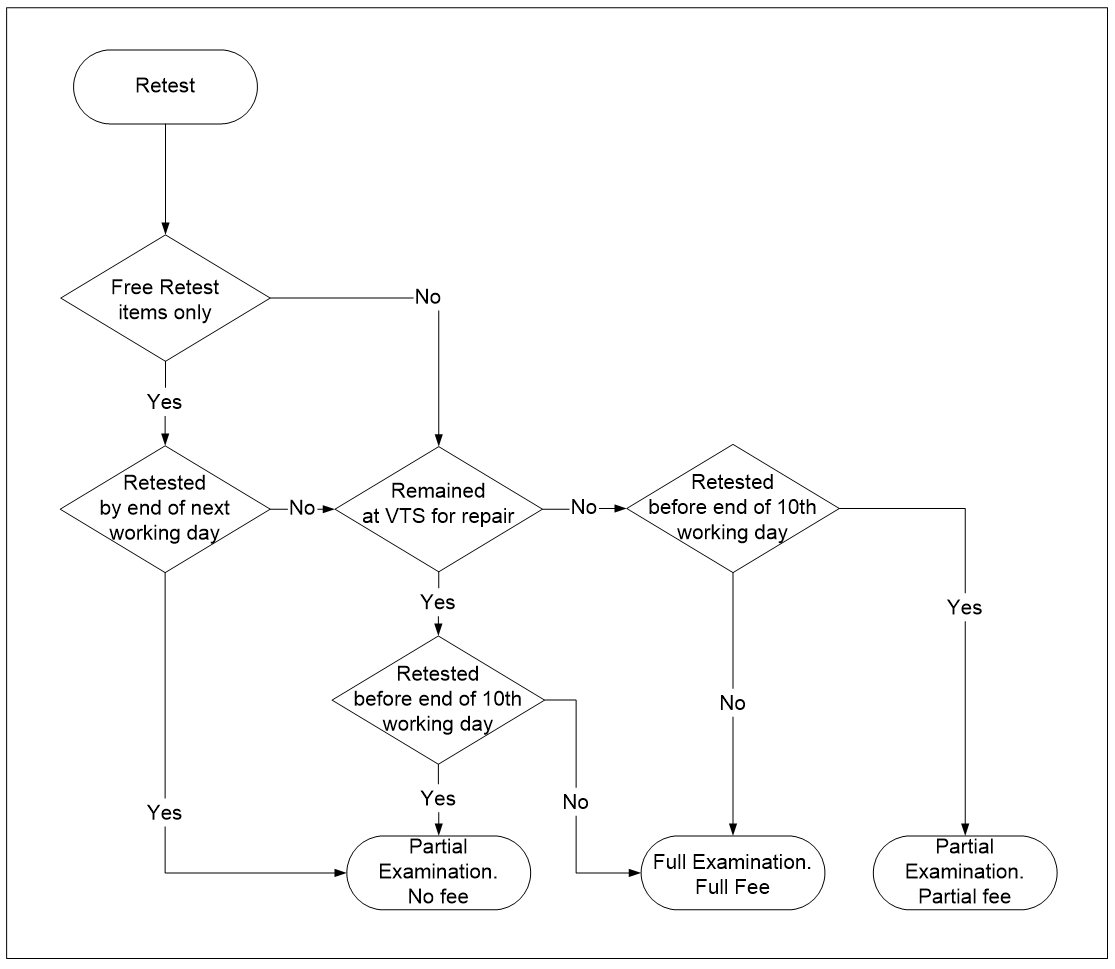
Statutory free retests, requiring only a partial re-examination, are available when:
-
the VTS has not changed ownership
-
the vehicle remains at the VTS for repair and the re-examination is conducted before the end of the 10th working day following the day of the initial test - in such circumstances the vehicle must not leave the premises and the failure result must be recorded following the initial test
-
the vehicle is returned to the same VTS where the vehicle failed the initial test before the end of the next working day on which testing is carried out and all the failure items are those which are statutory free retest items only (see Section L. Accounts and fees)
If the vehicle is removed from the VTS for repair and returned for a retest before the end of the tenth working day following the day of the initial test then, provided the test station has not changed ownership, only a partial re-examination is required. For which half the statutory maximum test fee may be charged.
When a partial re-examination is permissible, the tester must examine all the failed defects (dangerous and major) along with any items that may have been affected by repairs carried out since the initial test. Where applicable the partial retest must also include carrying out another brake performance test and entering the results in the MOT testing service. The tester should also check any minor defects and or advisory items that had been recorded at the time of the initial test and mark as repaired as appropriate.
Only one partial re-examination is permissible per full test.
In all other cases, a vehicle having failed an MOT test must have a full re-examination when presented for retest and a further test fee (up to the maximum allowed for the class) may be charged.
Vehicles in classes 4A or 5A that have passed the seat belt installation element of a test but failed in other ways, that are returned to the same VTS for retest, must be re-examined as class 4 or 5 respectively. That is, the seat belt installation check should not be repeated or the additional fee for that check charged. In such cases the VT30 for the original fail must be endorsed or a non-component advisory should be recorded to the effect that the seat belt installation check has been passed.
Ideally, any re-examination should be carried out by the tester who completed the original test, but where this is not reasonably practicable any tester listed at that VTS may carry out the re-examination.
If, during the re-examination of a vehicle in any circumstances, it becomes clear that the vehicle does not meet the necessary standard, whether because the original defect has been inadequately repaired or because another defect is present, the vehicle must be failed and a further failure for the test outcome recorded.
Charges for repair work carried out on the vehicle, with the owner’s prior consent, are made by the garage in the usual way and are not covered by the statutory test fee.
If, after the retest only minor defects remain and a pass result is recorded, then there is no further retest option to remove the minor defects.
There is no retest for tests that result in only minor defects or advisory items.
Use of testing stations by DVSA
AEs must allow their VTSs to be used by DVSA for examining vehicles subject to an appeal or complaint about a test result provided that 3 days’ notice has been given. The notice period may be reduced by mutual agreement. DVSA will pay one half of the relevant test fee for the use of the premises and equipment unless the arrangement is cancelled at least 24 hours prior to the appointment.
6. Quality management
AEs are responsible for the quality of testing within their garage or garages.
Others, most notably testers, also have a responsibility upon them associated with this, but it is for AEs to ensure there are adequate systems for the management of the quality of testing at their garage or garages.
To that end AEs must ensure an adequate system of quality management at each of their VTSs. Such a system will need to be tailored to meet the individual circumstances of the VTS or VTSs, such as:
- number of VTSs
- volume of test
- numbers of testers
- experience of staff
In all cases its objective must be the same; to best ensure that MOT testing is conducted to consistently high standards.
In operating systems, AEs should always remember that sometimes things will go wrong. A successful quality management system is one that identifies things going wrong in a timely way and helps the AE put things right. A quality regime that never identifies things going wrong is unlikely to be working effectively. Where things are found to be going wrong, then it is key to record this and show what has been done to prevent reoccurrence.
Going forward, much of DVSA’s focus in identifying how well garages are managing quality will come from reviewing their quality management system. This will mean that it is necessary to document the system and how it operates. This need not be an onerous task – and, again, needs to be proportionate to the size and complexity of the AE’s operation.
The overall quality management system should always include:
- people
- training
- procedures
- equipment
- assurance
- improvement
People
This should include:
- policies for recruiting staff
- probation criteria
- policies around what you will do when there are quality failings
- information about site managers (where they are used)
Where AEs do have a responsibility across sites there would be an expectation that site managers are suitable individuals with suitable training to do their job.
Training
This will include the checks you do to make sure that all of your staff have the necessary training, both mandated training from DVSA, and also any other training they need to be able to understand and implement changes to tester’s manuals, test standards and test results entry. Also, any training they require to safely work in your garage. It may include a link to your people policy so that there is clarity on what you expect from your staff in terms of their own personal development. It would be expected that such a system should be designed to ensure that all staff conducting MOT testing have followed the in-year training requirement and have passed the annual assessment.
Procedures
You need to ensure that your staff know how MOTs operate in your VTSs including:
- what documents to use
- how bookings are operated
- how to access information such as manuals, guides and reports (for example, test quality information, test logs, slot usage and transactions)
Equipment
This needs to ensure that all relevant staff understand how to ensure equipment upkeep and calibration, that process is clear and there are clear procedures for dealing with any equipment failures.
Assurance
A procedure needs to be in place to check that at least a sample of MOTs are checked to ensure that the correct routines and procedures are followed and that the correct standards are applied.
An Authorised Examiner (AE) may consider implementing an assurance approach which could include a third party or trade representative. Any third party should cover aspects relating to MOT test standards and the administrative management of the MOT business. Alternative approaches could be to:
- nominate an experienced and well-regarded tester to conduct the assurance checks
- rotate the responsibility across the team
- partner with neighbouring garages
The AE must ensure that quality control checks are carried out by a competent person who has the appropriate knowledge, skills and experience to assess MOT testing standards. See Section M System rules and user roles.
The key factor in whatever approach is to ensure that all testers have a proportion of tests rechecked by someone who is independent of that tester – so they can have some degree of objectivity.
The frequency of checks may typically be expected to be 1 per tester every 2 months. However, this is based on the average garage throughput of 2 to 3 tests per day for experienced testers – so should be varied to reflect the volume of tests done or any other special circumstances – such as the experience of testers. For example, if a tester is inexperienced or doing twice the average of 2 to 3 tests per day you should consider increasing the checks to once a month.
Where a VTS has one tester it is expected that the AE should also have in place a suitable means of assuring the quality of testing This could include using a third-party assessor, a reciprocal arrangement with a local VTS. Where this is not possible other methods should be used to ensure the quality of testing, for example the use of test quality reports to check the testers own performance against the national statistics, noting reasons for differences and any action taken if appropriate.
The assurance processes in place should be subject to regular review, this will enable an AE to monitor the effectiveness and if necessary, make changes where required.
Assurance checks should include the operation of the VTS, and the test quality of the MOT tests carried out by the testers at the VTS.
Whoever is conducting the quality assurance check should either:
- closely watch all parts of the test as they are carried out
- closely observe the testing process and conduct a full re-examination of the vehicle to check standards application
Once the tester has completed the test, which will be the subject of a quality control (QC) check, any difference in the test result, test standards or observed defects must be discussed and resolved prior to confirmation of the test result on the MOT testing service.
The result of the assurance check must be recorded, including any agreed action. That agreed action could be additional training, a garage development session or any other appropriate action. The key thing here is to show that corrective action is taken.
Where unusually high numbers of failings are found, it would be expected that the frequency of checks is increased until such time as it is evidenced that the problem has now been solved.
Improvement
Overall, the system needs to demonstrate that things are fixed when they are found wanting. A good quality system will find problems and record their resolution so there is a culture of learning and improving.
7. Use of data and data protection
The MOT testing service contains personal data. The collection, storage and use of personal data within the service is explained generally in the DVSA personal information charter and in the privacy notice for MOT testing service.
All system users must ensure that the data held is kept secure and only released to those who have a right to see it.
Access for registered users of the MOT testing service will be via a secure log-on process, designed to reduce the opportunity for unauthorised access. In addition to an MOT security code, all users require a user ID and a password and users may only access data appropriate to their role(s).
It is the responsibility of each individual user of the system to ensure that all the information or data that is processed is done so legally. Failure to comply with the Act may lead to prosecution over and above any DVSA disciplinary action.
Some personal information relating to the users is held on the system, such as testers name and address, and care should be taken when accessing this information.
Each system role has a clearly defined set of access rules that allow access to information appropriate to that role. Audit logs will be created and kept on the system, and will record all appropriate actions against each user ID.
In order to safeguard the data, each system user should not:
-
give another person information that they would not otherwise have access to - this includes test result information
-
supply any information to a third party or member of the public unless you are told otherwise in the current MOT guide, inspection manuals or special notices (SNs), such as providing documents to vehicle presenters - any requests for information should be made in writing and sent to DVSA’s Information Access Team at DVSA headquarters
-
access personal information when there is a danger that unauthorised persons may view the information
DVSA national headquarters
Driver and Vehicle Standards Agency
Berkeley House
Croydon Street
Bristol
BS5 0DA
Section D
Requirements for authorisation
Who is eligible to become an authorised examiner, their responsibilities, how to apply, what happens when DVSA receives an application, site requirements, mandatory roles, required training, testing requirements for all vehicle classes.
1. Authorised examiner
An authorised examiner (AE) is the organisation that operates and manages one or more vehicle testing stations (VTSs) and is responsible for controlling the quality of testing carried out. Except in the case of a sole trader the AE is not a person but a legal entity, for example a company, partnership or a local authority.
A designated council (DC) is a local authority authorised to carry out MOT tests.
Unless stated DCs are treated the same as AEs within this document.
This document sets out the requirements to be met when applying to become an AE or DC. It’s intended to assist with the application process by providing the information required on how to start a new application or to apply for a variation to an existing authorisation.
Normally an application to become an AE is made in conjunction with an application for a VTS. However, DVSA will accept an application to become an AE without a link to a tester or an approved VTS.
In all cases applicants should be conversant with their responsibilities. Before final authorisation to test is granted an AE must demonstrate compliance with all requirements.
All applicants should be fully aware of the requirements before completing and returning an Application for MOT Authorisation Form (VT01).
The application must be made by the legal entity that holds full control and responsibility for MOT testing functions. Authorisations are granted in accordance with the conditions applicable to the authorisation.
These conditions include compliance with the requirements set out in the MOT testing guide and appropriate inspection manuals (as amended) together with any additional specific conditions contained within the written authorisation notice.
AEs are in law fully responsible for ensuring that statutory MOT testing at all their VTSs is carried out to the required standard and in the manner instructed by DVSA. Failure to comply with the authorisation requirements for the MOT service may lead to your application being rejected.
An AE entity may be authorised without access to approved facilities however, before authorisation to test is granted an AE must have an approved testing facility. Authorisation of an AE and approval of a vehicle test station (VTS) may be done using a single application form; the specific requirements for a VTSs’ approval are set out in common to all classes.
Who is eligible to become an authorised examiner
Authorisation to carry out MOT testing will be granted only to applicants who can satisfy DVSA that they are of good repute, as defined in Appendix 7: Convictions and repute, and where applicable that their premises, equipment and personnel meet the required standards.
An application for appointment as an AE can be made by a:
- sole trader
- partnership
- company
- designated council
Any authorisation by DVSA allows only the legal entity authorised to provide the testing service. If a company is reconstituted in a way that leads to a new company registration and number being issued, then it will be regarded as a new entity and a new authorisation is needed. If, in a partnership, a partner leaves or joins the partnership this becomes a new entity and a new authorisation is needed. The same is true in the case of a sole trader who either takes on a partner or forms a company.
Sole trader
If the application is made by a sole trader, the AE would be the person making the application, and who must sign it.
Partnership
If the application is made by a partnership, the AE would be the partnership itself (for example, the partnership of F Bloggs and A N Other) and the application is to be signed by a person ‘duly authorised’ by the partnership to do so. Confirmation that the person is ‘duly authorised’ in a form of a statement to that effect signed by each of the partners will normally be required together with a copy of the current partnership agreement
Company
If the application is made by a company, the AE would be the company itself, not the directors or company management staff regardless of who owns the company and who the directors are. The application is to be signed by any person ‘duly authorised’ by the company to do so. Written confirmation that the person is ‘duly authorised’ signed by an ‘officer of the company’ is required. The directors must be recorded on the company’s register at Companies House.
Designated council
A designated council is:
- the council of a county, district or London borough
- a unitary authority or island council of a region or Islands area (in Scotland)
- the City of London
Authorised examiners (AEs) responsibilities
It’s important that you understand all that is required to be an AE before signing the application.
General
AEs are held fully responsible for the actions of their staff and others acting on their behalf or with their agreement, all such staff must be adequately supervised and fully conversant with their testing duties. For a partnership or company, all partners or directors and officers of the company are equally responsible. Each authorised entity is required to have an authorised examiner designated manager (AEDM) (see Mandatory roles). The responsibilities of testers are set out in Section E. Tester.
Every new AE is required to have at least one AEP, plus an AEDM. An AEDM is required to attend a DVSA approved MOT Manager’s Course. If the AEDM does not hold the role of AEP, an AEP is also required to attend a DVSA approved MOT Manager’s Course.
AEs must notify DVSA immediately in writing of any conviction of an individual involved in the MOT scheme under their authorisation. This includes:
-
AE principals (AEPs)
- AEDMs
-
AE delegates (AEDs)
- site managers
- site admin
- testers
For conviction definitions see Appendix 7:Convictions and repute.
The extent of an AE’s liability for vehicle damage is set out in Regulation 14 (1) of the Motor Vehicles (Tests) Regulations 1981 (SI 1981 No 1694) as amended. AEs must not display disclaimers against liability for loss, damage or injury caused while vehicles are in their custody for MOT tests and must ensure that no vehicle presenter is asked to sign any such disclaimer. Appendix 4: Liability for loss or damage describes fully the scope of AE’s liabilities.
AEs are advised to be members, or become members, of a Chartered Trading Standards Institute (CTSI) approved code of practice. Details of approved codes can be found on the TSI website.
Premises and equipment
After approval of the site, every AE must, at all times, properly maintain the premises, facilities and testing equipment at all the VTSs for which they are responsible. This includes:
-
all facilities and equipment that were present at the time of the VTS’s approval and any additions or alternatives that were agreed with DVSA by prior notification
-
all facilities and equipment required by any mandatory upgrade introduced by DVSA
All testing equipment must be kept in good working order and measuring apparatus must be kept calibrated in accordance with DVSA’s requirements.
Testing must stop on any class or type of vehicle, if any mandatory item of equipment falls out of calibration, is missing a mandatory upgrade or inspection, is unable to connect to the MOT testing service when required or malfunctions in a way that could prevent a test being properly conducted on that class or type of vehicle. Refer to B4. General responsibilities - premises and equipment for information on what to do in the event of equipment failure.
An AE must apply to DVSA for approval prior to the changes being made if they want to:
- add test classes
- replace or modify any fixed test equipment that will alter the approved dimensions or layout
- alter the building or the layout of equipment
The AE can apply using the VT01 application form. Supporting drawings should be enclosed with the application.
No proposed change will be acceptable if it reduces clearances or dimensions (including those for access) below the limits specified in the requirements for authorisation or, for features approved only as `acceptable variations’, below their existing values.
DVSA must be notified of any changes to fixed equipment and/or equipment that needs to be connected (transfer results to the MOT testing service) using the ‘Change testing equipment’ link on the VTS page on the MOT testing service.
The changes will be checked by DVSA at the next visit. If the changes do not meet the requirements for authorisation approval may not be given.
The renewal of mobile testing equipment does not have to be notified to DVSA provided that the replacement is on the current DVSA approved list and will not affect the range of vehicles that can be tested.
Access by DVSA staff
AEs must allow the inspection of their testing arrangements, equipment, facilities, records, and the checking of their tester’s competence, re-examinations of recently tested vehicles by DVSA staff at any time during normal working hours or when the VTS is open. AEs should always ask to see the official warrant that DVSA enforcement staff carry. If you have doubts about anyone asking to see official documents, refuse access and call the DVSA customer service centre.
AEs must allow their VTSs to be used by DVSA for examining vehicles subject to an appeal or complaint about a test result provided that 3 days’ notice has been given. The notice period may be reduced by mutual agreement. DVSA will pay one half of the relevant test fee for the use of the premises and equipment, unless the arrangement is cancelled at least 24 hours ahead.
Contact DVSA
Security
AEs are responsible for ensuring that blank MOT contingency testing (CT) certificates are not accessible at any time to unauthorised persons.
The AE shall take reasonable precautions to ensure that all MOT security code users which they are responsible for safeguard their MTS passwords and access to their authentication app and unique email address recorded on the user’s MTS profile.
Outside working hours, the security of the MOT security code generator and email is the responsibility of the service user.
Testing responsibilities
AEs must ensure that the MOT tests are carried out without avoidable distraction or interruption and strictly in accordance with the conditions of their authorisation, which includes compliance with the MOT testing guide, the appropriate inspection manual and any other instructions issued by DVSA.
They must ensure that, for each test, all assessments of pass/fail criteria are made, all appropriate documents are signed, and all database input details are confirmed by the tester who carried out the test. AEs must ensure that assistance is always available to testers for those parts of the test that require it.
AEs must offer an appointment to test any vehicle of a class within their authorisation at the earliest practicable date and time, with consideration for their existing MOT workload and customer requirements.
All appointments made for vehicles without a current MOT certificate must be recorded in writing. The record must include the vehicle’s registration mark (VRM), the date and time of the appointment and the name of the person making it. This record must be kept for at least 3 months after the date of the appointment.
An AE must not carry out an MOT test on a vehicle if it’s of a class or type of vehicle which they are not authorised to test, or a type of test they are not authorised to carry out, or the vehicle cannot be accommodated within the test facilities. They must tell the vehicle presenter immediately of any such circumstances, pointing out that consequently the test cannot be carried out.
Full details of reasons for refusal to test are contained in the respective MOT inspection manuals.
Any individual presenting a vehicle for an MOT test has the right to observe the test in safety from the approved viewing area(s).
Cessation for disciplinary reasons
DVSA, on behalf of the Secretary of State, has the discretionary power to take disciplinary action against an AE, including cessation of the authorisation. Failure to adhere to the requirements of authorisation may result in disciplinary action against the AE and/or the tester.
When the AE is a sole trader the responsibility for taking action to ensure that the authorisation is operated in accordance with the Secretary of State’s requirements and the penalties for failure to do so falls on that person. With partnerships and companies, however, individuals must ensure correct operation of testing. The responsibility therefore falls not only on the company or partnership but also on the following individuals:
- in the case of a company, all the officers of the company and any other person ‘duly authorised’ by the company to sign applications and other similar documents relating to the authorisation
- in the case of a partnership, each partner and any other person ‘duly authorised’ by the partnership to sign applications and other similar documents relating to the authorisation
Where the authorisation of the AE operating at a particular site has been ceased, for disciplinary reasons as above, anyone wishing to apply for authorisation at that site must be able to show that they are sufficiently independent from the former AE, partners or officers of the company. The maximum acceptable involvement of the former AE is as a landlord.
The former AE, including the AEDM and any individuals who were directly accountable in the cessation of the previous authorisation shall not be involved in any way with the management or responsibility of any authorisation. The spouse, partner, family members of the former AE, including the AEDM and any individuals who were directly accountable in the cessation of the previous authorisation, would not be considered sufficiently independent.
If an AE has received a 2 or 5 year disciplinary cessation of all their sites, none of the associated AEPs will be able to hold any role within another AE and/or Vehicle Testing Station during the cessation period.
Changes to businesses
DVSA must be told within 28 calendar days about any significant changes to the control or operation of the business. Failure to notify such changes within this period may be treated as a shortcoming under Section I. Discipline. For further information on changes to business, see Section B3. Cessation of authorisation and other changes to businesses.
A company that continues to operate under the same registration and company number may continue testing provided that any changes to the officers of the company or change in the relationship to any parent company have been notified to DVSA in writing.
Any directors added to a currently Approved AE will need to meet the current requirements, including a DBS check. An exception to this is for directors who are permanently based abroad; however, the AE must still inform DVSA of their inclusion as directors to the business.
An AE that makes a change (addition or removal) to the members (AE principals) of the business will need to meet the current requirements. For example, each AE principal will need to have an account in the MOT testing service.
It’s possible for the AEDM, or other appropriate roles, to update some authorisation details directly, such as telephone numbers, email and correspondence addresses, via the MOT testing service. Any other details must be notified to DVSA in writing.
The AE can cease the nomination of a tester. In the case of a multi-site AE, this cessation may be from all sites, a selection of sites, or a single site. A cessation by one AE or DC does not affect any current or future nominations by other AEs. DVSA must be notified by recording the change of details on the MOT testing service.
How to apply to become an AE
Application
An AE (DC) is the legal business entity that operates and manages one or more VTSs and is responsible for controlling the quality of testing carried out.
With the exception of a sole trader the AE (DC) is not a person but the legal entity, for example a partnership, a company or local authority.
All applications must be made on an Application for MOT Authorisation Form (VT01). All relevant sections should be completed, and the form returned to DVSA along with the relevant enclosures.
Those applying should not submit their application until confident that they will fully meet all the requirements as set out, further detail of the requirements are contained within the Motor Vehicle (Tests) Regulations as amended, the MOT testing guide and other sections of the applications pack (as appropriate).
Your failure to supply the required documents applicable to your application may lead to your application being delayed or refused.
Third Parties submitting an application on behalf of an AE
If a consultant or third party is dealing with an application on behalf of the AE. A letter of authority must accompany the application.
The letter of authority must be:
- on the AE applicants headed paper
- signed by an AE principal or the AE designated manager if you are already an approved AE
A scanned copy of letter of authority can be sent by email if it’s sent from the AE applicant’s email address.
Personal verification checks
You must provide a declaration of non-conviction supported by a basic Disclosure and Barring (DBS) certificate for each person proposed to be involved within the authorisation. This includes all company directors, partners, or sole traders and the AEDM.
The declaration of non-conviction must be signed along with the DBS check details sections completed or copy of certificate attached.
The basic DBS check must be dated within 3 months of DVSA’s receipt of any application.
A basic DBS check verifies an applicant’s identity based on the evidence provided and can confirm they are free from any unspent convictions.
A basic DBS check can be requested from a number of source, including directly from the Disclosure and Barring Service.
A criminal conviction is a judgement made by a court that a person or company is guilty of any offence. The penalty imposed may range from an absolute discharge through to imprisonment. This does not include fixed penalty offences. You must inform DVSA, in writing immediately of any convictions, as defined in Appendix 7: Convictions and repute, that occur between the date of application and authorisation of that application, and there on after.
If following approval, it’s brought to DVSA’s attention there are any unspent convictions that have not been disclosed, this may result in the cessation of authorisation to carry out statutory testing. Cessation may occur even though the conviction would no longer be considered but would have led to refusal on the initial VT01 application.
Declaration of non-conviction
In the case of a company you must provide a declaration of non-conviction for the company. A criminal conviction is a judgement made by a court that a person or company is guilty of any offence. The penalty imposed may range from an absolute discharge through to imprisonment. You must inform DVSA, in writing immediately of any convictions, as defined in Appendix 7: Convictions and repute, that occur between the date of application and authorisation of that application, and there on after.
If following approval, it’s brought to DVSA’s attention there are any unspent convictions that have not been disclosed, this may result in the cessation of authorisation to carry out statutory testing. Cessation may occur even though the conviction would no longer be considered but would have led to refusal on the initial VT01 application.
Partnership agreement
A copy of the partnership agreement signed by all partners must be provided.
Companies Act 2006
If the applicant is subject to the Companies Act 2006 you’ll need to demonstrate either:
- the corporate name
- the name of each partner
- the individual person’s name
For each person named, you’ll need to give an address at which documents can be served.
You’ll need to include this in all:
- the places where you carry on your business and where you deal with customers or suppliers
- business letters
- written orders for the supply of goods or services
- invoices and receipts
- written demands for the payment of business debts
For more information on the requirements of the Act, please visit Companies House.
The company number of the business to provide access to the Companies House record of appointments that confirms that all the listed applicants are known to Companies House.
Trained AEDM
Every new AE is required to have a trained AEDM.
Bankrupt or sequestrated
A person that is adjudged bankrupt or, in Scotland, has his estate sequestrated is not eligible to apply whilst this status remains. For applicants that have been subject to this order, within five years of the application date, DVSA require either a copy of the Certificate of Discharge or an independent declaration to confirm that you are no longer under these restrictions.
Receipt of application by DVSA
If the information supplied in the application form and enclosures is satisfactory, DVSA will progress the application. Where the application form or enclosures are incomplete, they will be returned to the applicant with details of the additional information required.
After reviewing the application and following appropriate enquiries and possible inspections the applicant will be informed in writing of the outcome of DVSA’s considerations, which will be either:
- approval in principle (AIP) given
- authorisation/designation granted
- intention to refuse notified
Approval in principle given
Where the requirements for authorisation/designation are not met but with reasonable changes they can be met, the applicant will be given written AIP. This will list items to be complied with before authorisation/designation is granted and will include a time limit after which the AIP will expire. Final approval will only be given when all the required changes (or agreed alternatives) have been made.
Where the applicant is not prepared to comply with an item, or items, listed they must notify DVSA as soon as is possible, and before the expiry date of the AIP. The application will then be issued with an intent to refuse.
Delays to authorisation
To reduce the number of dormant applications, all applications will be reviewed periodically. A request will be sent to the applicant either by email or letter by recorded delivery, seeking evidence of good intent (which could be a letter confirming the application is proceeding). This review will be carried out during the 6th month after receipt of the application and 14 calendar days given for the reply. If no reply is received or the reply is such that the terms of the initial AIP are no longer valid, then the original application will be terminated without further notice.
Authorisation granted
Authorisation will be granted when DVSA is satisfied that:
- the requirements for authorisation have been met
- an AE Principal has attended the MOT Managers Course
- an AE Designated Manager has attended the MOT Managers course;
- a quality management system (if applicable) has been agreed
In the case of a council’s application, designation will be recommended. This will always have a standard set of conditions but may be subject to additional conditions specified in the authorisation/designation letter.
It’s emphasised that responsibility for ensuring that premises and equipment comply with other relevant acts, regulations, bylaws, health and safety at work requirements, and all other applicable instructions, rests with the applicant.
DVSA publishes information about authorised VTSs. This includes your trading name, address and phone number to assist the public in finding a VTS in their area.
DVSA will provide information when requested under the Freedom of Information Act. Personal information will not be included in these requests.
Information regarding an authorised examiner, VTS or its staff may also be supplied in response to a request from other enforcement agencies, for example the Police and HM Revenue and Customs.
Intent to refuse the authorisation or the designation
Where the Secretary of State is minded to refuse the application for authorisation, DVSA will notify the applicant in writing, detailing the reason(s) why the application may be refused.
The intention to refuse may be sent to the applicant at any stage during the application process when it becomes apparent that the application does not or is unlikely in the foreseeable future to meet the criteria.
The applicant may appeal against the intention to refuse to authorise or designate. Any appeal must be made in writing to the DVSA Office that issued the notice and be received within 14 calendar days from the date of the notification of the intention. An informal hearing may be requested in accordance with the Informal Hearing Notes for Guidance and Code of Practice issued with the notice.
If at the end of this appeal period no such appeal has been received DVSA will write to the applicant confirming the refusal to authorise.
If an application is from an entity or involves individuals that have been subject to cessation for disciplinary reasons, that application will not normally be considered until shortly before the cessation period expires. As such there can be no ‘intent to refuse’ until the cessation period has expired.
If at any time in the application process the applicant considers they cannot, or refuses to, meet the conditions they may give written notice to this effect to DVSA. On receipt of the applicant’s letter DVSA will confirm intent to refuse authorisation.
Additional requirements before a site is authorised to test
DVSA will accept an application to become an AE without a link to an approved VTS, however before final authorisation to test is granted an AE must demonstrate compliance with this requirement. The following additional requirements are required to be in place at each site to be approved.
MOT testing guide and inspection manuals
Online access to the MOT testing guide and the relevant inspection manuals for all the classes of vehicle for which authorisation to test is available.
Evidence of exclusive use
Evidence that the applicant has the sole use of the proposed MOT facility, including the test bay and reception area/office.
This evidence should be provided as a solicitor’s letter, supplied on headed paper, which specifically confirms ownership of the premises or lease or rental agreement.
The statement must confirm:
- the applicant has the legal right to operate within the premises
- that planning permission is in place
- that the applicant is the owner of the land or that an enforceable lease or rental agreement is in place between the applicant and the owner of the land
- the applicant has exclusive use of the premises and MOT testing facilities
This letter must be signed by a solicitor of the firm you appoint.
If the applicant is the site owner, DVSA may request they supply copies of documents from the land registry confirming that the applicant is the registered owner of the land. If a land registry entry is not available alternative proof of ownership must be accompanied by a written explanation from a solicitor.
If the applicant is not the site owner, DVSA may request evidence that the applicant has the right of exclusive use of the premises, in the form of a lease or rental agreement. The document needs to include:
- the rent to be paid for the premises
- specific mention that the prospective AE has exclusive use of the premises and facilities necessary for MOT testing
- evidence that the person or body granting the lease (the lessor) owns the site, or that the lessor’s lease for the premises allows sub-letting or assignment of all or part of the lease to someone else
- written confirmation from a solicitor that the lease is a proper and enforceable legal document
Irrespective of whether the applicant is the site owner or not, an applicant may provide written confirmation from a solicitor that a proper and enforceable lease is in place, in lieu of the document. This may, at DVSA discretion, allow a time limited approval of authorisation until suitable documents are provided. Failure to provide these documents by the time specified by DVSA will result in a suspension of authorisation until the requirements have been fulfilled.
Test appointments
Arrangements for making MOT test appointments by telephone and by personal visit.
AEs must offer an appointment to test any vehicle of a class within their authorisation and that can be safely accommodated on their MOT equipment at the earliest practicable date and time bearing in mind their existing MOT workload.
Testers
The AE will not be able to test until they appoint a DVSA approved tester. The AE must appoint a tester and conduct MOT tests within 12 months of approval to retain their authorisation.
Quality management
AEs are responsible for the quality of testing within their garage or garages.
Others, most notably testers, also have a responsibility upon them associated with this, but it’s for AEs to ensure there are adequate systems for the management of the quality of testing at their garage or garages.
To that end AEs must ensure an adequate system of quality management at each of their VTSs.
Such systems are defined further within Section B6. Quality management.
MOT testing service IT and associated equipment
Authorised examiners are responsible for the supply and maintenance of all IT equipment and internet connection used for MOT testing purposes. The requirements for this equipment are defined within Appendix 2: Facilities and security
Mandatory roles and training
For an AE to be authorised and a site to start testing, MOT specific roles must be appointed to individuals. These identify the individuals’ responsibilities with regard to the MOT service and where applicable, allow them appropriate access to the MOT testing service.
The following mandatory roles are required for the authorisation of a site to test:
- authorised examiner principal (AEP)
- authorised examiner designated manager (AEDM)
- tester
- site manager (SM)
Depending on the size and make up of a business an individual can hold one or multiple roles. The roles of AE principal and AEDM will be appointed by DVSA from the information supplied in the AE’s application, the remaining roles must be appointed by the AEDM.
There are additional non mandatory roles, giving varying levels of access to the MOT testing service, which AEs may find useful to aid with the running of their business.
Authorised examiner principal (AEP)
Authorised examiner principals (AEPs) are legally responsible for the entity. Every partner in a partnership; every director in a company or the sole trader in person must complete and submit separate AEP personal details using a VT01.
Authorised examiner designated manager (AEDM)
Every AE is required to have an AEDM who, on behalf of the AE, is responsible for ensuring testing is carried out in compliance with the Requirements of Authorisation.
Typically, the AEDM would be a person from within the AE, however it may also be a senior manager who has responsibility for testing across the entire AE.
Training requirements
Trained AE principal (AEP)
Each AE must have one AEP or more who has attained a Level 3 Award in MOT Test Centre Management or have attended the previously named MOT Managers course or Authorised Examiners course.
This course covers testing responsibilities, administrative arrangements, disciplinary and appeal processes. The course is designed to help the AE to fully understand their responsibilities within the MOT Service and the function that is carried out by the AEDM.
If the application to become an AE is from an individual they must attend the course.
If the application is from a partnership, the partner who will exercise the most direct control over all MOT testing operations must attend the course.
If the application is from a company, the director or an officer of the company having the most direct responsibility for all MOT testing operations at all sites, must attend the course.
If the application is from a designated council, then a senior council officer having direct responsibility for all MOT testing operations must be the one to attend the course.
Trained AE designated manager (AEDM)
Each AEDM must attain a Level 3 Award in MOT Test Centre Management or have attended the previously named MOT Managers course or Authorised Examiners course.
Timing of training
Normally, training must be completed before the authorisation can be granted.
In cases where a new authorisation becomes necessary only because a business undergoes one of the changes indicated below, the authorisation can be granted before training has taken place, provided that a suitable person is trained within 35 working days of the change. Failure to complete the necessary training within the specified period will result in cessation. These changes are:
- a sole trader takes on a partner or forms a company of which he or she is a director
- a partnership splits up, but an untrained partner continues the business as a sole trader
- a partnership splits up, but one untrained partner continues in a new partnership or as a director of a company; the same would apply if more than one of the untrained partners stayed with the new partnership or company
- a partnership that had originally applied for authorisation before 1 April 1995, and therefore did not need to have a trained person, is reconstituted by the addition or departure of one partner or more and therefore is now required to have a trained person in the partnership
- a receiver or manager ‘of the body’s undertaking’ is appointed for a company
Validity of training
The training is valid indefinitely unless an AE has been subject to cessation for disciplinary reasons. The AEDM for that AE may be required to attend a further course before again being acceptable as a trained person. If the AEDM is judged to have been directly involved in the incident leading to cessation then retraining will be mandatory. In such cases retraining will normally be permitted only when the AE is eligible for re-authorisation
The training will also not be valid if an AE is given a formal warning under DVSA’s disciplinary procedures - the AEDM for that AE may be required to achieved a Level 3 Award in MOT Test Centre Management within 35 working days of the date that the AE is notified of the disciplinary action
Applications for training
A Level 3 Award in MOT Test Centre Management course is booked with a training provider. There is a charge for the course, which varies and is set by the individual course provider.
Tester
Every new AE is required to have at least one tester who has achieved a Level 2 Award in MOT Testing or previous equivalent DVSA MOT Testers course, before testing can begin. If a tester isn’t present, authorisation to test can be granted, but the test station will be deemed to have surrendered approval if testing doesn’t begin within 12 months of the approval date.
Site manager (SM)
This is the role responsible for the day to day running of one or more VTSs. The SM can carry out VTS management, and non-testing functions for example assign users within a VTS. Normally there will be only one SM per VTS, however, in some cases there may be a requirement to have more than one SM listed against a VTS.
Many smaller single site AEs may well choose to assign the SM role to the AEDM, larger single site businesses may allocate it to another manager or supervisor. The decision on how many SM roles are needed and to whom they are given is left to the AEDM based on how the business is run.
2. Common to all classes
The Driver and Vehicle Standards Agency (DVSA), on behalf of the Secretary of State appoints authorised examiners and designated councils to carry out inspections known generally as MOT tests. The following sections set out the application procedure and requirements that must be met.
This section details the requirements for those applying to have a site approved as a VTS or seeking approval for changes to an existing VTS. It covers:
- how to apply
- application enclosures
- requirements for premises
- equipment requirements
- MOT testing signs and notices
- acceptable variations to layout and equipment
Applicants are advised not to proceed with alterations to buildings or purchase of equipment, etc, before receiving written approval in principle from DVSA.
How to apply
Applications must be made on the current Application for MOT Authorisation Form (VT01). All relevant sections should be completed, and the signed form returned to DVSA along with any requested enclosures as outlined in this section.
Where possible application enclosures, for example plans and drawings, should be supplied in a digital format. Those applying should not submit their application until confident that it will fully meet all the requirements, approval to test will only be granted to applicants who also meet the requirements to be an authorised examiner or are already authorised.
The requirements in this section should be read in conjunction with the class specific requirements for class(es) approval is sought and the list of acceptable equipment.
If the applicant proposes to carry out building alterations or obtain new equipment, it’s recommended that this is not done before DVSA has given approval in principle to the application.
Solicitors that submit evidence on behalf of the applicant must be governed by the Solicitors Regulator Authority (England and Wales) or the Law Society of Scotland (Scotland).
Application enclosures
Applications for a new site to be approved for testing or alterations to existing sites will need to be supported by the following evidence:
- site plan showing the buildings, the location of the testing bay, the access from and to the public highway and the location of the MOT notice board
- a fully dimensioned drawing of the proposed testing bay, or bays, showing adjacent equipment and parts of the building, the location of the test equipment, the position and dimensions of the entrances and exits, and the area from which the test may be observed
- planning permission or an exemption, such as a Certificate of Lawful Existing Use or Development (CLEUD), or written confirmation from the local authority. A letter from a solicitor confirming that the existing approval covers MOT testing or garage services and vehicle repair may be accepted.
The plan and drawings must show that the site will meet the requirements outlined in this section and the requirements for the class(es) approval to test is sought.
Requirements for premises
For a site to be considered for approval it must provide the following.
Premises
The premises must have:
- test facilities housed in a weatherproof building capable of being totally enclosed and provide a satisfactory working area – this is not mandatory for roller brake test or headlamp aim standing area on class 3, 4, 5 and 7 authorisations
- equipment laid out so that testing can be performed effectively – the equipment should be laid out and located so that other garage activities will not affect the proper conduct of the test
- unobstructed, safe and easy access via a metalled road from the site entrance to the building entrance
- adequate off-road parking
- a clearly defined weatherproof viewing area from which all stages of the MOT test in progress can be observed safely without interruption, except for road testing (room for 2 seated people is considered sufficient)
- a sign installed in the customer reception area to alert presenters of vehicles for MOT tests of the presence of the MOT viewing area
- safe access from the customer reception to the designated viewing area if the viewing area is to be located in the workshop
Alternatively, you may opt to install a fixed display monitor in the customer reception or waiting area to display camera relayed ‘live feed’ images of the whole of the test bay area. The image displayed on the monitor must be in colour and of good quality but must not be recorded.
If monitors are used:
- the monitor must be identified as the MOT viewing facility/area
- the monitor must be available to view the test when requested by the vehicle presenter
- the relayed images cannot be interrupted or used for other purposes during that period, for example displaying advertisements
Supplementary monitors (such as portable handheld devices) are acceptable only when a fixed viewing monitor is also available and functional.
Test bay
The test bay must have:
- clear unobstructed access and egress from the entrance of the building
- vehicle entrances and exits that conform to the dimensions applicable to the class(es) for which authorisation is sought
- a width which conforms to the dimensions applicable to the class(es) which authorisation is sought. Minor intrusions such as wall piers may encroach on these dimensions provided vehicle testing is not impeded. Minor intrusion means any part of the building structure or other fixtures which come within the minimum bay outline.
- they must be so positioned that vehicle movement and the recommended method of inspection are not impeded
- items of equipment other than the brake tester console and a desk surface for MOT purposes are not normally permitted
- headroom which conforms to the dimensions applicable to the class(es) for which authorisation is sought
- adequate general illumination. There must be sufficient artificial lighting to enable testing to be carried out without difficulty
Layout
The layout must:
- conform to the requirements of the class(es) for which authorisation is sought
- have at least 600mm clearance between the outer edges of equipment in adjacent bays on side by side layouts
- have at least 600mm clearance around all parts of a lift, including control boxes
- have a clearance of at least 1.0m forwards of the non drive on end and 1.5m to the rear of the drive on end of a lift or pit to any entrance/exit door or wall
MOT testing distraction or disruption
Where there is an increased likelihood of distraction and disruption to MOT tests when bays are not separated by walls, for example from other activities on the premises.
New applicants should be aware that where DVSA considers there may be a risk of testing distraction or disruption, they may be asked to clearly paint the outline of the boundaries of the test bays in open plan workshops/premises.
Test bays must then be kept clear of all non-MOT testing activities and equipment when testing is in progress
Existing testing stations that make alterations increasing the likelihood of testing distraction or disruption may be required to comply with the above paragraphs
Equipment requirements
Major equipment
A testing station needs a means of allowing the underside of vehicles to be properly examined without obstruction or hindrance. This will need to be fitted with steering and suspension play detectors on the DVSA list of acceptable equipment if it’s an Automated Test Lane (ATL) or One Person Test Lanes (OPTL).
A testing station may be permitted to have more than one underside inspection facility which share the same brake tester, headlamp testing area and emissions equipment providing:
- the underside facilities are located so that testing can be carried out effectively
- the additional underside facility meets the requirements for the class(es) tested and does not adversely affect the standard of the test
- if the additional underside facility is used as a headlamp standing area then it must have a dedicated headlamp aim tester unless the rails are continuous across all bays. The facility must also meet all the requirements associated with headlamp testing, including level and calibration certificates
- the viewing area has an unrestricted view of all the testing facilities - if this cannot be achieved from one viewing area then additional viewing areas must be provided
A testing station also needs:
- a headlamp aim testing facility
- brake testing equipment
- emissions testing equipment (excluding motor bicycles)
All testing equipment must be kept in good working order. Measuring apparatus must be calibrated in accordance with DVSA’s requirements. If an item of mandatory test equipment is not recalibrated by its due date, then testing which uses that item will be prevented until the item is recalibrated.
Miscellaneous equipment
A testing station also needs:
- a tyre tread depth gauge selected from DVSA’s latest list of acceptable equipment
- a corrosion assessment tool
- suitable pinch bars, long and short (not applicable to class 1 and 2)
- a steel tape measure (minimum extended length 1.0m)
- suitable wheel chocks for the class(es) of vehicle to be tested (not applicable class 1 and 2)
- brake pedal application device from the DVSA list of acceptable equipment (only mandatory for ATL and OPTL installations)
- suitably positioned mirrors or colour camera system for lighting checks (only mandatory for ATL and OPTL installations)
- a suitable handheld low voltage inspection lamp
- a 13 Pin Trailer Socket Test Tool from the DVSA approved equipment list (not applicable to class 1 and 2)
- a proprietary leak detection spray which meets BS EN 14291:2004 (not applicable to class 1 and 2)
MOT testing signs and notices
The three triangles MOT sign detailed in The Traffic Signs Regulations and General Directions 2016, Schedule 11, diagram 864 must be displayed in a prominent position, no part higher than 4.5m from the ground and no more than one sign on each road frontage.
The business trading name as described within either the Companies or the Business Names Acts is displayed conspicuous and legibly.
A notice board with a protective transparent covering must be positioned inside the vehicle testing station so that DVSA notices can be easily read by any persons intending to or submitting vehicles for test.
The MOT notice board must not be obscured or be inaccessible and must be of sufficient size to accommodate at least one A3 fees poster (landscape) and one Certificate of Authorisation (A4 portrait). It must not be used for any other purpose other than official DVSA MOT notices and company public liability insurance and certificates of incorporation.
If the notice board displays both MOT and business documents, there must be clear and distinct separation between the MOT documents and any documents not related to MOT testing.
All authorised examiners (AEs) must display:
- the certificate of authorisation (VT9) issued by DVSA
- the current fees and appeals poster (form VT9A) showing vehicle classes, test fees and appeals procedure and the details of how to contact DVSA
The current fees and appeals poster may be displayed adjacent to the ‘official’ notice board if it will not fit on the notice board proper. Additional copies of this poster can be obtained online.
Acceptable variations to layout and equipment
Provided there is no change in the class of vehicles tested, particular variations will be allowed for authorised examiners and applicants as shown below.
For existing authorised examiners
For existing authorised examiners moving their test bay or equipment within their present building(s), the test bay and equipment layout of these existing authorised examiners will be considered suitable if they meet the requirements as laid down above, except where it would be impossible to do so without major structural alteration, such as significant work to the roof, floor or loadbearing walls.
Test equipment requirements will be considered met if the existing authorised examiner retains their current equipment. If new equipment is obtained, it must meet the current relevant requirements.
For new applicants or existing authorised examiners moving into previously authorised premises using an existing test bay
For new applicants or existing authorised examiners moving into previously authorised premises using an existing test bay, provided a full test has been carried out and recorded on the MOT testing service by a tester at the site within the previous 12 months, the test bay and equipment layout of new applicants moving into previously authorised premises will be considered suitable if they meet the requirements for authorisation (previously Conditions of Appointment) that were current when the site was last accepted. Occasionally, certain updates will have to be complied with for example test equipment, tools. Advice should be sought from DVSA at the initial inspection.
Test equipment requirements will be considered met if the equipment last used for MOT testing is retained, provided that it’s still in full working order. However, any changes to required equipment that would have been necessary had the premises been in continuous testing must also be complied with.
MOT connected equipment as specified on DVSA’s latest list of acceptable equipment must be fitted and used when:
- applying to open a new MOT centre
- reopen a closed MOT centre (this applies regardless of how long it’s been closed)
- a MOT centre changes from one authorised examiner to another
- replacing previously authorised equipment
- adding an extra test lane (where changes include the installation of equipment that needs to be connected)
The Salter type brake meter (pull along brake tester) is not acceptable for new or reauthorisations.
Authorised examiners and new applicants in remote rural areas
The premises, equipment layout and equipment of authorised examiners and new applicants in remote rural areas will be considered suitable if the requirements are met in DVSA’s view as far as is reasonably possible.
To be considered for remote rural area status:
- the premises must be 15 miles or more by road from a testing station that meets the specification as laid down or as varied above.
- not more than 350 tests per year are likely to be carried out
Equipment awaiting approval
Brake and headlamp test equipment will normally be selected from DVSA’s latest list of acceptable equipment.
All applicants that wish to use any equipment not on DVSA’s list of acceptable equipment will be referred to DVSA
Exceptionally, where a manufacturer has sought acceptance of their equipment but DVSA has not assessed its suitability, applicants may use equipment not on the list of acceptable equipment, provided the application is supported by:
- a certificate signed by the manufacturer, or recognised agent in the case of imported equipment, that it meets the performance specification and is correctly installed
- an undertaking signed by the applicant that they will cease testing until the equipment is replaced or modified if subsequently DVSA decides that it does not meet its specification, or it’s not correctly installed (this would normally be three months)
3. Class 1 and 2 vehicles
Installation and equipment requirements
November 2009
DVSA, on behalf of the Secretary of State, appoints authorised examiners and designated councils to carry out inspections known generally as MOT tests. The following section sets out the additional requirements that must be met for testing Class 1 and 2 vehicles.
The dimensions in this section are the minimum requirements for authorisation as a vehicle test station for class 1 and 2 vehicles.
The dimensions of your test bay should take into account the requirements of your business.
When considering the contents of this document you should be aware that the equipment and/or layout selected may affect the type of vehicle able to be tested.
Applicants are advised not to proceed with alterations to buildings or purchase of equipment, etc, before receiving written approval in principle from DVSA.
Premises and test bay
Premises, test bays and equipment will be considered suitable if they meet the requirements laid out in Requirements for Authorisation for Vehicle Testing Station (Common to all Classes).
Test bay
A test bay with:
- an inspection area at least 3.2m wide by 3.7m long by 2.1m high, which must be substantially level and may include the brake test and/or headlamp aim standing area(s)
- vehicle entrances and exits at least 2.3m wide and 2.0m high
General inspection area equipment
Inspection area equipment will be considered suitable if the following are provided:
- wheel alignment checking apparatus comprising two straight bars of at least 2.0m long or two strong cords of at least 2.5m long
- sufficient jacks or stands so that motorcycles without centre stands can have each of their wheels raised clear of the floor independently
The following optional equipment may also be provided:
- a wheel supporting stand or bench capable of lifting the motorcycle to a comfortable working height
- a positively located turning plate which allows the steering to be turned freely from lock to lock
Headlamp aim testing
A headlamp aim testing facility will be considered suitable if it has a rail mounted headlamp tester on DVSA’s latest list of acceptable equipment.
Headlamp aiming screens are no longer acceptable for new authorisations.
Headlamp tester installation
A headlamp tester installation must have:
- a designated clearly marked vehicle standing area at least 2.5m long, 2.0m wide, certified as flat and level to within +/- 6mm - the forward edge of the standing area should be positioned so that it’s in line with the headlamp tester lens
- rails certified as being flat and level to within +/- 2mm and parallel to the forward edge of the standing area - the rails must be straight and the headlamp tester must not have excessive rock
- equipment positioned to take account of the vertical and horizontal location of headlamps tested, the standing area and datum line(s)
- clearance at the rear of the tester optical head to be at least 600mm
The standing area must be durably and clearly marked with a datum line (or lines) at the headlamp tester manufactures operational tolerance limits for positioning the vehicle headlamp in relation to the headlamp tester. A centre line on the standing area at right angles to the datum line is required.
The certificate for the above must show height measurements from a level plane at all intersecting points on a 300mm (max) square grid covering the standing area and at points 300mm apart on the rails, which must be within the limits stated. It must be signed by a competent person, such as; a surveyor, manufacturer’s representative or agent and include date, status, address of firm and VTS address. A copy must be provided to DVSA for placing on the garage file
Headlamp aim operating instructions
Headlamp aim equipment operating instructions must be available.
Checking the equipment alignment
Suitable arrangements for checking the alignment of the equipment with the standing area must be in place. These may consist of evidence provided by a competent outside agency or by the VTS using the manufacturer’s acceptable equipment. Provision must be made for checks to be carried out at no more than 6 monthly intervals and for records to be kept. It’s acceptable if an alignment check is within the 6th calendar month in which the alignment was last checked.
Brake testing
A brake testing facility will be considered suitable if it has:
- a calibrated decelerometer on DVSA’s latest list of acceptable equipment as approved for Class 1 and 2 testing (mandatory for garages authorised after November 2009)
- either a calibrated roller or plate brake tester that is on DVSA’s latest list of acceptable equipment
Roller brake tester
A roller brake tester (RBT) must be installed so that:
- it is centrally positioned in an area of substantially level floor (which in good building practice is within +/- 12mm of a level plane) at least 4.6m long and 1.2m wide
- the console is positioned so that it can easily be read by the tester performing the test on the machine
Plate brake tester
A plate brake tester (PBT) must be installed so that:
- it is centrally located in a substantially level area, at least 1.5m wide
- there is an unobstructed area of substantially level floor at least 4m long in front of the measuring plate and a similar area at least 2m long behind it. The width of each area must not be less than that in bullet point 1 above and all of these areas must lie within the test bay
- the measuring plate high friction surface to be flush with the floor
Weighing equipment
Suitable calibrated weighing equipment must be available, which may be incorporated into the roller or plate brake tester (weight charts are not acceptable).
Separate weighing equipment will be considered suitable provided:
- it is accurate to +/- 3%
- if weighing one wheel at a time, it must have a minimum capacity of 125kg for Class 1 testing or 250kg for Class 2 testing
- if weighing the whole machine, it must have a minimum capacity of 250kg for Class 1 testing or 500kg for Class 2 testing
Additional brake testing requirements
Operating instructions must be available for the decelerometer and the roller/plate brake tester.
Suitable arrangements for re-calibration of the decelerometer, weighing equipment and either the roller brake or the plate brake tester (whichever is installed). Arrangements for checking calibration may consist of evidence provided either by a competent outside agency or by the VTS using the manufacturer’s acceptable equipment
4. Class 3 and 4 vehicles
Installation and equipment requirements
November 2009
DVSA, on behalf of the Secretary of State, appoints authorised examiners and designated councils to carry out inspections known generally as MOT tests. The following section sets out the additional requirements that must be met for testing Class 3 and 4 vehicles.
The dimensions in this section are the minimum requirements for authorisation as a vehicle test station for class 3 and 4 vehicles.
The dimensions of your test bay should take into account the requirements of your business.
When considering the contents of this document you should be aware that the equipment and/or layout selected may affect the type of vehicle able to be tested.
Applicants are advised not to proceed with alterations to buildings or purchase of equipment, etc, before receiving written approval in principle from DVSA.
Premises, test bay and equipment layout
The test bay and layout dimensions stated are the minimum requirements measured from the inside of walls and doors, as appropriate. If there is a capability to test longer wheel based vehicles, such as if the lift will accommodate more than 3.35m wheelbase and the headlamp standing area is at the minimum requirements then the headlamp standing area dimensions will take precedence and a 3.35m wheelbase would be the longest which could be tested. If a longer dimension is required then all other dimensions must be proportional to this.
Premises, test bays and equipment will be considered suitable if they meet the requirements laid out in Requirements for Authorisation for Vehicle Testing Station (Common to all Classes).
Test bay
A test bay needs:
- vehicle entrances and exits at least 2.4m high by 2.4m wide (for plate brake testers see brake testing section below)
- a width of at least 3.6m. On a side by side layout bay size may overlap providing a 600mm clearance/working space is provided between equipment
- headroom of at least 2.4m (except over a lift - see below)
It must have headroom over a lift of at least 3.8m measured from the platform surfaces when fully lowered.
The headroom must extend:
- 500mm further than the outer edges of the lift platforms
- 500mm to the front of the platforms non drive on end
- 1m to the rear of the drive on end of the lift platforms
Equipment layout
Class 4 - Critical lift dimensions
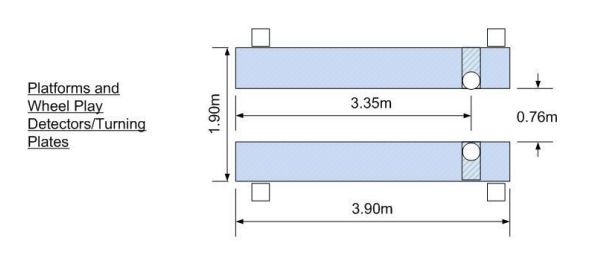
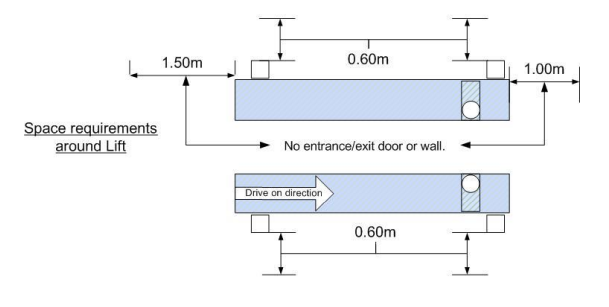
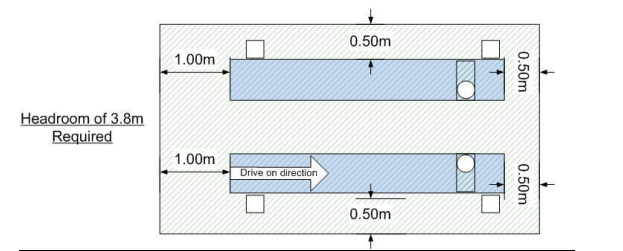
Underside inspection
The designated means of inspecting the underside of vehicles will be considered suitable if either a lift or a pit meeting the following is provided:
Lift
If a wheel supporting platform lift is provided, it must have:
- platforms without upstands or guard rails at least 3.9m long - the platform length does not include access ramps
- rolled edges or vertical rails for jacking equipment that are not more than 25mm higher than the platform.
- platform surfaces capable of being raised at least 1.5m from the floor - this is measured from the floor on which the lift is mounted
- a minimum of at least 760mm (may be reduced to 600mm if testing narrow track vehicles) between the inner edges of the platforms and at least 1.9m between the outer edges
- a safe working load (SWL) of at least 3 tonnes clearly marked on the lift
- jacking equipment clearly marked with a minimum SWL of 2.0 tonnes, capable of simultaneously raising both front or both rear wheels using the recommended test procedures and jacking points, the distance between the centre of the lifting pads must extend to a minimum of 1700mm - it must also be capable of lifting vehicles fitted with independent suspension (duplicated jacking equipment is acceptable)
- captive bearing based turning plates, positively secured to the platforms, which permit the steered wheels to be turned freely from lock to lock - the turning plates must move laterally across the full platform width - when installed there must be a minimum distance of 3.35m from the centre of the turning plates to the drive on end of lift platform
- chocks that operate automatically when the lift is raised - the 3.35m dimension for turning plates must not interfere with operation of the chocks - on non drive through layouts permanent chocks may be fitted to the non drive on end
You should have confirmation in writing by the lift installer that the installation of the lift complies with BS 7980:2024. A current LOLER thorough examination certificate. Vehicle lifts should be CE and or UKCA marked. Any modifications to existing vehicle lifts should conform to BS 7980:2024 and BS EN 1493:2022 regarding safety distances for toe protection.
If a scissor lift is used, the scissors must be located underneath the platforms, allowing unobstructed access between them.
An automated test lane (ATL) or one person test lane (OPTL) needs:
- wheel play detectors from the DVSA list of acceptable equipment, securely fixed to the lift
- at least 3.35m from the drive on end of the lift platforms to the centre line of the wheel play detectors. The 3.35m dimension for wheel play detectors must not interfere with operation of the chocks
- written declaration from the hoist manufacturer (not installer) that the hoist is suitable to be fitted with wheel play detectors
Pit
If a pit is provided, it must have:
- an uninterrupted working length of at least 3.9m
- a width of at least 760mm and not more than 920mm over the working length measured across both pit walls (this may be extended up to 1300mm if used in combination with Class 7)
- a depth of at least 1.5m and not more than 1.8m, over the working length. Staging may be used to meet this requirement
- adequate access for personnel which does not intrude on the working dimensions. Access steps may encroach on the required dimensions to an entrance/exit door or wall provided there is a minimum clearance width of not less than 600mm
- been sealed to prevent the ingress of water
- jacking equipment as required for a lift. Rolled edges and vertical rails for jacking equipment must not exceed 25mm height
- captive bearing based turning plates, positively secured to the floor which permits the steered wheels to be turned freely from lock to lock
If it has an ATL or OPTL, it must have combined steering and wheel play detectors on DVSA’s list of acceptable equipment. No part of the installation should be within 1.5m of the pit working length drive on end.
The location of turning plates and play detectors must be that the tester has adequate space to safely inspect all the items required when stood in the pit.
Headlamp aim testing
A headlamp aim testing facility will be considered suitable if it has a calibrated rail mounted 2005 specification headlamp tester on DVSA’s latest list of acceptable equipment.
Headlamp tester installation
A headlamp tester installation must have a designated vehicle standing area which is certified as flat and level to within +/- 6mm in any 3m.
It must have a clearly outlined area of floor 3.6m long measured from the datum line by 2.1m wide, which may:
- be the lift platforms (lift platforms must rest on positive stops when lowered)
- straddle a pit or roller brake tester
- be the plates of a plate brake tester
If during headlamp testing vehicle wheels rest on turning plates which are not longitudinally adjustable by at least 600mm, they must be within the +/- 6mm limits.
Additional equipment fitted in the standing area must comply with the +/- 6mm level requirements.
The headlamp tester installation must have rails certified as level to within +/- 2mm and parallel to the standing area. The rails must be straight and the headlamp tester must not have significant rock or twist at any point along the rails.
The certificate for the above must show height measurement from a level plane at all intersecting points on a 300mm (max) square grid covering the standing area and at points 300mm (max) apart on the rails. It must be signed by a competent person, such as a surveyor, manufacturer’s representative or agent and include date, status, address of firm and VTS address. A copy must be provided to DVSA for the garage file.
The headlamp aim tester must have 600mm clearance behind the headlamp aim tester optical head. Floor mounted equipment must not be installed in this area.
The standing area must be durably and clearly marked with a datum line (or lines) at the headlamp tester manufactures operational tolerance limits for positioning the vehicle headlamp in relation to the headlamp tester.
Headlamp aim equipment operating instructions must be available .
Headlamp aim tester drawings
Class 4 - Headlamp aim dimensions
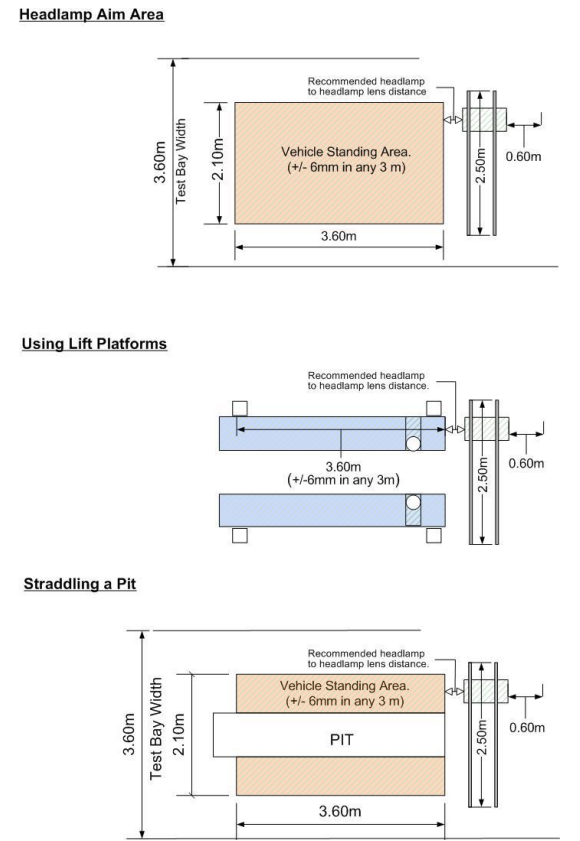
Brake testing
Brake testing equipment will be considered suitable if the following are provided:
- a calibrated decelerometer on DVSA’s latest list of acceptable equipment
- a calibrated roller brake tester or a calibrated plate brake tester that is on DVSA’s latest list of acceptable equipment - if it’s being used on an ATL lane, it needs to be approved for ATL use on DVSA’s latest list of acceptable equipment
- roller/plate brake tester user/operator instructions
Roller brake tester
A roller brake tester (RBT) must be installed so that it is centrally located in an unobstructed working area at least 9.0m long and at least 2.4m wide. At least 3.35m to the front and rear of the RBT centre line should be substantially level (which in good building practice is within +/- 12mm of a level plane). The remainder of the area must not exceed a 10% slope (100mm in 1m).
Part of the brake testing standing area can be outside the building, providing the first part of the RBT floor plate is at least 1.5m inside the building (where a doorway meets the class 7 width requirement then the 1.5m can be measured from the RBT centre line).
Where part of the roller brake test vehicle standing area is located outside of the building, the standing area must not encroach any public thoroughfare.
In the case of a ‘drive-through’ layout where the roller brake tester is fitted after the lift or pit there shall be a clear distance of at least 3.35m between lift platforms and the RBT centre line. Lead-off ramps from floor mounted lifts shall not encroach on this area.
You must also make sure that the RBT is installed so that:
- any part of a roller brake tester is at least 600mm from an inspection pit, lift platform or lift recess (except cross pit rollers)
- it is in accordance with the manufacturer’s instructions
- the console is positioned to be easily read whilst performing the test
- when a cross-pit RBT is installed there must be an isolator that prevents operation of the RBT when a person is in the pit - it must be positioned so other equipment will not interfere with brake testing. i.e. turning plates
Plate brake tester
A plate brake tester (PBT) must be installed so that:
- it is certified as installed in accordance with the manufacturer’s instructions
- the plates are centrally located in a substantially level test area which (including approach and run-off area) is at least 3.0m wide
- a clear area of 4.5m shall be provided in advance of the plate brake tester. This area must be substantially level and any gradient must not exceed 5% (50mm in 1m) nor the equipment positioned within it. All or part of the 4.5m can be outside the building. Where it is perceived that there may be a safety risk, barriers and/or warning signs may be required along the approach area and/or the run off area
- doorways positioned within the 4.5m approach area must be at least 3m wide
- where the plate surface is not flush with the surrounding floor, lead on and off ramps must be located at least 600mm from any doorway
- a clear run off distance of 3.0m shall be provided after the PBT working surface (this must not include any part of the lift or lead on ramps)
- in the case of a ‘drive-through’ layout where the plate tester is fitted AFTER the lift or pit there shall be a clear distance of 4.5m between them. Lead-off ramps from floor mounted lifts shall not encroach on this area
- the console is positioned to be easily read whilst performing the test
Brake tester standing area drawings
Class 4 - Brake standing area dimensions
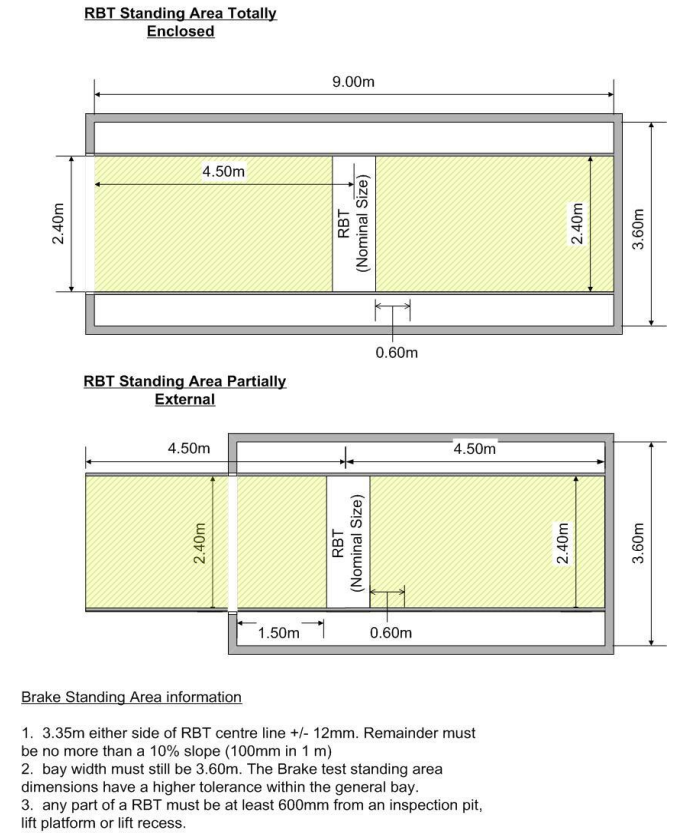
Emissions testing
All class 4 testing stations must have the following emissions testing equipment.
Spark ignition engine emissions
Exhaust gas analysis equipment will be considered suitable for all spark ignition engine vehicles if the following is provided:
- a calibrated exhaust gas analyser on DVSA’s latest list of acceptable equipment suitable for all spark ignition vehicles
- gas analyser user/operator instructions
- confirmation that the analyser contains the current up to date database
Diesel engine emissions
Diesel smoke test equipment will be considered suitable if the following is provided:
- a calibrated diesel smoke meter on DVSA’s latest list of acceptable equipment
- smoke meter user/operator instructions
Connected equipment
Some types of MOT equipment are enabled to transfer test results from the test equipment to the MOT testing service (MTS).
The equipment types this applies to are:
| Equipment type |
|
Mandatory from |
|
Classes |
| Roller brake testers |
|
1 October 2019 |
|
4, 5, 7 |
| Decelerometers |
|
1 February 2020 |
|
4, 5, 7 |
| Exhaust gas analysers |
|
1 May 2021 |
|
4, 5, 7 |
| Diesel smoke meters |
|
1 May 2021 |
|
4, 5, 7 |
Who needs connected equipment
Connected equipment is required to be fitted and used by a garage where approval is sought:
- for a garage that hasn’t previously conducted MOT tests (new)
- for a currently testing VTS that is undergoing a change of ownership (where the site is transferred to a different AE)
- at a garage that has previously been a MOT test station but has ceased to test (regardless of how long ago it tested)
It will also be required if a VTS is:
- making a voluntary upgrade of a piece of equipment listed in the table in a VTS
- adding an additional test lane including a piece of equipment listed in the table
- replacing broken equipment listed in the table
Where either an Exhaust Gas Analyser or a Diesel Smoke Meter that a part of a combined unit is replaced by the same make and model this is classed as a repair to the combination unit.
How to connect equipment to the MOT service
A software code (a key) is required to connect the equipment to the MOT testing service. The key can be requested by the AEDM, AE Delegate or Site Manager via the MOT testing service using the ‘Request a key’ link.
The key should be kept securely and given to the installation engineer who will connect the equipment to the MOT testing service.
A check must be made on the first test after the equipment is installed that the results have been sent through to the MOT testing service.
Contact the equipment supplier immediately if results are not sent through.
Class 3 only testing
Where only Class 3 testing is conducted the requirements for Class 4 are varied as
follows:
Premises
There are no variations to the premises requirements - they are the same as those for class 4
Test bay
The test bay must have:
- vehicle entrances and exits at least 2.3m wide and 2.0m high
- bay width at least 3.2m
- bay headroom at least 2.1m
- headroom over a lift of at least 3.2m
Equipment layout
There must be a clearance of at least 900mm to the front and rear of a lift or pit to any entrance/exit door or wall.
Lift
The lift must have:
- platforms at least 3.00m long
- a safe working load (SWL) of at least 1.5 tonnes clearly marked on the lift
- a suitable method of supporting the ‘single wheel’ of any three wheeled vehicle on a firm surface with a captive bearing based turning plate - a SWL of at least 500kg must be clearly marked on the support
- jacking equipment clearly marked with a minimum SWL of 500kg
- captive bearing based turning plates, positively secured to the platforms, which permit the steered wheels to be turned freely from lock to lock - the turning plates must move laterally across the full platform width
- when installed there must be a minimum distance of 2.35m from the centre of the turning plates to the drive on end of lift platforms
Pit
The pit must have:
- an uninterrupted working length of at least 3.0m with a single bridge and turning plate
- a suitable method of supporting the ‘single wheel’ of any three wheeled vehicle on a firm surface with a captive bearing based turning plate - a safe working load SWL of at least 500kg must be clearly marked on the support
- jacking equipment clearly marked with a minimum SWL of 500kg
Headlamp aim testing
It must have a designated vehicle standing area at least 3.0m long and 1.8m wide.
Brake testing
It must have a calibrated Category A decelerometer on DVSA’s latest list of acceptable equipment.
A roller brake tester must be installed so that it is centrally located in an unobstructed working area at least 7m long and 3.2m wide.
A plate brake tester must be installed so that:
- it is located in a substantially level test area which (including the approach and run-off area) is at least 3.6m wide.
- it is situated with at least 2.0m clear space, on the side of the measuring plate, from the PBT centre line
- doorways positioned within the 4.5m approach to the plate brake tester must be at least 3.6m in width (to enable vehicles to be off-set to test the single wheeled axle)
The brake testing facility must be able to cater with either a single front or rear wheel configuration.
Emissions testing
Emissions testing is not required for Class 3 testing.
Dual class premises (Class 3 and 4)
Premises and equipment considered suitable for Class 4 testing will also be accepted for Class 3, and 3-wheeled Class 4 testing if the underside inspection facility has a suitable method of supporting the ‘single wheel’ of any three wheeled vehicle on a firm surface and on a turning plate. A single wheel support must cater for single front or rear wheel configuration and there must be acceptable arrangements for testing headlamp aim, if applicable, for both wheel layouts.
It will also need suitable jacking arrangements. If the jacking equipment is unsuitable for raising a 3 wheeler single wheel there must be suitable additional equipment of 500kg capacity.
5. Class 5 vehicles
Installation and equipment requirements
November 2009
DVSA, on behalf of the Secretary of State, appoints authorised examiners and designated councils to carry out inspections known generally as MOT tests. The following section sets out the additional requirements that must be met for testing Class 5 vehicles.
The dimensions in this section are the minimum requirements for authorisation as a vehicle test station for class 5 vehicles.
The dimensions of your test bay should take into account the requirements of your business.
When considering the contents of this document you should be aware that the equipment and/or layout selected may affect the type of vehicle able to be tested.
Applicants are advised not to proceed with alterations to buildings or purchase of equipment, etc, before receiving written approval in principle from DVSA.
Requirements for Class 5 testing
There are three categories for Class 5 testing:
- category 1- all single deck vehicles.
- category 2 - double deck vehicles.
- category 3 - articulated vehicles.
Class 5 lightweight vehicle only premises have the same requirements as for Class 7.
Normally, only a drive through layout will be accepted where approval is sought to test articulated vehicles.
Premises, test bay and equipment layout
Premises, test bays and equipment will be considered suitable if they meet the requirements laid out in Requirements for Authorisation for Vehicle Testing Station (Common to all Classes).
Premises must have a facility to prevent the build-up of exhaust fumes, either by means of ventilation or by exhaust extraction equipment for connection to the exhaust pipes of vehicles.
Test bay
To test double deck vehicles, a testing station needs a test bay with:
- vehicle entrances and exits at least 4.6m high and 4.2m wide
- a width of at least 4.5m
- headroom of at least 5.0m (except over a lift)
- headroom over a lift of at least 6.3m, measured from the platform surfaces when fully lowered, extending over an area of at least 1.5m on each side of the lift longitudinal centre and at least 6.5m fore and aft of the lift transverse centre line.
To test single deck vehicles, a testing station needs a test bay with:
- vehicle entrances and exits 3.7m high and 4.2m wide
- a width of at least 4.5m
- headroom of at least 4.0m (except over a lift)
- headroom over a lift of at least 5.3m, measured from the platform surfaces when fully lowered, extending over an area of at least 1.5m on each side of the lift longitudinal centre and at least 6.5m fore and aft of the lift transverse centre line.
Underside inspection
The designated means of inspecting the underside of vehicles will be considered suitable if either a lift or a pit meeting the following is provided.
Lift
If a wheel supporting platform lift is provided, it must have:
- platforms without upstands or guard rails at least 7.0m long - the platform length does not include access ramps.
- rolled edges or vertical rails for jacking equipment must not be more than 25mm higher than the platform
- platform surfaces capable of being raised at least 1.45m from the floor. Measured from the floor on which the lift is mounted
- a 2.88m width between posts
- platforms with a minimum width of 650mm
-a minimum width of 2.55m between the outer edges of the platforms
- a minimum width of 800mm between the inner edges of platform
- a safe working load (SWL) of at least 12 tonnes; the SWL to be clearly marked on the lift
- jacking equipment preferably power operated, on a trolley platform able to move an appropriate distance along the pit - having a minimum SWL of 6.0 tonnes, capable of simultaneously raising both front wheels of any vehicle using the recommended test procedures and jacking points - it must also be capable of lifting vehicles fitted with independent suspension
- at least two chocks, permanent chocks may be fitted at the platform forward ends, if not a ‘drive-through’ installation
- a satisfactory intercom system between the examiner and the assistant. Means of communication will be considered on their merits
You must have confirmation in writing by the lift installer that the installation of the lift complies with BS 7980:2024. A current LOLER thorough examination certificate. Vehicle lifts should be CE and or UKCA marked. Any modifications to existing vehicle lifts should conform to BS 7980:2024 and BS EN 1493:2022 regarding safety distances for toe protection.
If a scissor lift is used, the scissors must be located underneath the platforms, allowing unobstructed access between them.
Wheel play detectors may be installed on each side of the lift at the point where the jack will be used and if installed must be controlled by a “wandering” hand control at this point so that the tester may remain close by a wheel when the wheel play detector is operated to inspect for wear.
Pit
If a pit is provided, it must have:
- an uninterrupted working length of at least 13.0m (may be reduced to a minimum of 10m if two cross tunnels, one at either end are provided)
- a width of at least 800mm and not more than 1.3m, over the working length
- a depth of at least 1.4m and not more than 1.8m, over the working length. Staging may be used to meet this requirement
- the capacity to accommodate the weight of all vehicles that fall into the category to be tested
- been sealed to prevent the ingress of water
- jacking equipment preferably power operated, on a trolley platform able to move an appropriate distance along the pit - having a minimum SWL of 6.0 tonnes, capable of simultaneously raising both front wheels of any vehicle using the recommended test procedures and jacking points - it must also be capable of lifting vehicles fitted with independent suspension
- adequate access for personnel which does not intrude on the working dimensions, there must be at least one method of easy access either by a staircase at one end of the pit or by a cross tunnel, and adequate escape facilities either at the other end of the pit or along its length
- a satisfactory ‘intercom’ system between the examiner and the assistant - means of communication will be considered on their merits
Any upstands/guard rails if fitted, to be no higher than 25mm.
Wheel play detectors may be installed on each side of the pit at the point where the jack will be used and if installed must be controlled by a “wandering” hand control at this point so the tester may remain close by a wheel when the wheel play detector is operated to inspect for wear.
Headlamp aim testing
A headlamp aim testing facility will be considered suitable if it has a rail mounted headlamp tester on DVSA’s latest list of acceptable equipment.
Headlamp tester installation
A headlamp tester installation must have a designated vehicle standing area which is certified as flat and level to within ± 6mm in any 3.0m and is either, a clearly marked area of floor 11.0m long by 3.0m wide, which may straddle a pit, or roller brake tester, or is the lift platforms.
It must have rails mounted and certified as parallel to within ± 2mm of the standing area plane.
The certificate for the above must show height measurement from a level plane at all intersecting points on a 500 mm (max) square grid covering the standing area and at points 300mm (max) apart on the rails. It must be signed by a competent person, such as a surveyor, manufacturer’s representative or agent and include date, status, address of firm and VTS address. A copy must be provided to DVSA for placing on the garage file.
If the roller brake tester encroaches on the standing area, then the standing area levels must include the cover plates and meet the +/- 6 mm requirements.
If the lift platforms form part of the standing area then steel plates must be fitted under automatic chocks. If the lift is also used as the designated standing area for headlamp testing, the platforms must rest on fixed stops when lowered.
Equipment must be correctly aligned to the standing area and positioned to take account of the vertical and horizontal location of headlamps tested.
There must be 1.0m (600mm for 2005 specification equipment) clearance at the rear of the tester optical head. Floor mounted equipment such as brake testers must not be installed in this area
The standing area must be durably and clearly marked with a datum line (or lines) at the headlamp tester manufactures operational tolerance limits for positioning the vehicle headlamp in relation to the headlamp tester.
Any other test equipment within the standing area must be arranged so that it does not interfere with the proper testing of headlamps.
Additionally, in all installations, it is recommended that the rails are sunk into the ground to avoid any excess wear and tear on them. Where vehicles are driven over them the rails must be recessed or suitably protected.
There must be suitable arrangements for checking the alignment of the equipment with the standing area. Arrangements for checking alignment may consists of evidence provided either by a competent outside agency or by the VTS using the manufacturer’s acceptable equipment. Provision must be made for checks to be carried out at no more than 6 monthly intervals and for records to be kept. It is acceptable if an alignment check is within the 6th calendar month in which the alignment was last checked
Brake testing
Brake testing equipment will be considered suitable if the testing station has:
- a calibrated decelerometer on DVSA’s latest list of acceptable equipment
- a calibrated roller brake tester on DVSA’s latest list of acceptable equipment
- roller brake tester user/operator instructions
- suitable data on ABS warning systems
- a means of determining brake efficiency and imbalance from the roller brake tester readings
- suitable arrangements for re-calibration of the decelerometer, and the roller brake tester
A roller brake tester (RBT) must be installed so that:
- it is centrally located in an unobstructed, substantially level area, at least 22.0m long and 4.0m wide
- 11.0m standing area to the rear of the RBT may extend outside a building provided the ground is substantially level is constructed of acceptable material and the roller brake tester bed plate is installed not less than 1.5 m from an entrance or exit. Where part of the roller brake test vehicle standing area is located outside of the building, the standing area must not encroach any public thoroughfare
- vehicles are substantially level while being tested (a gradient of not more than 5%)
- the console is positioned so that it can easily be read by the tester performing the test on the vehicle
- an intercom system allowing the tester to communicate with the assistant when any axle is positioned in the brake rollers
- any part of the roller brake tester is at least 600mm from an inspection pit, lift platform or lift recess (except cross pit rollers)
- when a cross-pit RBT is installed there must be an isolator that prevents operation of the RBT when a person is in the pit -it must be positioned so other equipment will not interfere with brake testing
- there must be four chocks available for use in the roller brake test area
The RBT may be installed outside the building. The rollers should have a canopy to protect them from the rain and the console should be mounted in a suitable position protected from the weather and excessive exhaust fumes. The brake tester should be situated adjacent to the test bay with a viewing facility.
Emissions testing
All class 5 testing stations must have the following emissions testing equipment:
Spark ignition engine emissions
Exhaust gas analysis equipment will be considered suitable for all spark ignition engine vehicles if the following is provided:
- a calibrated exhaust gas analyser on DVSA’s latest list of acceptable equipment
- gas analyser user/operator instructions
- confirmation that the analyser contains the current up to date database
Diesel engine emissions
Diesel smoke test equipment will be considered suitable if the following is provided:
- a calibrated diesel smoke meter on DVSA’s latest list of acceptable equipment
- smoke meter user/operator instructions
Connected equipment
Some types of MOT equipment are enabled to transfer test results from the test equipment to the MOT Testing service (MTS).
The equipment types this applies to are:
| Equipment type |
|
Mandatory from |
|
Classes |
| Roller brake testers |
|
1 October 2019 |
|
4, 5, 7 |
| Decelerometers |
|
1 February 2020 |
|
4, 5, 7 |
| Exhaust gas analysers |
|
1 May 2021 |
|
4, 5, 7 |
| Diesel smoke meters |
|
1 May 2021 |
|
4, 5, 7 |
Who needs connected equipment
Connected equipment is required to be fitted and used by a garage where approval is sought:
- for a garage that hasn’t previously conducted MOT tests (new)
- for a currently testing VTS that is undergoing a change of ownership (where the site is transferred to a different AE)
- at a garage that has previously been a MOT test station but has ceased to test (regardless of how long ago it tested)
It will also be required if a VTS is:
- making a voluntary upgrade of a piece of equipment listed in the table in a VTS
- adding an additional test lane including a piece of equipment listed in the table
- replacing broken equipment listed in the table
Where either an Exhaust Gas Analyser or a Diesel Smoke Meter that a part of a combined unit is replaced by the same make and model this is classed as a repair to the combination unit.
How to connect equipment to the MOT service
A software code (a key) is required to connect the equipment to the MOT testing service. The key can be requested by the AEDM, AE delegate or site manager via the MOT testing service using the ‘Request a key’ link.
The key should be kept securely and given to the installation engineer who will connect the equipment to the MOT testing service.
A check must be made on the first test after the equipment is installed that the results have been sent through to the MOT testing service.
Contact the equipment supplier immediately if results are not sent through.
6. Class 7 vehicles
Installation and equipment requirements
DVSA, on behalf of the Secretary of State, appoints authorised examiners and designated councils to carry out inspections known generally as MOT tests. The following section sets out the additional requirements that must be met for testing Class 7 vehicles.
The dimensions in this section are the minimum requirements for authorisation as a vehicle test station for class 7 vehicles.
The dimensions of your test bay should take into account the requirements of your business.
When considering the contents of this document you should be aware that the equipment and/or layout selected may affect the type of vehicle able to be tested.
Applicants are advised not to proceed with alterations to buildings or purchase of equipment, before receiving written approval in principle from DVSA.
Premises, test bay and equipment layout
The test bay and layout dimensions stated are the minimum requirements measured from the inside of walls and doors, as appropriate. If there is a capability to test longer wheel based vehicles, more than 4.2m wheelbase, and the headlamp standing area is at the minimum requirements then the headlamp standing area dimensions will take precedence and a 4.2m wheelbase would be the longest which could be tested. If a longer dimension is required then all other dimensions must be proportional to this.
Premises, test bays and equipment will be considered suitable if they meet the requirements laid out in Requirements for Authorisation for Vehicle Testing Station (Common to all Classes). Class 5 lightweight requirements are as Class 7 conditions of appointment.
Test bay
The testing station must have a test bay with:
- vehicle entrances and exits at least 3.2m high by 3.0m wide. If part of the brake test standing area the door must be at least 3.5m wide (for Plate brake testers see brake testing section below)
- a width of at least 4.2m
- headroom of at least 3.2m (except over a lift)
It must have headroom over a lift of at least 4.8m measured from the platform surfaces when fully lowered which extends:
- 500mm further than the outer edges of the lift platforms
- 500mm to the front of the non drive on end of the lift platforms
- 1m to the rear of the drive on end of the lift platforms
Underside inspection
The designated means of inspecting the underside of vehicles will be considered suitable if either a lift or a pit meeting the following is provided:
Lift
If a wheel supporting platform lift is provided, it must have:
- platforms without upstands or guard rails, at least 4.8m long - the platform length does not include access ramps
- rolled edges or vertical rails for jacking equipment must not be more than 25mm higher than the platform
- platform surfaces capable of being raised at least 1.4m from the floor. (measured from the floor on which the tester stands)
- adjustable platforms which allow the class of vehicle to be tested - a minimum of at least 760mm between the inner edges of the platforms and at least 2.1m between the outer edges
- a safe working load (SWL) of at least 3.5 tonnes clearly marked on the lift
- jacking equipment clearly marked with a minimum SWL of 2.6 tonnes, capable of simultaneously raising both front or both rear wheels - duplicated jacking equipment is acceptable
- heavy duty captive bearing based turning plates, positively secured to the platforms, which permit the steered wheels to be turned freely from lock to lock - the turning plates must move laterally across the full platform width - when installed there must be a minimum distance of 4.2m from the centre of the turning plates to the drive on end of lift platforms
- chocks that operate automatically when the lift is raised - the 4.2m dimension for turning plates must not interfere with operation of the chocks - on non-drive through layouts permanent chocks may be fitted to the non drive on end
You must have confirmation in writing by the lift installer that the installation of the lift complies with BS 7980:2024, a current LOLER thorough examination certificate. Vehicle lifts should be CE and or UKCA marked. Any modifications to existing vehicle lifts should conform toBS 7980:2024 and BS EN 1493:2022 regarding safety distances for toe protection.
If it has an automated test lane (ATL) or one person test lane (OPTL) it needs:
- wheel play detectors from the DVSA list of acceptable equipment, securely fixed to the lift
- at least 4.2m from the drive on end of the lift platforms to the centre line of the wheel play detectors - the 4.2m dimension for wheel play detectors must not interfere with operation of the chocks
- written declaration from the hoist manufacturer (not installer) that the hoist is suitable to be fitted with wheel play detectors
If a scissor lift is used, the scissors must be located underneath the platforms, allowing unobstructed access between them.
Pit
If a pit is provided, it must have:
- an uninterrupted working length of at least 6.0m
- a minimum width of 760mm and not more than 1.3m over the working length measured across both pit walls
- a depth of at least 1.4m and not more than 1.8m, over the working length. Staging may be used to meet this requirement
- adequate access for personnel which does not intrude on the working dimensions. Access steps may encroach on the required dimensions to an entrance/exit door or wall provided there is a minimum clearance width of not
less than 600mm
- been sealed to prevent the ingress of water
- jacking equipment as required for a lift. Rolled edges and vertical rails for jacking equipment must not exceed 25mm height
- suitable captive bearing based turning plates, positively secured to the floor which permit the steered wheels to be turned freely from lock to lock
If it is an ATL or OPTL, it must have combined steering and wheel play detectors on DVSA’s list of acceptable equipment. No part of the installation should be within 1.5m of the pit working length drive on end.
The location of turning plates, steering and wheel play detectors must be that the tester has adequate space to safely observe the items required to be observed when stood in the pit.
Headlamp aim testing
A headlamp aim testing facility will be considered suitable if it has a calibrated rail mounted headlamp tester on DVSA’s latest list of acceptable equipment.
Headlamp tester installation
A headlamp tester installation must have a designated vehicle standing area which is certified as flat and level to within +/- 6mm in any 3m and is a clearly outlined area of floor of 4.5m long measured from the datum line by 2.5m wide. This may:
- be the lift platforms (lift platforms must rest on positive stops when lowered
- straddle a pit or roller brake tester.
- be the plates of a plate brake tester.
Additional equipment fitted in the standing area must comply with the +/-6mm level requirement.
Rails must be certified as level to within +/- 2mm and parallel to the standing area. The rails must be straight, and the headlamp tester must not have significant rock or twist at any point along the rails.
The certificate for above must show height measurement from a level plane at all intersecting points on a 300 mm (max) square grid covering the standing area and at points 300mm (max) apart on the rails. It must be signed by a competent person, such as a surveyor, manufacturer’s representative or agent and include date, status, address of firm and VTS address. A copy must be provided to DVSA for the garage file.
There must be 600mm clearance behind the headlamp aim tester optical head. Floor mounted equipment must not be installed in this area
The standing area must be durably and clearly marked with a datum line (or lines) at the headlamp tester manufactures operational tolerance limits for positioning the vehicle headlamp in relation to the headlamp tester.
Headlamp aim equipment operating instructions must be available.
Brake testing
Brake testing equipment will be considered suitable if the following are provided:
- a calibrated decelerometer on DVSA’s latest list of acceptable equipment and
- a calibrated roller brake tester or a calibrated plate brake tester that is on DVSA’s latest list of acceptable equipment. If an ATL lane, it must be approved for ATL use on DVSA’s latest list of acceptable equipment
- roller/plate brake tester user/operator instructions
Roller brake tester
A roller brake tester (RBT) must be installed so that it is centrally located in an unobstructed working area at least 14m long and at least 3.5m wide.
At least 4.2m to the front and rear of the RBT centre line should be substantially level (which in good building practice is within +/- 12mm of a level plane). The remainder of the area must not exceed a 10% slope (100mm in a 1m).
Part of the brake testing standing area can be outside the building, providing the RBT centre line is at least 1.5m inside the building in the case of a ‘drive-through’ layout where the roller brake tester is fitted after the lift or pit there shall be a clear distance of at least 4.2m between them. Lead-off ramps from floor mounted lifts shall not encroach on this area.
Where part of the roller brake test vehicle standing area is located outside of the building, the standing area must not encroach any public thoroughfare.
It must be installed so that:
- any part of a roller brake tester is at least 600mm from an inspection pit, lift platform or lift recess
- it is in accordance with the manufacturer’s instructions
- the console is positioned to be easily read by the tester performing the test
- when a cross-pit RBT is installed, there must be an isolator that prevents operation of the RBT when a person is in the pit - it must be positioned so other equipment will not interfere with brake testing. i.e. turning plates
Plate brake tester
A plate brake tester must be installed so that:
- it is certified as installed in accordance with the manufacturer’s instructions
- the plates are centrally located in a substantially level test area which (including approach and run-off area) is at least 3.6m wide
- doorways positioned within the 7m approach area must be at least 3.6m wide
- where the plate surface is not flush with the surrounding floor, lead on and off ramps must be located at least 600mm from any doorway
- a clear run off distance of 4m shall be provided after the plate brake tester working surface (this must not include any part of the lift platforms)
- in the case of a ‘drive-through’ layout where the plate tester is fitted after the lift or pit there shall be a clear distance of 7m between them - lead off ramps from floor mounted equipment shall not encroach on this area
- the console is positioned so that it can easily be read whilst performing the test
A clear area of 7.0m shall be provided in advance of the plate brake tester. This area must be substantially level and any gradient must not exceed 5% (50mm in 1m) nor have any other equipment positioned within it. All or part of the 7.0m can be outside the building. Where it is perceived that there may be a safety risk, barriers and/or warning signs may be required along the approach area and/or the run-off area.
Emissions testing
All class 7 testing stations must have the following emissions testing equipment:
Spark ignition engine emissions
Exhaust gas analysis equipment will be considered suitable for all spark ignition engine vehicles if the following is provided:
- a calibrated exhaust gas analyser on DVSA’s latest list of acceptable equipment
- gas analyser user/operator instructions
- confirmation that the analyser contains the current up to date database
Diesel engine emissions
Diesel smoke test equipment will be considered suitable if the following is provided
- a calibrated diesel smoke meter on DVSA’s latest list of acceptable equipment
- smoke meter user/operator instructions
Connected equipment
Some types of MOT equipment are enabled to transfer test results from the test equipment to the MOT testing service (MTS).
The equipment types this applies to are:
| Equipment type |
|
Mandatory from |
|
Classes |
| Roller brake testers |
|
1 October 2019 |
|
4, 5, 7 |
| Decelerometers |
|
1 February 2020 |
|
4, 5, 7 |
| Exhaust gas analysers |
|
1 May 2021 |
|
4, 5, 7 |
| Diesel smoke meters |
|
1 May 2021 |
|
4, 5, 7 |
Who needs connected equipment
Connected equipment is required to be fitted and used by a garage where approval is sought:
- for a garage that hasn’t previously conducted MOT tests (new)
- for a currently testing VTS that is undergoing a change of ownership (where the site is transferred to a different AE)
- at a garage that has previously been a MOT test station but has ceased to test (regardless of how long ago it tested)
It will also be required if a VTS is:
- making a voluntary upgrade of a piece of equipment listed in the table in a VTS
- adding an additional test lane including a piece of equipment listed in the table
- replacing broken equipment listed in the table
Where either an Exhaust Gas Analyser or a Diesel Smoke Meter that a part of a combined unit is replaced by the same make and model this is classed as a repair to the combination unit.
How to connect equipment to the MOT service
A software code (a key) is required to connect the equipment to the MOT testing service. The key can be requested by the AEDM, AE delegate or site manager via the MOT testing service using the ‘Request a key’ link.
The key should be kept securely and given to the installation engineer who will connect the equipment to the MOT testing service.
A check must be made on the first test after the equipment is installed that the results have been sent through to the MOT testing service.
Contact the equipment supplier immediately if results are not sent through.
What happens when shortcomings are found in MOT testing or operations, why disciplinary action may be taken against authorised examiners and testers, disciplinary points and how they're evaluated, when formal disciplinary action will be taken, making an appeal against cessation of authorisation.
1. Shortcomings in testing and operation
When shortcomings are found either in testing or in the operation of the MOT testing service, DVSA will take action according to the circumstances. For minor shortcomings this will usually consist of advice or counselling, but for more serious cases (or repeated minor shortcomings) formal disciplinary action and prosecution may be considered.
The Secretary of State has absolute discretion to notify persons that they shall cease to be authorised examiners (AE) or testers. These functions are carried out on behalf of the Secretary of State by DVSA.
This section provides guidance for all involved in MOT testing, whether as testers, AEs or DVSA staff, on how this discretion will normally be applied and:
-
explains the procedures normally to be followed when DVSA becomes aware that a tester or AE may not be maintaining the required standards necessary to ensure integrity of the MOT testing service
-
sets out the maximum level of disciplinary action that will normally be applicable so as to ensure procedural consistency
The section is not intended as a set of rules to be rigidly applied. DVSA uses predefined sanctions and a disciplinary points system to gauge the severity of shortcomings, the total number of points is then used as a guide to the appropriate level of disciplinary action. In judging what course to follow in a particular case or series of cases, DVSA will consider all known circumstances and may alter the level of action to reflect the circumstances.
DVSA reserves the right to modify, in light of experience, the points or actions indicated in this section. DVSA will tell you about such modifications in special notices or by amending the pages of this guide.
Where the guide does not cater for a specific shortcoming, points will be allocated in line with those given to shortcomings of similar significance.
DVSA may publish details of vehicle testing stations (VTS) who have been removed from the MOT service following formal disciplinary action. Details will be published after the appeal period has lapsed or the appeal has been determined.
2. Underlying principles - general
Where a vehicle is re-examined after test, any action taken will be based on its likely condition at the time of test, taking into account all known factors that could have changed the condition of the vehicle.
All judgements are based on the balance of probabilities. However, the Secretary of State does have considerable discretion about who may be testers or AEs and, while seeking always to adhere to the principles stated here, reserves the right to exercise that discretion as widely as seems appropriate to the particular circumstances.
In deciding the appropriate course of action to be taken shortcomings that constitute a threat to road safety, having an impact on the environment or likely to affect the integrity of the MOT scheme or DVSA will be treated with the utmost seriousness and carry more weight in the determination of the final outcome.
The outcome of formal disciplinary action may take the form of:
- no further action
- an advisory warning letter
- a temporary suspension notice
- a formal warning
- cessation of a tester’s approval or an AE’s authorisation in the form of either short term cessation (for 28 calendar days with conditional return) or cessation (for 2 or 5 years)
When considering the outcome of disciplinary cases, DVSA will also consider if the good repute of an AE (including any individuals who is part of the AE) and a tester has been lost. Where good repute has been lost, any affected individual(s) will be unable to hold any role within the MOT testing service.
Where this occurs, DVSA will notify any authorisations that are affected by this loss of good repute, advising that the individual(s) concerned can no longer be involved in MOT testing operations. For further information about repute, see Appendix 7: Convictions and repute
When a problem is brought to DVSA’s attention, either by a tester who is being pressurised by an AE to test improperly or by an AE who is unhappy with a tester’s performance, this will not normally count against the party reporting it. However, where an AE is unhappy with the testing standards of a tester the AE should consider stopping the tester from testing pending the outcome of any action by DVSA.
Testers must be in a fit condition, both physically and mentally, to carry out testing to the required standard. A tester taking medication should read the instructions for its use and, if in doubt, not continue testing without their doctor’s confirmation that the medication will not affect their ability to test. If a tester is recovering from illness or injury, he/she should test only if confirmed as fully fit to do so. A tester being on medication or recovering from illness will not normally be treated as mitigation for errors in testing.
The effectiveness of a tester who is under severe emotional stress must also be suspect. If the stress is likely to affect the tester’s ability to test, they should not test. Similarly, testers whose judgement may be affected by alcohol or other substances should not test. In either event, these factors will not normally be regarded as mitigation, however, each case will be treated on the merits of the evidence available. AEs should implement reasonable management controls to try to ensure that the testers they use are in a fit condition to test.
3. Underlying principles - testers
In cases involving tester’s judgement or minor procedural omissions or deviations from the testing system a formal warning will usually be issued on the first offence that in DVSA’s opinion justifies formal action.
Where there is one or more instances of more serious procedural omissions or deviations from the testing standards this may lead to a short-term cessation.
Where there are instances of significant procedural omissions, for example major elements of the test missed, significant negligence or significant malpractice, a single instance will usually lead to cessation.
A single serious incident of substandard testing that could have a significant effect on road safety will usually lead to cessation.
Cessation will usually be justified for a single case if the tester is personally involved in an act which could also justify single offence cessation for an AE or where very serious infringements have taken place.
Appendix 8.1. Cessation without previous warning (single offence cessation) indicates the type of case usually considered to be very serious.
Serious infringements that involve fraud may be considered for prosecution.
Cessation will be justified if
A tester who has been required to stop testing because of failure to complete required training or demonstration tests but who continues to take part in testing, other than as an assistant, may have disciplinary action taken against them resulting in cessation.
Where disciplinary action has resulted in the issue of a formal warning or short-term cessation letter this may be taken into consideration should further disciplinary action be contemplated. Such letters generally remain valid for 5 years from their date of issue.
A tester who has been issued with a 2 or 5 year cessation will not be permitted to hold any roles within an AE and/or VTS during the cessation period. Requesting or accepting any MOT roles during this period could result in the loss of their good Repute as defined in Appendix 7: Convictions and repute. It could also affect any future application to re-enter the MOT Scheme following cessation.
4. Underlying principles - authorised examiners
Cessation will be considered where any individual involved in an authorisation:
Except in the case of very serious infringements that DVSA consider to justify single offence cessation action, an AE will normally have been issued with a formal warning and given the opportunity to correct failings, before the subsequent offences under consideration lead to the cessation of authorisation. Appendix 8.1. Cessation without previous warning (single offence cessation) indicates the type of case usually considered to be very serious.
Serious infringements that involve fraud may be considered for prosecution.
Where offences are serious enough to justify consideration for cessation, with the exception of single offence cessation, short term cessation (with or without training) action will normally be considered in the first instance.
Where single offence cessation is considered, DVSA will take care to ensure that the offence justifies such serious action having regard to the risk to road safety or the repute of the MOT testing service.
Normally, the points counted against an AE will be no less than those counted against the tester for the same fault unless there is clear evidence of deceit by the tester and the AE has not been remiss in the application of management controls and quality assurance. Tester shortcomings brought to DVSA’s attention by an AE as a result of management quality checks will not normally be counted against the AE.
Previous disciplinary sanctions can be taken into consideration for 5 years should further disciplinary action be contemplated from the date of issue.
If an AE has received a 2 or 5 year disciplinary cessation of all their sites, none of the associated AEPs will be able to hold any role within another AE and/or VTS during the cessation period. Requesting or accepting any MOT roles during this period could result in the loss of their good repute as defined in Appendix 7: Convictions and repute. It could also affect any future application to re-enter the MOT scheme following cessation.
Multi-site AEs
In considering cases involving AEs who operate at more than 1 site, each site will be treated separately in the first instance. If the repute of the MOT testing service is considered to have suffered through the actions of the AE, DVSA has the right to issue a notice of cessation to the AE regarding all of the AEs’ sites. If a specific site is subject to cessation for disciplinary reasons, then no further sites will be authorised in the same catchment area within the period of cessation. Regardless of whether any individual sites are subject to notices of cessation, DVSA may review the overall effectiveness of that AE’s management system.
If it appears to DVSA that there are problems affecting a significant proportion of sites DVSA may ask for an action plan to be prepared and implemented to improve the group performance. If problems continue, DVSA may consider granting no further authorisations until the record of the remaining parts of the group has improved or, in severe cases issuing notices of cessation to part or all of the group. In considering the overall performance of the group, convictions relating to non-VTS sites within the group may also be taken into consideration
Where an AE has been shown on the balance of probabilities to be culpable of misdemeanours affecting all sites, for example deliberate failure of minor items to encourage trade, and the resulting accumulated disciplinary points are sufficient to warrant disciplinary action all sites may be issued with notices of cessation.
5. Disciplinary action - how it can arise
Some examples of typical circumstances that can lead to disciplinary action against a tester or AE are:
- a justified complaint where defects have been found on a vehicle that had previously passed its MOT test (this is known as an ‘inverted appeal’)
- a justified appeal against a vehicle that had previously failed its MOT test (this is known as a ‘statutory appeal’)
- a re-examination of a recently tested vehicle by DVSA revealing an incorrect pass/fail decision
- an observed test where a vehicle (with or without induced defects) is submitted for examination by a ‘mystery shopper’ (a person posing as a customer) in order to check the tester’s testing methods or standards and those methods or standards appear to be inadequate/incorrect
- an unobserved test with induced defects - this provides for leaving the vehicle at the VTS and collecting it later that day in order to check the tester’s testing methods or standards - generally, this is used to target sites where there are perceived standards issues or other enforcement methods are impracticable
- an observed test when DVSA has asked for test procedures to be demonstrated by a tester and these procedures have proved unsatisfactory
- the recognition by DVSA of a deficiency in the operation of the MOT testing service at a VTS
- other more involved investigations in cases where DVSA believe there may be significant abuses, which may include covert surveillance of sites offering MOT tests or at sites where potentially testable vehicles are present
- data analysis or intelligence that triggers investigations leading to identification of a deficiency
- involvement in offering a service that undermines MOT test standards or the integrity of the MOT testing service, such as removing or bypassing emission control equipment or the ‘clocking’ of odometer instruments
Serious corrosion will not normally be considered to warrant disciplinary action, for the application of incorrect testing standards, if it was reported more than three months after the original test. In the case of other defects, disciplinary action is unlikely to be considered if the fault was reported more than 28 days after the original test.
6. Points evaluation, and possible action
Shortcomings found are attributed a predefined sanction or scored under a points system; the points for particular shortcomings are set out in the appendices listed below. Shortcomings not listed are allocated the same scores as others of similar seriousness.
Action after initial assessment of points
The course of action to be taken by DVSA will be determined by DVSA’s initial assessment.
A low points score may lead to advice being given to the tester or AE.
A higher score may result in DVSA considering formal disciplinary action. DVSA will determine whether starting the formal disciplinary procedure is justified; if it is not, appropriate advice may be issued to the AE or tester.
A level 1 sanction will lead to advice being given to the tester or AE.
A level 2 sanction will lead to a temporary suspension notice being issued to the AE or tester.
A level 3 sanction will result in DVSA considering formal disciplinary action against the AE or tester.
At the end of this section is a flow-chart showing the normal chain of events from the finding of shortcomings to the point at which action is considered.
Advice
If the points score from a visit is below the level shown in the chart at the end of this section or a level 1 sanction is defined, advice will normally be given.
It is not part of the formal disciplinary system however, it can be taken into account in considering the significance of mitigation offered in a formal disciplinary case arising within 5 years of the advice being given.
For any advice to be used in this way it must be given in writing and this will normally be via a copy of the vehicle examiner’s report, or advisory warning letter/notice. They can be delivered electronically via email or through an MOT testing service notification/event.
Temporary suspension notices
Temporary suspension notices will be issued if a level 2 sanction is defined at the point a shortcoming is discovered.
A temporary suspension notice will remain in place until sufficient rectification to the shortcoming found has taken place, and sufficient evidence of rectification is accepted by DVSA.
Temporary suspension notices can be taken into account in considering the significance of mitigation offered in a formal disciplinary case arising within 5 years of the notice being issued.
Formal disciplinary action will normally be initiated if a level 3 sanction is defined or the points score from a visit or occurrence is at or above the level shown in the chart at the end of this section.
7. Formal disciplinary procedure
Unless otherwise specified, if formal disciplinary action is to be considered, a letter (referred to as a contemplated disciplinary letter) will be sent to each of those parties against whom action is being considered.
The letter will be accompanied by copies of all documentary evidence that is being considered such as vehicle examiner’s reports or photographs and will invite written representations to be made via email about the case within 15 working days of the date of the letter.
In addition, if the maximum level of sanction indicated is cessation, the contemplated disciplinary letter will note any previous formal warnings and short term cessation letters which will be considered in deciding what action DVSA will take.
Where cessation is contemplated and previous formal warnings or short-term cessations are cited, testers and AEs may make relevant representations about all cited formal warnings or short-term cessations.
DVSA will review the evidence and representations on any previous formal warnings or short-term cessation letters that are being considered.
Formal warnings which have previously been reviewed will not be reviewed further, unless new and additional evidence is provided.
Once the deadline is passed, DVSA will consider the action to be taken. All representations made by, or on behalf of, the tester or AE will be studied, together with the evidence and photographs sent along with the contemplated disciplinary letter. Should any new evidence (other than clarification or confirmation of previous evidence) be considered by DVSA, the tester or AE will be given the opportunity to comment on it.
The case may then be re-scored considering all the evidence offered.
Disciplinary casework and letters will be sent to you by email as the preferred option. This will be encrypted and sent to your personal email address on the MOT testing service (MTS) system, which will ensure data protection. In the case of an AE, the email will be sent to the authorised examiner designated manager (AEDM) of the AE. It is therefore essential, users check their email address is correct, personal and not shared. Instructions on how to open the letters will be contained within the same email.
If you have engaged a third-party consultant, it will be your personal decision to forward this information onto them. We will not send this information to anyone except the individual(s) concerned in the case.
Where a case is judged serious enough to justify formal action, one of the following options will be chosen:
- a formal warning, a warning which will be taken into account in the event of future formal disciplinary action
- a formal warning as above but with a requirement to successfully complete additional training
- a tester’s approval or AE’s authorisation will cease in the form of either a short term cessation, (for a period of 28 calendar days) or a cessation (for a period of two or five years)
If the action is a formal warning with a requirement to complete additional training, the notice will also tell the tester or AE that if they do not complete and record evidence of the training, they will be prevented from testing from a date specified. That date will normally be 35 working days after the date of the notice. Once the training has been successfully completed, testing rights will be restored. The case will still count as a formal warning should any future disciplinary action be considered.
Testers and AEs will be notified of the final decision in writing along with any conditions attached to the outcome.
Fast track
This process simplifies and speeds up the disciplinary process. It provides less uncertainty for the authorised examiner and tester, as they will know the outcome sooner.
The process will only be used when:
- there is factual evidence that can be documented
- the evidence is not contested
- the authorised examiner (AE) and tester both agree that the shortcoming has occurred, and they are content to use this process
- the AE or vehicle testing station (VTS) and tester have no preceding disciplinary cases in the previous 5 years
and where the shortcomings have been identified in any of the following circumstances:
- statutory test results are recorded using the wrong vehicle details
- security breaches
- a vehicle and/or tester not present for excessively long duration tests
- abuse or misuse of the MOT testing service free text option
- mystery shopper for Class 4, 5 or 7 only, where 2 to 4 defects are missed or incorrectly applied
- a targeted reinspection, MOT Compliance Survey or an appeal for Class 4, 5 or 7, where 2 to 4 defects are missed or incorrectly applied
- MOT6D – Demonstration Test with induced defects (class 4, 5 and 7 only) where there are missed defects and/or major procedural errors
Where the outcome is a 2 or 5 year cessation
The AE must submit a full application and meet all current requirements to be accepted back into the MOT scheme, and their AEDM must attend an MOT managers course.
A tester must demonstrate they meet the acceptable criteria for becoming a tester as specified in Section E2. Eligibility for becoming a tester. In addition, they must also complete the required training and complete a practical demonstration, refer to Appendix 6 Tester Training and Demonstration Tests.
Where the outcome is short term cessation
The AE must submit an application and meet all the requirements for an AE following a short term cessation be accepted back into the MOT scheme.
This will include:
- completion of a VT01 application form
- DBS checks for each AE principal and the AEDM
- declarations of non-conviction for the business and each AEP
- declaration that the site remains unchanged from the previous authorisation
- the AEDM may have to attend an MOT managers course if they have not done so in the previous 2 years
- if the AEDM is not an AE principal, an AE principal may need to attend an MOT managers course on behalf of the AE
The application must be submitted after the issue of the notice of cessation but before the end of the period of cessation. After this date a full application will need to be submitted. Testing may only resume after the 28 day cessation period and once these and any other requirements have been met.
The maximum level of sanction normally considered appropriate for any particular points score is set out in the following appendices:
AEs and testers can provide mitigation that is relevant to the current disciplinary case, DVSA will consider this and it may lead to a reduction in the sanction that is imposed.
Additionally, in the case of an AE, if evidence is offered of the operation of a quality-control or quality management regime significantly better than the minimum acceptable to DVSA, in operation prior to the disciplinary case, this will be taken into consideration and could lead to a reduction in the level of sanction taken.
Although steps put in place to prevent further issues will be considered, AEs and testers should not expect this to mitigate the current case.
Notice of cessation
Where cessation is the outcome of formal disciplinary action this will normally become effective 35 working days after the issue of a notice of cessation. In the case of cessation for 2 or 5 years this period may be reduced. For example, the notice has early effect should DVSA believe there to be a serious risk to road safety.
For a tester, the notice period before cessation becomes effective may be reduced to either:
- 10 working days, if the particular case justifies more than 100 points
- Immediate effect, if the particular case justifies 500 points or more
For an AE, the notice period before cessation becomes effective may be reduced to either:
Cessation may be implemented with immediate effect, without DVSA first issuing the normal contemplated disciplinary letter or considering any representation in a few very serious cases that DVSA sees as representing a very significant risk to road safety or the integrity of the MOT service.
The notice period before cessation becomes effective for AEs and Testers may be extended to a maximum of 24 hours. During this period testing may be monitored, where anomalies are identified the cessation will take immediate effect.
Cessations in relation to convictions or repute, as defined in Appendix 7: Convictions and repute will normally be implemented for:
Period of cessation for testers
When a tester ceases to be approved for disciplinary reasons, this will normally be for:
Period of cessation for authorised examiners
When an AE has ceased to be authorised for disciplinary reasons this will normally be for:
-
28 calendar days - in the case of short-term cessation
-
2 years - the period may be extended to 5 years where the cessation results from repeated shortcomings considered to have major road safety implications or damage the integrity of the MOT testing service.
-
5 years - where the cessation results from a shortcoming(s) listed in Appendix 8.1. Cessation without previous warning (single offence cessation)
-
an indefinite period - where cessation has been actioned in relation to conviction as defined in Appendix 7: Convictions and repute - the cessation will remain in place until all convictions become spent
8. Appeals against cessation
Testers who have ceased to be approved and AEs who have ceased to be authorised following disciplinary action may appeal against the action to the Secretary of State.
An AE or tester wishing to lodge such an appeal must do so in writing, as soon as possible and no later than 14 days after the date of the notice of cessation, via the DVSA office that notified the decision.
Cessation will take effect on the date notified even if the appeal is still under consideration.
The Secretary of State has delegated the decision on such appeals to the Chief Executive of DVSA who is supported by a wholly independent section.
An important element of this procedure is that appeals must be fully made aware of the relevant issues and arguments so that they can properly review the decision.
Your written representations or statement must contain full particulars of the reason(s) for the case you wish to appeal. DVSA may refuse a request for an appeal where acceptable grounds for the appeal have not been advised.
To assist you, the grounds of appeal have been categorised. The following list is not exhaustive, and it is recognised that there are some overlapping ground. The grounds of appeal include:
- the disciplinary procedures have not been followed by DVSA at each and every stage
- the technical evidence is disputed
- other evidence is disputed
- the wrong interpretation has been placed upon the facts
- the sanction imposed or the number of disciplinary points allotted is not in accordance with the MOT testing guide
- the penalty is not proportionate to the offence
- there are mitigating circumstances
Once a decision has been made by our MOT appeals team, in general, there is no further form of appeal to DVSA. Once you have exercised your right of appeal and no new evidence has been provided that would change our decision; it would not be appropriate for the case to be reviewed further.
If you remain dissatisfied with the outcome of the appeal you can ask your MP to refer the case to the Parliamentary and Health Services Ombudsman (PHSO); although please be aware due to the nature of MOT testing sitting under a legislative process, they may not be prepared to consider your request. If they do, please note that PHSO will only look for instances of maladministration.
Further information can be found on the ombudsman website.
Alternatively, you can seek to have the decision judicially reviewed. A High Court judge will scrutinise the decision to establish whether the decision made was lawful.
Read more about how a judicial review works.
If you choose to seek a judicial review of the decision, this should be lodged as soon as practically possibly and no later than 3 months after the date of the appeal decision.
An appellant may ask for an informal hearing, guidance on which can be found in Appendix 8.8: Informal hearings.
10. Disciplinary action flow chart
Disciplinary action flow chart
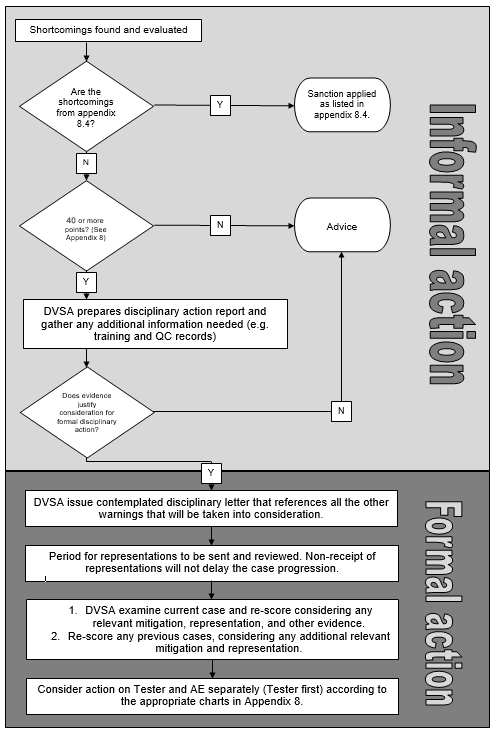
Y= Yes N= No
Cessation may be implemented with immediate effect, without DVSA first issuing the normal contemplated disciplinary letter or considering any representation in a few very serious cases that DVSA sees as representing a very significant risk to road safety or the integrity of the MOT service.
Section M
System rules and user roles
The facilities and security needed to carry out MOT testing, signs and notices, maintaining and calibrating testing equipment, documentation, IT and associated equipment, the MOT security code.
2. Sign and notices
The three triangles MOT sign detailed in ‘The Traffic Signs Regulations and General Directions 2016, Schedule 11, diagram 864’ must be displayed in a prominent position, no part higher than 4.5m from the ground and no more than one sign on each road frontage.
The business trading name as described within either the Companies Act 2006 or the Company, Limited Liability Partnership and Business (Names and Trading Disclosures) Regulations 2015 is displayed conspicuously and legibly.
3. Notice board
A notice board must be installed with a protective transparent covering which must be positioned inside the vehicle testing station so that DVSA notices can be easily read by any persons intending to or submitting vehicles for test.
The MOT notice board must not be obscured or be inaccessible and must be of sufficient size to accommodate at least one A3 fees poster (landscape) and one certificate of authorisation (A4 portrait) and must not be used for any other purpose other than official DVSA MOT notices and company public liability insurance and certificates of incorporation.
If the notice board displays both MOT and business documents, there must be clear and distinct separation between the MOT documents and any documents not related to MOT testing.
All authorised examiners (AEs) must also display:
- the certificate of authorisation (VT9) issued by DVSA
- the current fees and appeals poster (form VT9A) showing vehicle classes, test fees and appeals procedure and the details of how to contact DVSA
The current fees and appeals poster may be displayed adjacent to the ‘official’ notice board if it will not fit on the notice board proper. Additional copies of this poster can be obtained online.
4. Equipment calibration
The MOT list of acceptable equipment lists the various makes and models of test equipment that have a measuring capability, such as headlamp aim testers and brake testers. The suitability of other test equipment is individually assessed at each VTS.
Find MOT equipment approved by DVSA.
Equipment maintenance, calibration and records
All testing equipment must be kept in good order and measuring apparatus must be calibrated regularly in accordance with DVSA’s requirements. In all cases calibration records must be kept for a minimum of two years.
In the case where the serial number of the equipment cannot be found the VTS should make up a number, which identifies the equipment, and mark the equipment accordingly. Where a VTS uses an item of test equipment that is awaiting approval, the AE should contact DVSA for advice.
The AE is required to ensure that calibrations are carried out when required. For roller brake testers (RBTs), plate brake testers (PBTs), automated test lane (ATL) weighing facility, motorcycle weighing equipment (where applicable) and headlamp aim testers, the calibration expiry date will be taken as the month end date. For example, a certificate showing an expiry date of 15 July 2024 will be taken as 31 July 2024. See Roller and plate brake testers, ATL and motorcycle weighing facilities, and headlamp aim testers’
RBTs, PBTs, weighing equipment and headlamp aim testers can be calibrated anytime during the six months following its last date of calibration. The equipment is then considered calibrated until the end of the 6th month.
Test equipment must be calibrated and maintained in accordance with DVSA’s requirements. AEs must ensure maintenance and calibration appointments are arranged and carried out in a timely manner to prevent these becoming overdue.
If an item of mandatory test equipment is not re-calibrated – or, in the case of ATL or OPTL steering and suspension play detectors, not inspected – by its due date, then testing which uses that item must stop until the equipment has been recalibrated or inspected.
Testing must also stop if any mandatory item malfunctions in a way that could prevent a test being properly conducted. Testing must not be resumed until the equipment has been properly repaired. If equipment fails during a test but before its use has been completed, the test must be aborted and any fee paid returned.
Maintenance periods
All equipment must be maintained in good working order at all times.
In the case of ATL or one person test lane (OPTL), maintenance periods for steering and suspension play detectors is a minimum of:
- 6 months for pneumatic equipment
- 12 months for hydraulic equipment
Maintenance must be conducted by the manufacturer, manufacturer’s agent, a suitably qualified maintenance engineer or calibration specialist and a maintenance report issued detailing any remedial work conducted.
A signed and dated declaration that the equipment is in good working order must be issued after the maintenance has been completed.
Portable appliance testing
Under Health and Safety legislation (including the Health and Safety at Work Act 1974, the Electricity at Work Regulations 1989 and the Provision and Use of Work Equipment Regulations 1998), employers are responsible for the inspecting and testing of all types of electrical equipment in all work situations.
Among other things, the Provision and Use of Work Equipment Regulations require that equipment provided for use at work is safe, maintained in a safe condition and, in certain circumstances, inspected to ensure this remains the case.
In particular, the Electricity at Work Regulations place a legal responsibility on employers and employees to comply with the provisions of the regulations and take reasonable steps to ensure that no danger results from the use of electrical equipment.
It is therefore the responsibility of AEs to ensure that all electrical equipment used on their premises, has been tested to ensure that it poses no risk to health and safety.
Frequency and location of calibration
Equipment should be calibrated as follows.
Exhaust gas analysers
The user should make a daily leak check on the hose and probe. Most machines have an automatic facility for doing this. If not, a physical check of the hose and probe must be carried out to confirm that there are no leaks.
Depending on the make or type, exhaust gas analysers must be calibrated every 3, 6 or 12 months. This must be carried out according to the approved procedure by a recognised calibration technician only. An exhaust gas analyser must be calibrated with a certified calibration gas and when the ambient temperature is above 5°C.
Gas analysers cannot be properly calibrated if the mains AC voltage is less than 204V or more than 264V.
Roller brake testers, plate brake testers, ATL and motorcycle weighing facilities, headlamp aim testers
RBTs, PBTs, ATL and motorcycle weighing facilities, and headlamp aim testers can be calibrated anytime during the six months following its last date of calibration. The equipment is then considered calibrated until the end of the 6th month. Where the calibration certificate only states the month and year of expiry, the last day of that month should be taken as the calibration expiry date.
The requirement for motorcycle weighing equipment to be calibrated only applies to sites approved to the November 2009 Requirements for Authorisation.
Decelerometers
Decelerometers calibrated prior to 1 April 2023 must be calibrated at intervals not exceeding 2 years.
From 1 April 2023 decelerometers must be calibrated at intervals not exceeding 1 year.
Decelerometers may only be calibrated by:
- the manufacturer
- a calibrator accredited by the United Kingdom Accreditation Service (UKAS)
Salter brake testers
From 1 April 2023, calibration of Salter brake testers will no longer be acceptable if completed by vehicle testing station (VTS) staff.
Salter brake testers must be calibrated at intervals not exceeding 2 years.
Salter meters can be done by:
- the manufacturer’s local depot if available
- a firm that has taken over responsibility for equipment support from the manufacturer
- a calibration specialist
- a local trading standards office
Tyre tread depth gauges
Tyre tread depth gauges require a periodic accuracy check at least every 6 months. This can be done by placing the base foot onto a flat surface, such as a window glass, and checking that the zero datum’s align.
AEs are to keep a separate record showing the date of the accuracy check.
Diesel smoke meters
Diesel smoke meters should be checked by the user every week.
They should be calibrated every 12 months by a technician accredited by UKAS.
Calibration personnel
Equipment may be calibrated on site only by the following personnel.
Exhaust gas analysers and diesel smoke meters
Exhaust gas analysers and diesel smoke meters should be calibrated by a technician accredited by UKAS. There are two exceptions:
-
equipment (non-catalyst or catalyst) with an approved automatic monthly self-gassing facility requires a 12 monthly UKAS calibration with monthly calibrations which may be performed by VTS staff
-
non-catalyst OIML Class 1 equipment with an approved self-gassing facility requires a 6 monthly UKAS calibration with an intermediate calibration which may be performed by VTS staff
Roller brake testers, plate brake testers and headlamp aim testers
From 1 April 2023, calibration of brake testers and headlamp testers will no longer be acceptable if completed by vehicle testing station (VTS) staff.
RBTs, PBTs and headlamp aim testers must be calibrated by either:
- the original manufacturer
- firm that has taken over responsibility for equipment support from the manufacturer
- a calibration specialist
ATL and motorcycle weighing facilities
From 1 April 2023, calibration of ATL and motorcycle weighing facilities will no longer be acceptable if completed by vehicle testing station (VTS) staff.
ATL and motorcycle weighing facilities should be calibrated by either:
- the original manufacturer
- a company which has taken over responsibility for equipment support from the manufacturer
- a calibration specialist
Calibration is only required for motorcycle weighing facilities for sites approved to the November 2009 Requirements for Authorisation.
Independent calibrators
VTSs employing calibration specialists must satisfy themselves of the technical competence and viability of the company concerned and be able to demonstrate this to DVSA upon request. .
Documentation
In cases where a VTS employs either the manufacturer or a calibration specialist, there must be a written contract and the test station must obtain a certificate for each calibration.
5. Calibration certificates
All certificates must contain:
- a certificate serial number
- details of the equipment, including make, model and serial number
- title and address of calibration company or agency
- signature of calibrator and date of calibration
- smoke meter and gas analyser calibration certificates shall meet the UKAS and DVSA standard agreed
Calibration certificates must include a record of the test load, gauge readings and percentage error. Calibration results may be recorded in kgf or the equivalent in imperial lbs.
Retention
Calibration records must be readily retrievable and be kept for a minimum of two years. Calibration records may be retained digitally or as a hardcopy.
Exhaust gas analysers certificates
Calibration certificates for exhaust gas analysers are normally valid for 3, 6 or 12 months from the date of issue. However, if the certificate is issued no more than 14 days before the expiry of an existing certificate, then the expiry date may be 3, 6 or 12 months from the date of expiry of the old certificate.
Roller brake tester and plate brake tester certificates
Certificates for RBTs and PBTs must include a record of the test load, gauge readings and percentage error. The following limits apply in both forward and reverse operation as applicable.
Some older roller brake testers were approved to different calibration values to those listed. To accept any different values, evidence must have been supplied in the manufacturer’s original operating instructions.
Minimum values for roller brake testers
The minimum values for roller brake testers are as follows.
Class 1 and 2
If approved before 1 July 1996, the minimum values are:
- 30kgf (66lb)
- 100kgf (220lb)
- 200kgf (440lb)
If approved from 1 July 1996 onwards, the minimum values are:
- 0
- 50kgf (110lb)
- 100kgf (220lb)
- 200kgf (440lb)
- 300kgf (660lb)
Class 3 and 4
If approved before 1 July 1996, the minimum values are:
- 100kgf (220lb)
- 200kgf (440lb)
- 400kgf (880lb)
- 500kgf (1100lb)
If approved from 1 July 1996 onwards, the minimum values are:
- 0
- 100 kgf (220lb)
- 200 kgf (440lb)
- 400 kgf (880lb)
- 600kgf to 800kgf (1320kgf to 1760lb)
Class 5 (all equipment)
For low range, the minimum values are:
- 0
- 100kgf (200lb)
- 200kgf (440lb)
- 400kgf (880lb)
- 600kgf to 800kgf (1320lb to 1760lb)
For high range, the minimum values are:
- 0
- 1200kgf to 1500kgf (2640lb to 3300lb)
- 2000kgf to 2500kgf (4400lb to 5500lb)
- 3500kgf to 4000kgf (7700lb to 8800lb)
Class 7 (all equipment)
The minimum values are:
- 0
- 200kgf (440lb)
- 400kgf (880lb)
- 600kgf to 800kgf (1320lb to 1760lb)
- 1200kgf to 1500kgf (2640lb to 3300lb)
Minimum values for plate brake testers
The minimum values for plate brake testers are as follows.
Class 1 and 2 (all equipment)
The minimum values are:
- 0
- 30kgf (66lb)
- 100kgf (220lb)
- 200kgf (440lb)
Class 3 and 4 all equipment
The minimum values are:
- 0
- 30kgf (66lb)
- 100kgf (220lb)
- 200kgf (440lb)
- 600kgf (1320lb)
Class 7 all equipment
The minimum values are:
- 0
- 100kgf (200lb)
- 200kgf (440lb)
- 600kgf (1320lb)
- 1000kgf (2200lb)
Accuracy of brake force readings
Brake force readings shall be accurate to within:
Calibration certificates for brake testers are to contain the following (or similar) statement: “This is to certify that the above brake test equipment has been calibrated and is within the limits specified by DVSA”.
ATL weighing facility
Certificates must include a record of the test load, gauge readings and percentage error.
Accuracy to within +/- 3% between 200kg and 3000kg imposed weight traceable to an acceptable quality standard.
Calibration certificates for brake testers and ATL weighing facility are to contain the following (or similar) statement: “This is to certify that the above brake test equipment has been calibrated and is within the limits specified by DVSA”.
Headlamp aim testers
Calibration certificates for headlamp aim testers are to contain the following (or similar) statement: “This is to certify that the above headlamp aim testing equipment has been checked and is in correct alignment with the vehicle standing area”.
Diesel smoke meter
Smoke meters are to be calibrated every 12 months. Calibration certificates are normally valid for 12 months from the date of issue. However, if the certificate is issued no more than one month before the expiry of an existing certificate then the expiry date may be 12 months from the expiry of the old certificate.
A new diesel smoke meter should be supplied with an initial calibration certificate in one of two forms.
It may have a certificate of conformity issued by a BSI/ISO registered company, the meter will have been calibrated as a part of the in-house quality control procedure. It will carry the BSI and/or ISO logos, and will be dated. Within six months of the issue of a Certificate of Conformity a new meter must be calibrated by a UKAS accredited engineer.
You may find that some new smoke meters have very little time left to run with this type of certificate when delivered.
Alternatively, it may have a UKAS calibration certificate issued immediately prior to or following delivery by a UKAS Accredited Engineer. Like all other UKAS issued calibration certificates on diesel smoke meters a new meter must be calibrated by a UKAS Accredited Engineer within twelve months of the issue of this certificate.
If you have any questions regarding the certification of a smoke meter, contact the manufacturer or their agent.
Motorcycle weighing facility
Certificates must include a record of the test load, gauge readings and percentage error.
Accuracy should be within +/- 3%.
Calibration certificates for weighing facility are to contain the following (or similar) statement: “This is to certify that the above weighing facility has been calibrated and is within the limits specified by DVSA”.
6. MOT testing service IT and associated equipment
Authorised examiners are responsible for the supply and maintenance of all IT equipment and internet connection used for MOT testing purposes.
PC, iMac and Laptops
The MOT testing service is designed to run on most recent Windows and Mac OS computers and laptops with:
- a 1GHz processor
- 512MB system memory
- 20GB hard drive space
- 1024 by 768 screen resolution or above
- a network cable socket (RJ45) or Wi-Fi
MOT testing service is designed to run on any tablet with screen sizes of 9 inches and above (measured diagonally across the screen).
MOT testing service works on internet connections of 0.5Mbps (512 Kbps) and above.
The internet connection may be via fixed line, 3G, 4G, 5G or satellite.
Browser requirements
A suitable browser is required to view MOT testing service website. One of the following browsers will need to be installed on your device to use MOT Testing Service:
- Chrome (latest version) - supplied by Google and can be used on either Windows, MacOS, iOS and Android
- Firefox (latest version) - supplied by Mozilla and can be used on either Windows or MacOS
- Edge (latest versions) - supplied by Microsoft with its latest IT equipment
- Safari 12 and later - supplied by Apple with its latest IT equipment
- Safari for iOS 12.1 and later - supplied by Apple with its latest mobile equipment
- Samsung Internet (latest version) - can be used on Android operating systems
Printer requirements
An A4 black and white printer is required to print MOT certificates and other documents from the MOT testing service.
All printer consumables, such as paper and ink, are provided by the AE/VTS.
MOT security code
All MOT testing service users with a role assigned to their MOT testing service profile need to enter a security code when signing into MOT testing service. Security codes generated by authentication app will normally only be required once a day if the sign in details remain the same. MTS users who sign in using an email address will be required to authenticate each time they sign in, rather than just once per day.
The 6 digit security code is generated by either:
Authentication app
Users will use an authentication app installed on their personal smart phone or tablet. This app will be linked to their MOT testing service profile. The app automatically generates the security code and is entered into MOT testing service when required as part of the sign in process
Email
MOT testing service will send a security code to the users unique email address recorded on their MOT testing service profile. A new code is sent when required and is entered as part of the sign in process
7. Complaints about the MOT testing service
Complaints concerning MOT testing service should be made in the first instance via the MOT testing service desk. If the complaint is not resolved the AE should contact the DVSA customer service centre.
Contact DVSA service desk
Contact DVSA customer service centre
Section N
MOT contingency testing procedures
Contingency procedures for MOT testing, completing contingency test certificates, contingency testing catch ups, issuing duplicate and replacement contingency testing certificates.
1. Carrying out MOT contingency testing
When the MOT testing service is not available, users must follow contingency procedures in order that MOT testing can continue and customers are able to receive relevant documentation. MOT central records can be updated later with test details.
Contingency test (CT) procedures will be invoked by the MOT testing service desk when the MOT testing service is not available due to an authorised outage.
An authorised outage is defined as:
CT must not be used when IT equipment or services at a vehicle testing station (VTS) stops working. This includes:
-
IT equipment
-
internet connection
-
printers
Authorised examiners (AEs) are responsible for repair of this equipment or service and MOT testing must stop until the fault has been rectified.
During CT, test documents are handwritten without contacting the MOT testing service desk.
When normal service resumes all tests carried out under CT conditions must be input onto MOT central records.
Testers must attempt a normal registration on MOT testing service every occasion before starting a new test.
Authorising contingency testing
Users who experience a problem accessing MOT testing service should first check the service status page.
This page will advise on any problems with the service and if appropriate may display the contingency testing code.
If the status page says the service is running normally and you are still experiencing problems, contact the DVSA service desk.
If an automated message deals with the problem please do not continue with the call, there is no need to speak with an operator.
Contact DVSA service desk
Where VTSs are unable to contact the DVSA service desk, they should phone the DVSA customer service centre.
Contact DVSA customer service centre
Contingency testing incident code
The code will be used to validate any MOT documentation issued during the period of the CT.
VTSs must not test using CT procedures without a valid incident code.
A contingency code will last for one day, in the event of multiple authorised outages the same code will be used however; a new code is required for each new day an authorised outage lasts.
The fault tracking incident number issued by the DVSA business service desk during the reporting of a fault is not the same as a CT incident code and must not be entered on any MOT documentation.
2. Contingency testing documentation
Before any CT test is started the VTS must have the required test documentation that may be necessary to complete the test.
Backdating a test record or certificate or carrying out an MOT test without issuing the proper document may lead to formal disciplinary action being taken.
The documents are automatically filled in with the VTS name, number and address for security purposes.
VTSs must download from the MOT testing service (MTS) at least one copy of each:
Copies may be saved on a PC or tablet and printed when needed and/or hard copies may be kept and photocopied as required.
The MOT inspection checklist (VT29/VT29M) will also be required during CT.
Vehicle registration process during contingency testing
When registering a test in contingency the tester must collect all the following information using a VT29/VT29M.
Additional information required during CT should be recorded on the blank reverse side of the form:
When all of the above vehicle information has been obtained, a test may commence as appropriate and the VT29/VT29M is used in the normal way to record the test result. The tester must record defects including their severity, any advisory items and brake test readings.
Recording the vehicle registration mark (VRM)
The registration mark entered on the VT29/VT29M must be that actually carried by the vehicle at the time of test using only standard alpha numeric format.
If both military and civilian marks are displayed the civilian mark is to be used.
If the vehicle does not display a registration mark, ‘NOT DISPLAYED’ must be written in this section.
If a non-UK registration mark is displayed, that should still be entered in this section.
Recording the vehicle identification number (VIN), chassis number or frame number, where present
The full VIN, chassis or frame number must be entered onto the VT29/VT29M.
Write ‘NOT FOUND’ if a VIN, chassis or frame number is:
- not required due to the age of the vehicle
- cannot be found
- unreadable
If the VIN is less than the standard 17 characters it is not necessary to add or repeat digits in order to make the VIN/chassis entry 17 characters in length.
Storage requirements for contingency testing certificates
AEs are responsible for ensuring that blank MOT CT certificates are not accessible at any time to unauthorised persons.
Copies of all issued documents must be retained as specified in Section H. Retention of documentation.
Completing contingency testing documents
At the end of a test or re-test, the appropriate CT documentation must be completed and issued to the vehicle presenter.
All CT documents must be handwritten using a ballpoint pen. Entries on test certificates must be written clearly and firmly to ensure that any subsequent attempt to alter them will be obvious. Any box that is not used must be clearly marked as not applicable (‘N/A’).
Documents showing errors or alterations must not be issued. All alterations or errors must be clearly marked as ‘cancelled’ however; there is no requirement to retain the cancelled document.
A second copy of all CT20 and CT30 certificates issued during CT must be retained by the VTS.
CT20 test certificate
See Filling in a CT20 certificate.
CT30 - contingency refusal of an MOT test certificate (CT30)
The CT30 must be issued to notify the vehicle presenter of any defects.
See Filling in a CT30 certificate.
MOT inspection check list - VT29/29M
When testing in CT, testers must use this form to record vehicle details and any identified defects.
This must include the defect severity (dangerous, major or minor) and any advisories with sufficient detail to aid the completion of CT documents and accurate data entry during CT catch up.
The VT29/29M must be retained as specified in Section H. Retention of documentation).
Where a vehicle undergoes a partial re-test, the following details must be recorded against the original VT29 for the re-test:
This form is available to print from the MOT testing service or from GOV.UK.
It may also be used to record any advisory items found.
Emissions records
Relevant emissions records are to be treated in the normal way and must be retained for 3 months following the requirement of Section H. Retention of documentation of this guide.
Refusal to test
A hand completed CT30 should be issued to any vehicle presenter who requests written confirmation of the reason why the tester has refused to test their vehicle. This CT30 must be handwritten ballpoint pen.
No copy of this CT30 needs to be retained as it is not recorded on MOT central records. See Section B5. Testing responsibilities and Appendix 3: Grounds for refusal of this guide for the reasons why a tester may refuse to test a vehicle.
3. Filling in a CT20 certificate
You must complete the following sections of the CT20 test certificate.
Contingency MOT test number
This is the 8-digit alpha numeric number (contingency code) supplied by the DVSA service desk.
Registration mark
This should be copied from the vehicle.
VIN or chassis/frame number
This should be either:
- the full VIN/chassis/frame as quoted
- ‘NOT FOUND’
EU classification
The EU classifications with their vehicle descriptions can be found in the Introduction.
Country of registration
This is the country in which the vehicle was registered.
Odometer reading
This should be the odometer reading displayed at the time of test. Units (‘miles’ or ‘km’) must be entered.
If no odometer reading is displayed, ‘NOT DISPLAYED’ should be written in this section.
There is no requirement to record the odometer reading history.
Method of writing dates and times
The months of issue and expiry of a test certificate must always be put first followed by the day and year. No space must be left in which figures can be inserted.
Two numbers must always be used in the day of the month. The last 2 figures of the year must also be entered in words to prevent alteration. For example, May 01st 2016 Sixteen.
The time should be shown using the 24-hour clock. For example, 2:40pm should be shown as 14:40.
Expiry date of certificate
The CT20 certificate expiry date must only be 12 months less one day from the date of the test itself irrespective of whether a current test certificate still has time to run or it is an early first test.
When the service is restored, the odometer reading history and any additional time due as a result of permitted early testing will be added automatically to the test record and included on the exchange certificate.
Minor defects and advisories
Record all minor defects and any advisories, numbered sequentially. Defect descriptions must reflect the wording that would be printed if the system was operating normally in order that the information produced on exchange documents after catch up matches the handwritten version produced under CT.
If there is insufficient room then continue on another CT20. Where more than one sheet is required then each should be numbered at the bottom of the page. For example, 1 of 2, 2 of 2.
4. Filling in a CT30 certificate
You must complete the following sections of the CT30 test certificate.
CT number and vehicle details
The CT30 must clearly show the CT incident code and the required vehicle details as described for the CT20.
Defects
Record all defects, including the defect severity (dangerous, major or minor) and any advisories, numbered sequentially. Defect descriptions recorded must reflect the wording that would be printed if the system was operating normally in order that the information produced on exchange documents after catch up matches the handwritten version produced under CT.
If there is insufficient room then continue on another CT30. Where more than one sheet is required then each should be numbered at the bottom of the page - 1 of 2, 2 of 2.
Re-tests
Where a vehicle fails a re-test a new CT30 must be completed. Copies of all CT30 refusal notices must be retained as specified (see Section H. Retention of documentation).
5. Carrying out a contingency testing catch up
Catch up is the process for entering CT test result details onto MOT central records.
Catch up must be completed as soon as the service becomes available again.
Only the original test details are entered, duplicates are not recorded. If, as a result of an error on a CT certificate, a replacement CT certificate has been issued before the test has been caught up, the details entered at catch up should be those shown on the replacement certificate including the time and date of the actual test.
After normal service has been resumed, VTSs must ensure that all CT tests carried out have been entered onto MOT central records.
In order to check this, site managers must view or print off the VTS test log and compare this with the test documentation issued during CT.
Once site managers (SMs) are satisfied that this has been correctly done, CT documentation should be retained as specified in Section H. Retention of documentation.
If any outstanding CT tests come to light, these tests must be caught up immediately.
Testers are required to perform catch up for their own tests however another tester at the same VTS may under exceptional circumstances perform catch up tests on behalf of other testers.
Any tester entering results on behalf of another tester should choose ‘other’ on the contingency result entry screen and record the following in the ‘reasons’ box:
Incomplete tests prior to contingency testing
If you have registered a test but not completed entering the results when the system fails, when the system returns to normal the incomplete test will still be present. Continue as follows:
-
if the date is the same date as when the test was started this test record may be completed by entering the test results etc as noted on contingency paperwork before performing catch up
-
if the date is different this test record must be aborted and the test record created via catch up procedures
Errors noted during catch up
In some circumstances an error on a CT certificate may be noted at catch up, for example in trying to match with previous test records you may spot that you have transposed the characters in the VIN. If this happens, record the correct information on the VTS copy of the CT document issued and use the details you now know to be correct to perform catch up.
VTS test log
When the SM considers that all CT tests have been recorded onto MOT central records (catch up) SMs must view or print off the VTS test log. This will enable the SM to check and ensure all tests carried out under CT conditions have been recorded onto MOT testing service.
Exchange CT test documentation
Test documentation issued under CT must be exchanged for printed versions at the original VTS if requested. No charge can be made for this service. The required exchange documents should be produced using the ‘Issue Duplicate Test Documents’ process.
The original test details recorded during CT must be recorded on MOT central records, using catch up, before exchange documents can be printed.
Any returned hand-written test documentation must be retained by the VTS. CT certificates must be marked ‘exchanged’ and stapled to the corresponding copy CT documentation where available.
Changes in testing staff for contingency testing
During any CT incident it will not be possible to appoint and remove testers using the MOT testing service. In such circumstances the DVSA customer service centre must be notified in writing of the full name and user ID of any tester being appointed or removed.
As DVSA may not have access to MOT testing service either, the previous VTS of any incoming tester must be recorded along with the approximate date as to when they last tested.
When the CT incident has ended the VTS must assign the testing role to the tester before the tester will be able to be carried out computerised testing at the VTS and perform catch up of any CT tests that they had carried out.
6.Amending test records and issuing duplicate and replacement certificates when contingency testing
The procedures for producing duplicate certificates, amending test records and issuing replacement certificates vary depending upon:
- the time of the original test
- when the duplicate or test record amendment was requested
| Original test |
When duplicate or replacement requested |
What to do |
| Before the CT incident |
During the CT incident |
Do not use a CT certificate. More information on what to do. |
|
CT test |
During the CT incident |
Complete a duplicate or replacement for a CT certificate by hand. More information on what to do. |
|
CT test |
After CT but before catch up |
Enter the details that match the replacement CT certificate as a normal test before issuing a computerised certificate. More information on what to do. |
|
CT test |
After CT and catch up |
Follow normal duplicate and replacement procedures. More information on what to do. |
If the test was before the CT incident and they request a duplicate certificate, a test record amendment or replacement certificate during the incident
CT certificates must not be used to provide duplicates or replacements of certificates that have already been recorded on MOT testing service.
Test records cannot be amended during CT.
The situation should be explained to the applicant and they should be advised that a computerised document can be produced as soon as the system returns to normal. If the applicant is not satisfied with this response they should be advised to contact the DVSA customer service centre shown on the VT9A fees and appeals poster.
If the test was a CT test and they request a duplicate, a test record amendment or replacement certificate during the incident
A duplicate or replacement for a CT certificate must be completed by hand onto a normal CT certificate.
It must include the additional information. A copy of the replacement certificate must then be attached to the original CT paperwork.
When performing catch up duplicate certificates are not required to be recorded and the original CT certificate should be recorded as normal.
For replacement certificates, the original CT certificate should be marked ‘cancelled’ and the reason for the replacement must be clearly marked. The cancelled certificate must then be attached the original CT paperwork.
When performing catch up enter the new details recorded on the replacement certificate as a normal test.
A duplicate of a CT certificate can only be produced at the VTS who carried out the test but can be completed by any tester at that VTS; the producer must add their signature to the ‘issuer’s signature’ box.
The maximum fee for the duplicate certificate should be that shown on the latest MOT fees poster.
Amendments to the test record and its accompanying replacement certificate must only be issued by a tester, preferably the tester who carried out the original test. The tester must be satisfied that the amendments required are correct and refer to the vehicle that was actually tested.
Test record amendments and replacement certificates are issued free of charge.
If the test was a CT test and they request a duplicate certificate, a test record amendment or replacement certificate after the incident but before a catch up
In the case of a duplicate certificate, where the CT incident is over, but catch up has not yet been carried out, the tester must perform catch up before a computerised duplicate can be issued.
In the case of a replacement certificate, where the CT incident is over, but catch up has not yet been carried out, the tester must be satisfied that the amendments required are correct and refer to the vehicle that was actually tested.
The VTS copy of the CT certificate should be marked with the correct information and where available to customer copy must be retained with the VTS CT paperwork.
The tester must perform catch up entering the details that match the replacement CT certificate as a normal test before a computerised certificate can be issued.
If the test was a CT test and they request a duplicate or replacement certificate after the incident and a catch up
Normal duplicate and replacement procedures apply. See Section H4. Forms.
7. Examples of contingency testing documentation
Example 1 - CT20 contingency test pass certificate
CT certificates are handwritten, using indelible ink, during CT.
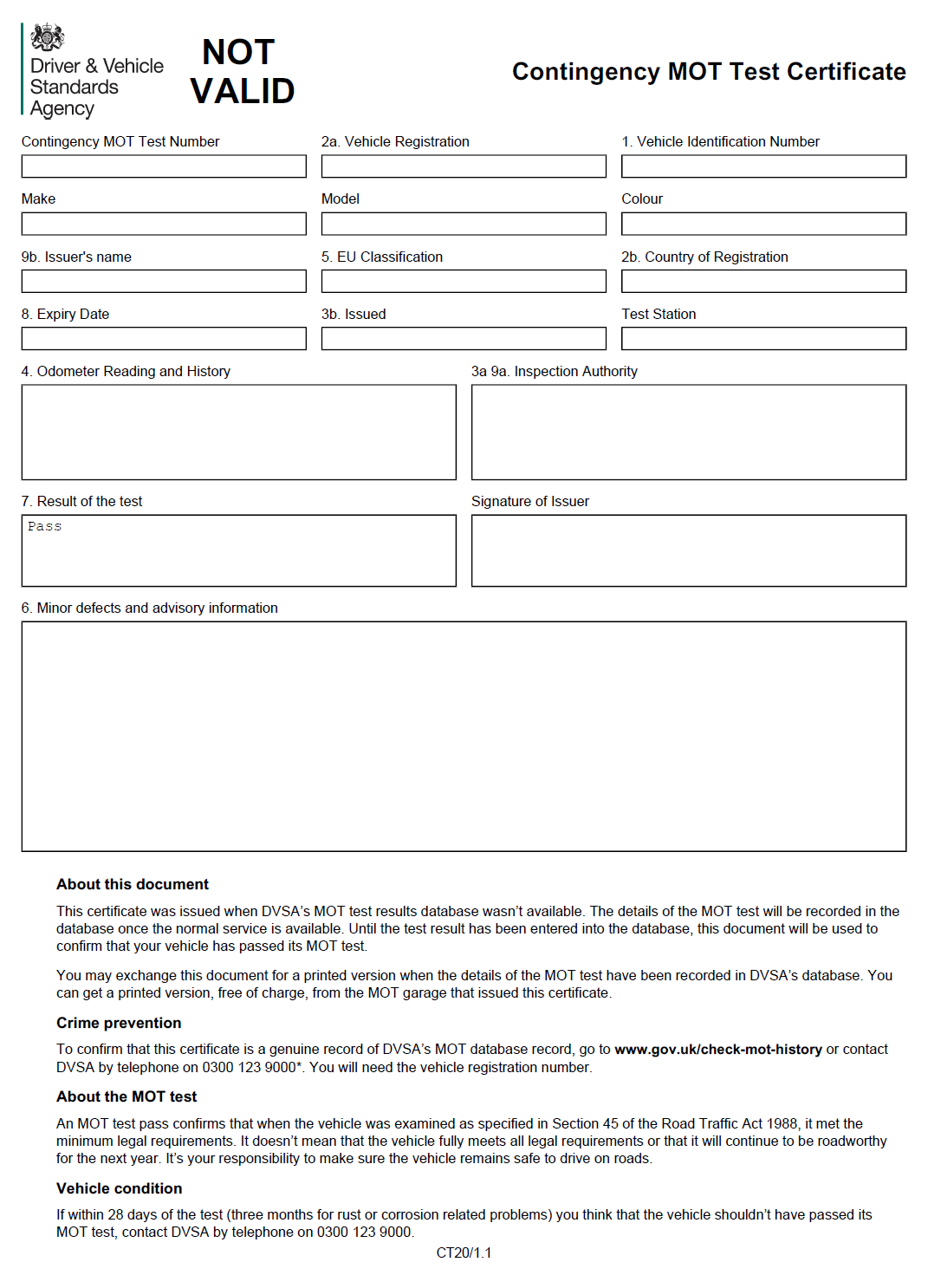
Example 2 - CT30 contingency refusal of an MOT test certificate
CT certificates are handwritten, using indelible ink, during CT.
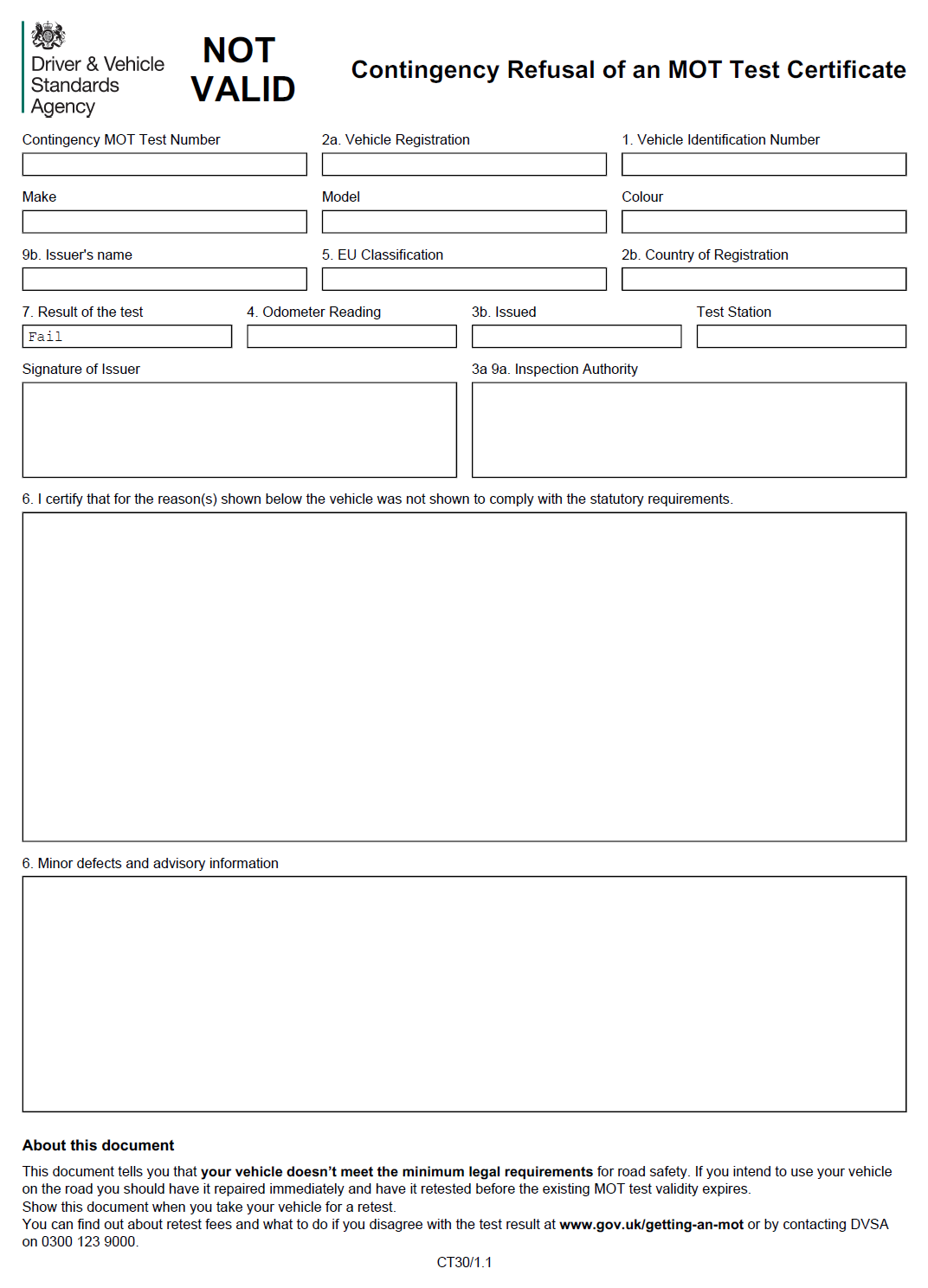
Appendix 2
Facilities and security
The facilities and security needed to carry out MOT testing, signs and notices, maintaining and calibrating testing equipment, documentation, IT and associated equipment, the MOT security code.
2. Sign and notices
The three triangles MOT sign detailed in ‘The Traffic Signs Regulations and General Directions 2016, Schedule 11, diagram 864’ must be displayed in a prominent position, no part higher than 4.5m from the ground and no more than one sign on each road frontage.
The business trading name as described within either the Companies Act 2006 or the Company, Limited Liability Partnership and Business (Names and Trading Disclosures) Regulations 2015 is displayed conspicuously and legibly.
3. Notice board
A notice board must be installed with a protective transparent covering which must be positioned inside the vehicle testing station so that DVSA notices can be easily read by any persons intending to or submitting vehicles for test.
The MOT notice board must not be obscured or be inaccessible and must be of sufficient size to accommodate at least one A3 fees poster (landscape) and one certificate of authorisation (A4 portrait) and must not be used for any other purpose other than official DVSA MOT notices and company public liability insurance and certificates of incorporation.
If the notice board displays both MOT and business documents, there must be clear and distinct separation between the MOT documents and any documents not related to MOT testing.
All authorised examiners (AEs) must also display:
- the certificate of authorisation (VT9) issued by DVSA
- the current fees and appeals poster (form VT9A) showing vehicle classes, test fees and appeals procedure and the details of how to contact DVSA
The current fees and appeals poster may be displayed adjacent to the ‘official’ notice board if it will not fit on the notice board proper. Additional copies of this poster can be obtained online.
4. Equipment calibration
The MOT list of acceptable equipment lists the various makes and models of test equipment that have a measuring capability, such as headlamp aim testers and brake testers. The suitability of other test equipment is individually assessed at each VTS.
Find MOT equipment approved by DVSA.
Equipment maintenance, calibration and records
All testing equipment must be kept in good order and measuring apparatus must be calibrated regularly in accordance with DVSA’s requirements. In all cases calibration records must be kept for a minimum of two years.
In the case where the serial number of the equipment cannot be found the VTS should make up a number, which identifies the equipment, and mark the equipment accordingly. Where a VTS uses an item of test equipment that is awaiting approval, the AE should contact DVSA for advice.
The AE is required to ensure that calibrations are carried out when required. For roller brake testers (RBTs), plate brake testers (PBTs), automated test lane (ATL) weighing facility, motorcycle weighing equipment (where applicable) and headlamp aim testers, the calibration expiry date will be taken as the month end date. For example, a certificate showing an expiry date of 15 July 2024 will be taken as 31 July 2024. See Roller and plate brake testers, ATL and motorcycle weighing facilities, and headlamp aim testers’
RBTs, PBTs, weighing equipment and headlamp aim testers can be calibrated anytime during the six months following its last date of calibration. The equipment is then considered calibrated until the end of the 6th month.
Test equipment must be calibrated and maintained in accordance with DVSA’s requirements. AEs must ensure maintenance and calibration appointments are arranged and carried out in a timely manner to prevent these becoming overdue.
If an item of mandatory test equipment is not re-calibrated – or, in the case of ATL or OPTL steering and suspension play detectors, not inspected – by its due date, then testing which uses that item must stop until the equipment has been recalibrated or inspected.
Testing must also stop if any mandatory item malfunctions in a way that could prevent a test being properly conducted. Testing must not be resumed until the equipment has been properly repaired. If equipment fails during a test but before its use has been completed, the test must be aborted and any fee paid returned.
Maintenance periods
All equipment must be maintained in good working order at all times.
In the case of ATL or one person test lane (OPTL), maintenance periods for steering and suspension play detectors is a minimum of:
- 6 months for pneumatic equipment
- 12 months for hydraulic equipment
Maintenance must be conducted by the manufacturer, manufacturer’s agent, a suitably qualified maintenance engineer or calibration specialist and a maintenance report issued detailing any remedial work conducted.
A signed and dated declaration that the equipment is in good working order must be issued after the maintenance has been completed.
Portable appliance testing
Under Health and Safety legislation (including the Health and Safety at Work Act 1974, the Electricity at Work Regulations 1989 and the Provision and Use of Work Equipment Regulations 1998), employers are responsible for the inspecting and testing of all types of electrical equipment in all work situations.
Among other things, the Provision and Use of Work Equipment Regulations require that equipment provided for use at work is safe, maintained in a safe condition and, in certain circumstances, inspected to ensure this remains the case.
In particular, the Electricity at Work Regulations place a legal responsibility on employers and employees to comply with the provisions of the regulations and take reasonable steps to ensure that no danger results from the use of electrical equipment.
It is therefore the responsibility of AEs to ensure that all electrical equipment used on their premises, has been tested to ensure that it poses no risk to health and safety.
Frequency and location of calibration
Equipment should be calibrated as follows.
Exhaust gas analysers
The user should make a daily leak check on the hose and probe. Most machines have an automatic facility for doing this. If not, a physical check of the hose and probe must be carried out to confirm that there are no leaks.
Depending on the make or type, exhaust gas analysers must be calibrated every 3, 6 or 12 months. This must be carried out according to the approved procedure by a recognised calibration technician only. An exhaust gas analyser must be calibrated with a certified calibration gas and when the ambient temperature is above 5°C.
Gas analysers cannot be properly calibrated if the mains AC voltage is less than 204V or more than 264V.
Roller brake testers, plate brake testers, ATL and motorcycle weighing facilities, headlamp aim testers
RBTs, PBTs, ATL and motorcycle weighing facilities, and headlamp aim testers can be calibrated anytime during the six months following its last date of calibration. The equipment is then considered calibrated until the end of the 6th month. Where the calibration certificate only states the month and year of expiry, the last day of that month should be taken as the calibration expiry date.
The requirement for motorcycle weighing equipment to be calibrated only applies to sites approved to the November 2009 Requirements for Authorisation.
Decelerometers
Decelerometers calibrated prior to 1 April 2023 must be calibrated at intervals not exceeding 2 years.
From 1 April 2023 decelerometers must be calibrated at intervals not exceeding 1 year.
Decelerometers may only be calibrated by:
- the manufacturer
- a calibrator accredited by the United Kingdom Accreditation Service (UKAS)
Salter brake testers
From 1 April 2023, calibration of Salter brake testers will no longer be acceptable if completed by vehicle testing station (VTS) staff.
Salter brake testers must be calibrated at intervals not exceeding 2 years.
Salter meters can be done by:
- the manufacturer’s local depot if available
- a firm that has taken over responsibility for equipment support from the manufacturer
- a calibration specialist
- a local trading standards office
Tyre tread depth gauges
Tyre tread depth gauges require a periodic accuracy check at least every 6 months. This can be done by placing the base foot onto a flat surface, such as a window glass, and checking that the zero datum’s align.
AEs are to keep a separate record showing the date of the accuracy check.
Diesel smoke meters
Diesel smoke meters should be checked by the user every week.
They should be calibrated every 12 months by a technician accredited by UKAS.
Calibration personnel
Equipment may be calibrated on site only by the following personnel.
Exhaust gas analysers and diesel smoke meters
Exhaust gas analysers and diesel smoke meters should be calibrated by a technician accredited by UKAS. There are two exceptions:
-
equipment (non-catalyst or catalyst) with an approved automatic monthly self-gassing facility requires a 12 monthly UKAS calibration with monthly calibrations which may be performed by VTS staff
-
non-catalyst OIML Class 1 equipment with an approved self-gassing facility requires a 6 monthly UKAS calibration with an intermediate calibration which may be performed by VTS staff
Roller brake testers, plate brake testers and headlamp aim testers
From 1 April 2023, calibration of brake testers and headlamp testers will no longer be acceptable if completed by vehicle testing station (VTS) staff.
RBTs, PBTs and headlamp aim testers must be calibrated by either:
- the original manufacturer
- firm that has taken over responsibility for equipment support from the manufacturer
- a calibration specialist
ATL and motorcycle weighing facilities
From 1 April 2023, calibration of ATL and motorcycle weighing facilities will no longer be acceptable if completed by vehicle testing station (VTS) staff.
ATL and motorcycle weighing facilities should be calibrated by either:
- the original manufacturer
- a company which has taken over responsibility for equipment support from the manufacturer
- a calibration specialist
Calibration is only required for motorcycle weighing facilities for sites approved to the November 2009 Requirements for Authorisation.
Independent calibrators
VTSs employing calibration specialists must satisfy themselves of the technical competence and viability of the company concerned and be able to demonstrate this to DVSA upon request. .
Documentation
In cases where a VTS employs either the manufacturer or a calibration specialist, there must be a written contract and the test station must obtain a certificate for each calibration.
5. Calibration certificates
All certificates must contain:
- a certificate serial number
- details of the equipment, including make, model and serial number
- title and address of calibration company or agency
- signature of calibrator and date of calibration
- smoke meter and gas analyser calibration certificates shall meet the UKAS and DVSA standard agreed
Calibration certificates must include a record of the test load, gauge readings and percentage error. Calibration results may be recorded in kgf or the equivalent in imperial lbs.
Retention
Calibration records must be readily retrievable and be kept for a minimum of two years. Calibration records may be retained digitally or as a hardcopy.
Exhaust gas analysers certificates
Calibration certificates for exhaust gas analysers are normally valid for 3, 6 or 12 months from the date of issue. However, if the certificate is issued no more than 14 days before the expiry of an existing certificate, then the expiry date may be 3, 6 or 12 months from the date of expiry of the old certificate.
Roller brake tester and plate brake tester certificates
Certificates for RBTs and PBTs must include a record of the test load, gauge readings and percentage error. The following limits apply in both forward and reverse operation as applicable.
Some older roller brake testers were approved to different calibration values to those listed. To accept any different values, evidence must have been supplied in the manufacturer’s original operating instructions.
Minimum values for roller brake testers
The minimum values for roller brake testers are as follows.
Class 1 and 2
If approved before 1 July 1996, the minimum values are:
- 30kgf (66lb)
- 100kgf (220lb)
- 200kgf (440lb)
If approved from 1 July 1996 onwards, the minimum values are:
- 0
- 50kgf (110lb)
- 100kgf (220lb)
- 200kgf (440lb)
- 300kgf (660lb)
Class 3 and 4
If approved before 1 July 1996, the minimum values are:
- 100kgf (220lb)
- 200kgf (440lb)
- 400kgf (880lb)
- 500kgf (1100lb)
If approved from 1 July 1996 onwards, the minimum values are:
- 0
- 100 kgf (220lb)
- 200 kgf (440lb)
- 400 kgf (880lb)
- 600kgf to 800kgf (1320kgf to 1760lb)
Class 5 (all equipment)
For low range, the minimum values are:
- 0
- 100kgf (200lb)
- 200kgf (440lb)
- 400kgf (880lb)
- 600kgf to 800kgf (1320lb to 1760lb)
For high range, the minimum values are:
- 0
- 1200kgf to 1500kgf (2640lb to 3300lb)
- 2000kgf to 2500kgf (4400lb to 5500lb)
- 3500kgf to 4000kgf (7700lb to 8800lb)
Class 7 (all equipment)
The minimum values are:
- 0
- 200kgf (440lb)
- 400kgf (880lb)
- 600kgf to 800kgf (1320lb to 1760lb)
- 1200kgf to 1500kgf (2640lb to 3300lb)
Minimum values for plate brake testers
The minimum values for plate brake testers are as follows.
Class 1 and 2 (all equipment)
The minimum values are:
- 0
- 30kgf (66lb)
- 100kgf (220lb)
- 200kgf (440lb)
Class 3 and 4 all equipment
The minimum values are:
- 0
- 30kgf (66lb)
- 100kgf (220lb)
- 200kgf (440lb)
- 600kgf (1320lb)
Class 7 all equipment
The minimum values are:
- 0
- 100kgf (200lb)
- 200kgf (440lb)
- 600kgf (1320lb)
- 1000kgf (2200lb)
Accuracy of brake force readings
Brake force readings shall be accurate to within:
Calibration certificates for brake testers are to contain the following (or similar) statement: “This is to certify that the above brake test equipment has been calibrated and is within the limits specified by DVSA”.
ATL weighing facility
Certificates must include a record of the test load, gauge readings and percentage error.
Accuracy to within +/- 3% between 200kg and 3000kg imposed weight traceable to an acceptable quality standard.
Calibration certificates for brake testers and ATL weighing facility are to contain the following (or similar) statement: “This is to certify that the above brake test equipment has been calibrated and is within the limits specified by DVSA”.
Headlamp aim testers
Calibration certificates for headlamp aim testers are to contain the following (or similar) statement: “This is to certify that the above headlamp aim testing equipment has been checked and is in correct alignment with the vehicle standing area”.
Diesel smoke meter
Smoke meters are to be calibrated every 12 months. Calibration certificates are normally valid for 12 months from the date of issue. However, if the certificate is issued no more than one month before the expiry of an existing certificate then the expiry date may be 12 months from the expiry of the old certificate.
A new diesel smoke meter should be supplied with an initial calibration certificate in one of two forms.
It may have a certificate of conformity issued by a BSI/ISO registered company, the meter will have been calibrated as a part of the in-house quality control procedure. It will carry the BSI and/or ISO logos, and will be dated. Within six months of the issue of a Certificate of Conformity a new meter must be calibrated by a UKAS accredited engineer.
You may find that some new smoke meters have very little time left to run with this type of certificate when delivered.
Alternatively, it may have a UKAS calibration certificate issued immediately prior to or following delivery by a UKAS Accredited Engineer. Like all other UKAS issued calibration certificates on diesel smoke meters a new meter must be calibrated by a UKAS Accredited Engineer within twelve months of the issue of this certificate.
If you have any questions regarding the certification of a smoke meter, contact the manufacturer or their agent.
Motorcycle weighing facility
Certificates must include a record of the test load, gauge readings and percentage error.
Accuracy should be within +/- 3%.
Calibration certificates for weighing facility are to contain the following (or similar) statement: “This is to certify that the above weighing facility has been calibrated and is within the limits specified by DVSA”.
6. MOT testing service IT and associated equipment
Authorised examiners are responsible for the supply and maintenance of all IT equipment and internet connection used for MOT testing purposes.
PC, iMac and Laptops
The MOT testing service is designed to run on most recent Windows and Mac OS computers and laptops with:
- a 1GHz processor
- 512MB system memory
- 20GB hard drive space
- 1024 by 768 screen resolution or above
- a network cable socket (RJ45) or Wi-Fi
MOT testing service is designed to run on any tablet with screen sizes of 9 inches and above (measured diagonally across the screen).
MOT testing service works on internet connections of 0.5Mbps (512 Kbps) and above.
The internet connection may be via fixed line, 3G, 4G, 5G or satellite.
Browser requirements
A suitable browser is required to view MOT testing service website. One of the following browsers will need to be installed on your device to use MOT Testing Service:
- Chrome (latest version) - supplied by Google and can be used on either Windows, MacOS, iOS and Android
- Firefox (latest version) - supplied by Mozilla and can be used on either Windows or MacOS
- Edge (latest versions) - supplied by Microsoft with its latest IT equipment
- Safari 12 and later - supplied by Apple with its latest IT equipment
- Safari for iOS 12.1 and later - supplied by Apple with its latest mobile equipment
- Samsung Internet (latest version) - can be used on Android operating systems
Printer requirements
An A4 black and white printer is required to print MOT certificates and other documents from the MOT testing service.
All printer consumables, such as paper and ink, are provided by the AE/VTS.
MOT security code
All MOT testing service users with a role assigned to their MOT testing service profile need to enter a security code when signing into MOT testing service. Security codes generated by authentication app or email will be required once a day if the sign in details remain the same.
The 6 digit security code is generated by either:
Authentication app
Users will use an authentication app installed on their personal smart phone or tablet. This app will be linked to their MOT testing service profile. The app automatically generates the security code and is entered into MOT testing service when required as part of the sign in process
Email
MOT testing service will send a security code to the users unique email address recorded on their MOT testing service profile. A new code is sent when required and is entered as part of the sign in process
Security card
The card generates a new 6 digit code when pressed. A new code is required each time a user signs into MOT testing service. Card holders must not write their user ID or password on the card. Security cards are no longer issued or replaced
7. Complaints about the MOT testing service
Complaints concerning MOT testing service should be made in the first instance via the MOT testing service desk. If the complaint is not resolved the AE should contact the DVSA customer service centre.
Contact DVSA service desk
Contact DVSA customer service centre
Appendix 6
Tester training and demonstration tests
Training requirements for testers, initial MOT testing training, demonstration tests, MOT annual training for testers, keeping a training record, assessment of new and returning testers, assessment of continuing competence, arranging a demonstration test.
1. Training for testers
In addition to meeting the criteria given in Section E2. Eligibility for becoming a tester prospective testers must successfully complete:
- an initial training course that explains the processes of MOT testing and reinforces the standards set out in the relevant inspection manual
- an observed demonstration test for an officer of DVSA
Testers may be required to complete additional training and observed demonstration tests before being allowed to test vehicles in classes that they have not previously been testing.
The following indicates the circumstances in which testers and potential testers are required to attend training courses, annual or additional training and to provide practical demonstrations of their testing competence to DVSA.
Candidates to become a tester
Anyone wanting to become a tester will need to do:
- initial tester training
- a demo test
From the date of issue of a Level 2 Award in MOT testing, a demonstration test must be successfully completed on a vehicle of testable age, within 6 months.
If the request for a demonstration test is over 6 months and up to 5 years from that date, the current years MOT annual training and MOT annual assessment and any additional training must be completed prior to the demonstration. Should this time period exceed 5 years they will need to re-attend initial training.
To continue testing following the issue of a formal warning, disciplinary period of 28 days (short term cessation), or when requested by DVSA, the tester will need to do:
- current year annual training and assessment
- additional training
- a demo test
If the current years training and assessment have already been completed, the tester will not need to redo them. However, if directed, they must take the appropriate additional training where requested within the disciplinary decision letter issued by DVSA and ensure all areas of weakness have been covered. All training must be complete prior to conducting the demonstration test.
Becoming a tester after a disciplinary period of either 2 or 5 years
To become a tester following a disciplinary period of either 2 or 5 years a tester will need to do:
- initial tester training
- a demo test
Testers wishing to add additional test classes
If a tester wants to add an additional test classes 3 and/or 5 to their test group they will need to do:
- additional training
- a demo test
See training requirements for class 3 and 5 vehicles.
Resuming testing following a lapse of 6 months to 5 years
To maintain their testing status, a tester must complete a full MOT test within a 6 month period for each test group they test. If a full test is not completed for either test group, the testers status becomes lapsed for that test group.
Before resuming testing following a lapse of over 6 months and up to 5 years, a tester will need to do:
- current year annual training and assessment
- additional training
- a demo test
Testers who wish to resume testing following a lapse of over 6 months and up to 5 years must complete the current years MOT annual training and MOT annual assessment and any additional training prior to the demonstration test.
Resuming testing following a lapse of 5 years
Before resuming testing following a lapse of 5 years a tester will need to do:
- initial tester training
- a demo test
If a candidate fails the demonstration test
If a tester candidate fails the demonstration test, they cannot reapply for another demonstration test for at least 10 working days to allow them time for further training and practice.
If a tester candidate fails the demonstration test on the second attempt, they cannot apply for a further assessment for 6 months. In addition, they are required to successfully complete the current year’s annual assessment and training prior to phoning the contact centre to arrange their demonstration test.
Any further failures would repeat the 6-month cycle, as such successfully complete the current year’s annual assessment and training. Should this cycle exceed 5 years they will need to re-attend initial training.
Monitoring test standards
To monitor test standards a tester will need to do a demo test when required to do so by DVSA.
Annual training
For annual training, a tester will need to do the current year annual training and assessment for each Group (A and/or B) they test. It is the testers responsibility to ensure that the annual assessment has been uploaded against their MOT Testing Service (MTS) profile
Testers who do not successfully complete the annual assessment and have it recorded against their MTS profile by the 31st of March will have their testing status switched to suspended. If they wish to resume testing, they must complete the current years MOT annual training and MOT annual assessment and any additional training prior to the demonstration test.
See MOT annual training for testers.
New testers are not required to complete the annual assessment or record annual training within the current year (1 April to 31 March) of a successful demonstration test unless they become lapsed.
2. Test groups
For the purpose of demonstration tests, vehicles are grouped as:
- group A - for all vehicles in class 1 and 2
- group B - for all vehicles in classes 3, 4, 4A, 5, 5A and 7
With group B classes, a demonstration test may be required for each vehicle class within the test group. In some cases, a demonstration test may be observed on one class and the tester questioned about class variation to assess their competency on the other vehicles in this test group.
3. MOT training requirements for testers (all classes)
MOT Tester training is delivered by third party training providers and is paid for by tester candidates.
These qualifications are Level 2 Award in MOT testing in either:
- class 1 and 2 vehicles (group A)
- class 4 and 7 vehicles (group B)
4. Training requirements for testing class 3 and 5 vehicles
Before testing class 3 or 5 vehicles, testers will be required to carry out:
- additional training
- a further demonstration test with DVSA
Contact the IMI or ABC Awards for details of where you can take class 3 and 5 training.
There is a charge for training. Each course provider sets their own price so the costs can vary.
5. MOT annual assessment and training for testers
Testers must complete at least three hours training annually and successfully complete the annual assessment. The annual assessment must be carried out solely by the tester.
If a tester fails the annual assessment, they should not re-sit the annual assessment for 7 calendar days to allow them time to study and review areas that may have caused them concern, this must be recorded on their training log. If that assessment is failed the tester should wait another 7 calendar days before they re-sit the annual assessment again, allowing further time for study.
The 7 calendar days cycle would be repeated if there were continued failures.
How MOT annual training is completed is purely at the discretion of the tester and authorised examiner (AE), which best suits the individual or organisational needs and requirements.
For further information please refer to MOT tester training and annual assessments.
The annual assessment is available from awarding organisations and is a pay per assessment approach. On successful completion of an assessment, the candidate will be provided with a certificate and a record of this assessment is recorded on MOT testing service by the awarding organisation.
When it can be proven that a tester did not complete their annual assessment themselves then DVSA will revoke the result and the tester is required to complete a further annual assessment and demo test before being allowed to return to testing.
6. Recording annual training
Testers are responsible for recording their training log on the MOT testing service (user’s profile page). Entries can only be made in the current training year (1 April to 31 March). These will be available to DVSA to review remotely.
The training record must include:
- the date of the training
- how long the training session lasted
- what topics you covered during the session
- notes on what you did, how you did it and what you learned
AEs must ensure that their testers’ training is up to date. Where a tester is assigned to more than one site, the AE cannot assume that other AEs have ensured the tester training records have been kept up to date.
You have to keep previous paper and electronic records (prior to those recorded on the MOT testing service) for 5 years. These must be made available to DVSA on request.
The training record must include:
- the tester name and user ID
- which groups the training covered
- the date of the training
- how long the training session lasted
- what topics were covered during the session
- notes on what you did, how you did and what you learned
7. Additional training
If the work of a tester reveals shortcomings in the required standards, DVSA may recommend that they carry out additional appropriate training. This may range from reading inspection manuals to sourcing external training support.
This recommendation does not prevent the tester from continuing to test, but failure to act upon it could decrease the value of anything put to DVSA in mitigation should formal disciplinary action against the tester be considered by DVSA within the following five years.
8. Demonstration tests
At various times, testers and prospective testers will be required to carry out an observed demonstration test to show that they are capable of testing in the required manner and applying the required standards.
Assessment of new and returning testers
The assessment of new testers, testers seeking to test additional classes and returning testers following a lapse in testing (see table above) will be scored using a major and minor error approach. Up to 5 questions will also be asked, incorrect answers will be marked as minors. If the demonstration is not completely satisfactory, counselling and advice may be given and written appropriate to the assessment result which will either be pass or fail as set out in Appendix 8.9: Major and minor errors demonstration test table.
Group A (class 1 and 2)
To pass the assessment the tester requires:
- no major errors
- no more than 4 minor errors in total across all sections
- not to exceed the total minors allowed as noted in any one section
Group B (Class 3, 4, 5 and 7)
To pass the assessment the tester requires:
- no major errors
- no more than 6 minor errors in total across all sections
- not to exceed the total minors allowed as noted in any one section
Assessment of continuing competence
A current tester may be requested by DVSA to carry out a demonstration test to monitor test standards and ensure continuing competence. Should this assessment not be completed satisfactorily, counselling may be given and written or disciplinary action may be taken in accordance with the disciplinary procedures (see Section I. Discipline).
Such demonstration tests will be scored using the points system set out in Appendix 8.3: Incorrect test methods.
If the candidate scores no more than 9 points
The assessment is considered to be satisfactory. However, counselling on any shortcomings should be noted.
If the candidate scores 10 to 39 points
The assessment is considered to have displayed minor shortcomings. However, counselling on any shortcomings should be noted and the tester should revise their knowledge and overcome the weaknesses noted. The tester may be required to carry out a further demonstration test for DVSA.
If the candidate scores 40 points or more
The assessment is considered to be unsatisfactory and this may result in disciplinary action.
9. Arranging a demonstration test
A demonstration test is arranged by filling in a demonstration test request form. This is for new or returning testers and testers that need a demo test following a training module to add an additional test class.
Before arranging the demonstration test, the candidate must be satisfied that they can competently test appropriate vehicles, can use the MOT testing service to obtain information, record and confirm test results both directly and indirectly using contingency testing.
Before requesting a demo test a candidate must record their MOT tester qualification certificate details onto the MOT testing service.
Disclosure and Barring Service (DBS) checks
A basic Disclosure and Barring Service (DBS) check must be submitted for each:
- new tester (or an existing tester adding an additional test group, A or B)
- tester returning after a disciplinary period of 28 days (short term cessation) or a 2 or 5 year cessation
- tester returning after being lapsed or suspended
The DBS check must be dated within the 3 months leading up to the demonstration test.
Submit your DBS consent check code when you apply to book a demonstration test.
If your DBS check shows unspent convictions or you do not have a consent code
You can still book a test if:
After you apply to book your demonstration test, you’ll need to post all pages of your original DBS. Please attach a covering letter with your MOT user id, your full name, the Test Group you are requesting a demonstration test on (Group A classes 1 & 2 Group B 4 & 7) and the date you made the online request. Include a stamped addressed envelope for its return.
Original certificates will be sent back using your stamped address envelope. If you wish to have your documents returned by any other service, such as Royal Mail Special Delivery, you must provide a pre-paid envelope that can be purchased from a Post Office.
DVSA
MOT Hub
Broadway Business Park
Broadgate
Chadderton
Oldham
OL9 9XA
The request will be processed and the candidate will be later contacted by a DVSA examiner to arrange the demonstration test.
Ideally, the demonstration test should be carried out within one month of the training course to which it is linked.
At VTSs equipped with an automated test lane (ATL) or one person test lane (OPTL) the demonstration test must be conducted using an assistant with the equipment in the manual mode with additional questioning and/or demonstration to ensure the tester can test with and without an assistant as well as demonstrating competence in equipment operation.
10. Use of the MOT testing service
As part of (or in addition to) the demonstration test testers and prospective testers will be required to demonstrate satisfactorily that they can use the MOT testing service. In order to become a tester or continue to test a tester will be assessed using the criteria in Section E3. Ongoing requirements and on their ability to use the MOT testing service.
Where the satisfactory use of the MOT testing service has not been demonstrated the following action may be taken.
In the case of a prospective tester
Prospective testers will not be allowed to test until they have demonstrated satisfactory use of the MOT testing service.
In the case of an existing tester
Existing testers who have not demonstrated satisfactory use of the MOT testing service will be advised of their shortcoming and recommended that they carry out additional training in the use of the system in order to become proficient.
Testers who have difficulty in using the MOT testing service due to reading difficulties such as dyslexia should contact the DVSA customer service centre.
Contact DVSA
Appendix 8
Disciplinary procedures
Reasons for cessation of authorisation for authorised examiners and testers, informal appeal hearings, notice of cessations.
Test results
‘Recording a test result’ means either:
- recording if the vehicle passed or failed its MOT on the MOT testing service
- completing a CT20 or CT30 certificate if you’re carrying out a contingency test
1. Cessation without previous warning (single offence cessation)
A. Authorised examiners
Normally an authorised examiner’s (AE’s) authorisation will be subject to cessation for disciplinary reasons following a single instance of the types mentioned under sections 1, 2 and 3 below, whether committed by the AE or their employee or agent.
Where fraud has been committed, prosecution may be considered.
Authorisation may also be subject to cessation following a single instance of the types mentioned in sections 4 and 5 below, again whether committed by the AE or their employee or agent.
1. Fraud, dishonesty or gross negligence
| Shortcoming |
Points |
| Improper recording on the MOT testing service of the test result of a vehicle or issue of a VT20 or a VT30 involving some act of fraud, including misuse of the MOT testing service, dishonesty, or gross negligence |
500 points |
For example:
- a tester records a pass or fail test result without personally taking any active part in the examination of the vehicle
- a duplicate VT20 is issued unjustifiably
- unjustified changes are made to a test record
- a bribe is accepted to record a pass result for a vehicle
- the recording of a test result to vehicles which have attended a VTS in which their start and finish test time recorded in the MOT testing service would not allow a full examination to be carried out
- CT20 or CT30 issued for vehicles when there was no contingency testing (CT) incident
2. Conviction
This includes:
-
AE principals (AEPs) - directors, partners, and sole traders
- authorised examiner designated managers (AEDMs)
-
AE delegates (AEDs)
- site managers (SMs)
- site admin
- testers
3. Repute
4. Other very serious offences
| Shortcoming |
Points |
| a. A test is carried out by a person who is not properly authorised to carry out tests at the VTS - a person is properly authorised to test at a particular VTS if they are acceptable as set out in Section E - Tester
|
500 points |
| b. Testing is carried out on a vehicle that the VTS is not authorised to test. For example, wrong class or inappropriate emissions test group. The normal penalty will be reduced to 50 points if the vehicle is not obviously of a type that the VTS is not authorised to test provided that the documentation has not been incorrectly completed in a way that tends to disguise the vehicle’s correct classification |
500 points |
| c. The improper recording of a pass result to a vehicle operated by, or on behalf of, the AE or which the AE has an interest in selling or seeking to sell |
500 points |
| d. Assault (either physical or verbal) on, serious threats against, or deliberate intimidation of vehicle presenters or DVSA staff or contractors |
500 points |
| e. Involvement in offering a service that undermines MOT test standards and/or the integrity of the MOT testing service, such as removing or bypassing emission control equipment or the clocking of odometer instruments |
500 points |
| f. Testing of vehicles with major equipment known to be faulty or known to be out of calibration. Major items of equipment are defined in section D2
|
500 points |
5. Other serious offences
The following single acts may also result in cessation of authorisation. If the circumstances are not considered sufficiently serious to justify single-case cessation then the penalty will be 100 points.
| Shortcoming |
Points |
| a. Failure to notify DVSA of a conviction, as required in Section B4 - General responsibilities, to any persons involved in the MOT scheme under the authorisation, this includes: AEPs (directors, partners and sole traders), AEDMs, AEDs, site managers, site admin and testers, as defined in Appendix 7: Convictions and repute
|
500 or 100 points |
| b. Breaches of security leading to improper recording of a vehicle test result or where the system has been accessed. Or breaches of security that could enable unauthorised system access, such as passwords written down |
500 or 100 points |
| c. False statement made on an application for authorisation. Confirming details when required to do so, that are known to be false |
500 or 100 points |
| d. Failure to notify DVSA of a change in the constitution or operation of a business, a change to, or of an approved site, or the failure to cease testing after such a change pending DVSA’s written confirmation that testing may resume. Further information can be found in sections B3 - Cessation of authorisation and other changes to business and B4 - General responsibilities
|
500 or 100 points |
| e. The AE is no longer in control of the VTS or an AE ceased for disciplinary reasons is involved in the management of a VTS |
500 or 100 points |
| f. A vehicle and/or tester are not present on the premises for the duration of time that a test is registered on the MOT testing service |
500 or 100 points |
| g. Abuse or misuse of the MOT testing service free text option(s) which could cause loss of good repute to the MOT service -this provision will be used only in serious cases where urgent action is essential to preserve the integrity of the MOT service |
500 or 100 points |
| h. The improper recording on the MOT testing service of a test outcome, or the failure to correctly record a test result, which may have caused a complaint about data integrity (where there is evidence of incorrectly identifying the true vehicle identity) |
500 or 100 points |
| i. Other cases of loss of good repute as defined in Appendix 7: Convictions and repute
|
500 or 100 points |
| j. Deliberate obstructive behaviour towards vehicle presenters or DVSA staff or contractors |
500 or 100 points |
Examples of deliberate obstructive behaviour towards vehicle presenters or DVSA staff or contractors include:
- failure to offer an appointment for a test within a reasonable period of a request, bearing in mind existing test bookings and the availability of the vehicle concerned
- unjustified refusal to test a vehicle presented or to honour, within a reasonable time, an appointment previously made
- refusal to allow a test to be watched
- failure to allow or preventing a reinspection taking place where a reasonable request has been made
- preventing a DVSA activity being conducted, as permitted in the MOT testing guide, that has been reasonably requested
B. Testers
Normally a tester will be subject to cessation if they are personally involved in any act that could lead to single offence cessation of the authorisation of an AE.
Where fraud has been committed, prosecution may be considered.
The points penalties for such acts are listed above for AEs. A tester will also usually be subject to cessation for acts of the type covered below.
Additionally it is normal practice for a tester to be subject to cessation where there are significant procedural omissions (e.g. non-use of designated equipment), and cessation may be applied for a single major incident of substandard testing that could have significant road safety implications.
Penalty points will be calculated from Appendices 8.1 to 8.3 and the action level determined in accordance with Appendix 8.8.
Additional very serious offences for testers
1. Fraud, dishonesty or gross negligence
| Shortcoming |
Points |
| The improper recording of a pass result to a vehicle operated by, or on behalf of, the tester or which the tester has an interest in selling or seeking to sell |
500 points |
2. Conviction
| Shortcoming |
Points |
| a. Conviction for any offence as defined in Appendix 7: Conviction and repute
|
500 points |
| b. Conviction for any offence involving violence or intimidation which DVSA considers could put customers or DVSA staff at risk |
500 points |
3. Repute
4. Other serious offences
| Shortcoming |
Points |
| Production of false documents and/or false statements to DVSA or MOT training providers |
500 points |
2. Incorrect test standards
General
When investigating possible incorrect test standards DVSA will judge what the condition of the particular item would have been at the time of test. Points will be attributed based on what that condition was judged to be.
A single defect will not be double counted. For example, only one score is merited by a single area of corrosion covering adjacent body panels or components within 30cm of two critical components, but two separate areas of corrosion in a similar position draw a double score.
Disciplinary points
Disciplinary points will be awarded as follows for each defect when DVSA judges that the defect was in the condition described below at the time of test.
| Shortcoming |
Points |
| 1.Any defect categorised as dangerous within the relevant inspection manual that is missed on a testable item |
40 points |
| 2. Any defect categorised as major within the relevant inspection manual that is missed on a testable item |
20 points |
| 3. Item failed is not testable |
20 points |
| 4. Item failed has no defect (i.e. not a case involving an error of judgement) |
20 points |
| 5. Any defect categorised as minor within the relevant inspection manual that is missed or incorrectly added |
10 points |
| 6a. Error of judgement – dangerous defect (e.g. dangerous item ‘advised’, or ‘advisory’ item failed or wrong defect classification) |
10 points |
| 6b. Error of judgement – major defect (e.g. major failure item ‘advised’, or ‘advisory’ item failed or wrong defect classification) |
5 points |
| 6c. Error of judgement – minor defect (e.g. minor item ‘advised’, or ‘advisory’ item failed or wrong defect classification) |
0 points |
3. Incorrect test methods
Scoring methods
Items that the presenter may have difficulty observing during a mystery shopper check are marked with an asterix in the associated tables. DVSA will take this into account if disciplinary action is to be considered.
The following methods are used to report shortcomings noted during an observed test:
Major and minor error scoring method
The major and minor error scoring method will be used for:
- new candidates who have attended a group A or group B testers training course
- testers returning to testing following a 2 or 5 year cessation or following a lapse of 5 years and have successfully re-attended an initial tester training course
- following a lapse in testing of six months
- following the issue of a formal warning, short term cessation or wish to resume testing following a lapse of two years
- when an additional test class is wanted (class 3 or 5)
Shortcomings of method noted during this type of assessment will be scored according to the major and minor errors demonstration table for group A and group B.
Disciplinary points error scoring method
The disciplinary points error scoring method will be used for the assessment of a tester to ensure continuing competence.
Shortcomings of method noted during this type of assessment will be scored according to the point tables for group A and group B.
Where no testable item within a section or sub-section is assessed the section or sub-section scores will be applied.
The term assistant for a VTS authorised to use an ATL or OPTL means the appropriate equipment used to replace the assistant.
Retests
The extent of test required is set out in Section B - Testing responsibilities. For such retests, disciplinary points will only be awarded for shortcomings in those parts of the test that you were required to do (excluding non-testable advisories).
Split testing
Split testing occurs when a tester records the test result but only personally assesses some of the testable items. For the remaining items, another person’s assessment is relied upon.
Items assessed by the other person will be considered as not examined, and the maximum points for those items will be limited to 50.
Tester recording the test result
The tester who records the result will be liable for:
- incorrect test methods (whether by the tester or the other person)
- inappropriate standards applied (whether by the tester or the other person)
- items that were not examined at all
The penalty for failing to carry out the part of the test done by the other person will be subject to a maximum of 50 points.
Tester who carries out part of the test
The tester who carries out part of a test but allows another tester to record the test will receive disciplinary points for:
- incorrect test methods in the part they conducted
- incorrect test standards in the part they conducted
The penalty for failing to carry out the part of the test done by the other person will be subject to a maximum of 50 points.
Responsibility for test results
Only the score assigned to the tester who recorded the test result will be considered against the relevant AE (Authorised Examiner).
Seeking advice and guidance
Testers can seek advice from another tester in marginal decisions or when the second tester is more familiar with a particular vehicle type.
However, the tester conducting the test must make the final decision on whether to pass or fail a specific item.
Cases where the tester who recorded the test result had not personally made any of the pass/fail assessments are dealt with under Appendix 8.1.
4. Incorrect operation of testing scheme
General
A graduated sanction level will be applied for shortcomings in this section rather than following the traditional disciplinary points method. The levels will be applied consecutively for each occurrence within a 5-year period. The sanction may increase in severity on each occurrence, within 5 years.
The sanction levels to be applied are as follows.
Level 1 (L1)
Advice will be issued to the AE and/or tester in writing via an MOT advisory warning letter/notice and recorded as an MTS event.
Level 2 (L2)
Testing will be suspended until the case has been answered and rectified satisfactorily. Issued via a temporary suspension notice and recorded as an MTS event.
Level 3 (L3)
A disciplinary case will be submitted for:
- previous or repeating failures to adhere to MOT testing service rules or test standards, regardless of the previous role or disciplinary outcomes
- failure to follow DVSA guidance that has been reasonably requested
- other cases of loss of good repute as defined in Appendix 7: Convictions and repute
Sanctions
The following table lists the graduated sanction level which will be applied to each shortcoming. Where more than one level sanction is noted both will apply.
All items and sanctions will be considered against the AE and/or tester.
A. Equipment calibration and maintenance
The level of action is determined by the number of occurrences of the shortcoming as indicated by levels L1, L2 or L3 in the columns.
Some test equipment requires periodic calibration checks, as defined in Appendix 2: Facilities and security. It is the AE’s responsibility to provide valid calibration records to DVSA staff. Failure to produce these records will result in the following sanctions being applied.
| Shortcoming |
First occurrence |
Second occurrence |
Third occurrence |
Fourth or more occurrence |
| 1. One or more items of equipment on which calibration is overdue or calibration certificate not available |
L2 |
L2 |
L2 and L3 |
L2 and L3 |
Where the calibration certificate is not available and there is no evidence to suggest the calibration is overdue or that the equipment is inaccurate, DVSA may permit pre-booked vehicles to be tested for no more than 24 hours before the suspension is applied.
Unless DVSA has been notified that testing has been suspended, test equipment which is clearly malfunctioning, inoperative or missing a mandatory upgrade/inspection, regardless of its calibration status, will also attract the following sanction level.
| Shortcoming |
First occurrence |
Second occurrence |
Third occurrence |
Fourth or more occurrence |
| 2. Any major items of equipment clearly unable to fulfill their prescribed testing functions or missing mandatory upgrade/inspection. For major items of equipment see section D
|
L2 |
L2 |
L2 and L3 |
L2 and L3 |
| 3. Any equipment with minor faults where the defect may reduce the effectiveness or accuracy with which it carries out required testing functions, such as seized turn plates or defective play detectors - this shortcoming also covers missing or defective tyre tread depth gauges |
L1 |
L2 |
L2 and L3 |
L2 and L3 |
B. Other items
The level of action is determined by the number of occurrences of the shortcoming as indicated by levels L1, L2 or L3 in the columns.
| Shortcoming |
First occurrence |
Second occurrence |
Third occurrence |
Fourth or more occurrence |
| 1.Mandatory notices, and signs required by MOT guide not displayed in required manner or illegible |
L1 |
L2 |
L2 |
L2 and L3 |
| 2.Viewing area or access to it unusable or viewing facility provides a restricted view of all the testing area |
L1 |
L1 |
L2 |
L2 and L3 |
| 3.Emissions records not readily retrievable for previous 3 months |
L1 |
L1 |
L1 |
L3 |
| 4.An adequate appointment system was not provided on request. For example, full details of vehicle and presenter are not contained |
L1 |
L1 |
L1 |
L3 |
| 5. Displaying or asking customers to sign a loss or damage disclaimer |
L1 |
L1 |
L1 |
L3 |
| 6. Where a new vehicle record has been created on the MOT testing service, that does not match the presented vehicle and a test record has been recorded (where this is not covered in Appendix 8.1) |
L1 |
L1 |
L1 |
L3 |
| 7. Inappropriate reason for rejection or incorrect location recorded |
L1 |
L1 |
L1 |
L3 |
| 8. Incorrect manual entry of measured test values onto the MOT testing service, where overall test result remains unchanged (where the incorrect manual entry has been deliberately entered to change the overall test result, refer to Appendix 8.1) |
L1 |
L1 |
L1 |
L3 |
| 9. VT20/CT20 certificate or VT30/CT30 notice not issued when required or on request |
L1 |
L1 |
L1 |
L3 |
| 10. CT30 notice showing failures issued for non testable items |
L1 |
L1 |
L1 |
L3 |
| 11. Where the vehicle and tester are still on the premises - failure to register a vehicle at the start of the test and / or the result is not entered within one hour of the test being completed |
L1 |
L1 |
L1 |
L3 |
| 12. Charging more than the statutory fee for the class of vehicle tested |
L1 |
L1 |
L1 |
L3 |
C. Training
When records cannot be produced, or the produced records do not comply with the listed requirements the shortcomings will be subject to graduated sanctions that are applied to the AE and tester.
The level of action is determined by the number of occurrences of the shortcoming as indicated by levels L1, L2 or L3 in the columns.
| Shortcoming |
First occurrence |
Second occurrence |
Third occurrence |
Fourth or more occurrence |
| 1. One or more training year records incomplete, not completed correctly or not produced |
L1 |
L1 |
L1 |
L3 |
Where the tester has been in continuous service at the same VTS corresponding to the shortcoming and has received advice/advisory notice previously, consideration should be given to applying the same sanction to the AE. Testers with less than 4 weeks service with an AE should not impact the AE.
| Shortcoming |
First occurrence |
Second occurrence |
Third occurrence |
Fourth or more occurrence |
| 2. A tester not completing the annual assessment as required (completing the assessment without help or assistance), they will attract the following sanction level |
L2 |
L2 |
L2 and L3 |
L2 and L3 |
The tester will have to successfully complete the annual assessment and demo test before being allowed to return to testing.
6. Normal sanction levels for testers
There are 4 normal sanction levels for testers:
- advise
- formal warning
- short term cessation
- cessation
Advise
The tester should be given advice if they have between 1 and 39 points from the current case.
The tester will be subject to a formal warning if they have:
- 40 points or more for the current case
- less than 50 points in total from the current case, unspent formal warnings, and unspent short term cessation
Short term cessation
The tester will be subject to a short term cessation if they have:
- 40 points or more for the current case
- between 50 and 99 points in total from the current case, unspent formal warnings and unspent short term cessation
Cessation
The tester will be subject to cessation if they have 500 or more points from Appendix 8.1 for the current case.
The tester will also be subject to cessation if they have:
- 40 points or more for the current case
- 100 points or more in total from the current case, unspent formal warnings, and unspent short term cessation
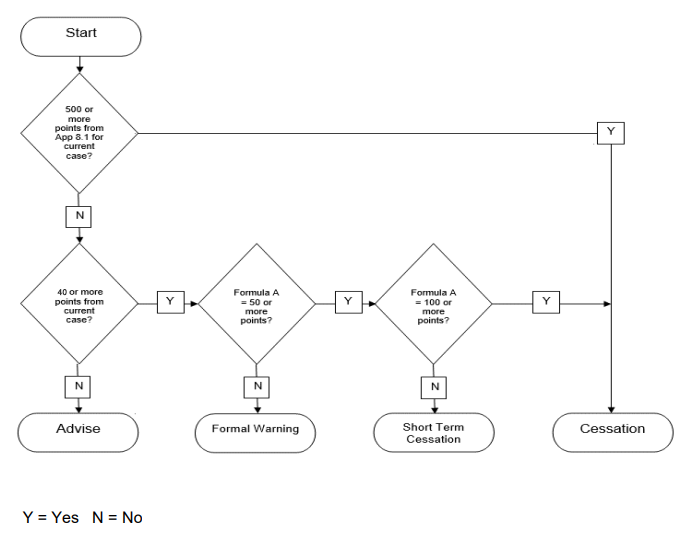
Formula A is the total number of points from:
- the current case
- unspent formal warnings
- unspent short-term cessation.
Formal warnings and short-term cessations become spent after 5 years.
All relevant mitigation will be taken into consideration before deciding on any level of disciplinary action.
7. Normal sanction levels for authorised examiners
There are 4 normal sanction levels for authorised examiners:
- advise
- formal warning
- short term cessation
- cessation
Advise
The AE should be given advice if they have between 1 and 39 points from the current case.
The AE will be subject to a formal warning if they have:
- 40 points or more for the current case
- less than 140 points in total from the current case, unspent formal warnings, and unspent short term cessation
Short term cessation
The AE will be subject to a short term cessation if they have:
- 40 points or more for the current case
- between 140 and 199 points in total from the current case, unspent formal warnings and unspent short term cessation
Cessation
The AE will be subject to cessation if they have 500 or more points from Appendix 8.1 for the current case.
The AE will also be subject to cessation if they have:
- 40 points or more for the current case
- 200 points or more in total from the current case, unspent formal warnings, and unspent short term cessation
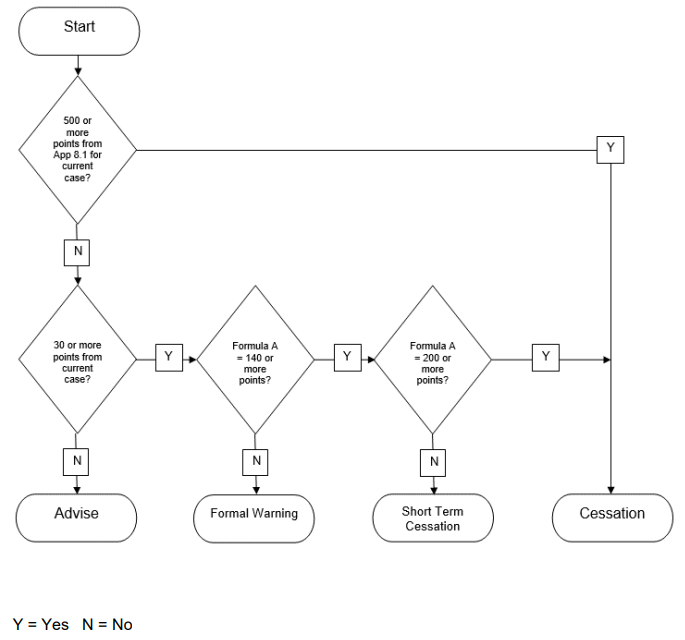
Formula A is the total number of points from:
- the current case
- unspent formal warnings
- unspent short-term cessation
Formal warnings and short-term cessations become spent after 5 years.
All relevant mitigation will be taken into consideration before deciding on any level of disciplinary action.
8. Informal hearings
Notes for guidance and code of practice for informal hearings
These notes explain the procedures for informal hearings which may be held as part of the process of determining appeals from:
- authorised examiners (AE), designated councils (DC), testers and designated council inspectors (DCI) who have been served with a statutory notice of cessation of their authorisation, designation or approval to test
- applicants who have been served with a notice of intent to refuse their application for authorisation, designation or approval to test
These notes should be read in conjunction with Section D. Requirements for authorisation,
Section E. Tester and Section I. Discipline.
The statutory requirements in relation to appeals are contained in the Motor Vehicles (Tests) Regulations 1981 as amended. The regulations provide that where those who have been served with a statutory notice wish to make representations to the effect that either:
- their authorisation, designation or approval should not cease or should be restored
- their application for authorisation, designation or approval to test should be approved
they should make such representations in writing within 14 days from the date of the notice (regulations 10 (1) (c) and 8 (9) respectively). All written representations or statements should fully set out your case and all the evidence you wish to rely upon. The availability of informal hearings does not affect the terms of the regulations.
Informal hearings provide an additional process whereby cases may be put personally to officials in DVSA’s appeals section.
Requests for a hearing
Requests for a hearing are at the discretion of DVSA and may be granted if there are exceptional circumstances.
If you wish to present your case at a hearing, you should submit your request preferably to the email address on the decision letter. We will accept postal hearing requests, however, this might cause a delay in processing the appeal if you use this method.
This request must be submitted as soon as possible after you have received the notice of cessation or intent to refuse to authorise, approve or designate. If a date for the hearing is offered by the Appeals team, you will be permitted to refuse the first date offered.
Who may attend the hearing
You may attend and/or be represented by your trade association, consultant or legal representative. The appeals section may arrange for DVSA personnel involved in the disciplinary or intended refusal action to attend the hearing where their evidence is at issue.
Prior to the hearing
An important element of this procedure is that the appeals officer must be fully aware of the relevant issues and arguments so that they can properly lead the discussion. Your written representations or statement should contain full particulars of the case you wish to make at the hearing including a list of any documents to which you wish to refer.
The provision of your written representations or statement within 14 days of the issue of the notice of cessation or intent to refuse is a necessary procedure. If you are appealing against a notice of cessation you may however, within the 14 day period, state in writing that you wish to rely, at hearing, on the written representations made earlier to the DVSA office that issued the decision.
To assist you the grounds of appeal have been categorised. The following list is not exhaustive, and it is recognised that there are some overlapping grounds:
- the disciplinary procedures have not been followed by DVSA at each and every stage
- the technical evidence is disputed
- other evidence is disputed
- the wrong interpretation has been placed upon the facts
- the sanction imposed and/or the number of disciplinary points allotted is not in accordance with the MOT testing guide
- the penalty is not proportionate to the offence
- there are mitigating circumstances
- the intent to refuse is unreasonable
The venue
Appeals will, where possible, be heard via Microsoft Teams. In extreme circumstances where this is not possible, we will consider conducting them in person at a mutually convenient location.
The hearing will be held by a senior officer of the appeals team who will have a thorough knowledge of the MOT service and the relevant procedures. The procedures will be fully explained to you at the start of, and throughout, the hearing.
The appeals officer will first set out the case as it appears from their reading of the papers, outlining what they consider are the main issues. In some cases, this might take the form of an agenda. They will also indicate those matters on which further information is needed. This will not preclude you from referring to other aspects you consider to be relevant.
All evidence will have been disclosed beforehand so that you will have had time to understand it and it will not normally be necessary to read this out at the hearing. If further documents are made available at the hearing the appeals officer may ask or allow questions on any points which emerge which may need further information or clarification.
The hearing will take the form of a discussion which you or your representative will be invited to start. You may, if you wish, decline to do so. The parties will be encouraged to ask questions informally throughout the proceedings, subject only to the discussion being conducted in an orderly manner.
Cross-examination will not be permitted unless the appeals officer considers that cross-examination is required to ensure a thorough examination of the main issues. You will be given the opportunity to make any final comments before the hearing is closed.
If a hearing needs to be adjourned this will be at the discretion of the officer holding the hearing. If a date for the resumption of the hearing cannot be set at the time of the adjournment, the date will be notified to the appellant within 5 working days.
The appeals officer may close the proceedings if, at any time during the hearing, matters are in their judgement not progressing satisfactorily. The appeal will then be determined on the basis of any written representations submitted. Full reasons for the closure of the hearing will be given in the appeal decision letter.
A recording will be made of the hearing (audio only). A copy of the recording and a transcript will be available as evidence in the event of subsequent court proceedings.
The decision
Decisions will not be made at the hearing as they are made by DVSA’s chief executive on behalf of the Secretary of State. The administrative target for determining appeals after hearings will be the same as that for appeals determined by written representations - 95% of appeals to be determined within 5 weeks.
In the case of written representations, the target date is calculated from the date the written representations are received. The target date following a hearing will be calculated from the date of the hearing. The decision letter will be issued by the appeals section on the date the appeal is determined.
Notice of cessation - effective date of cessation
If you wish your case to be heard at a hearing you should bear in mind that it is unlikely that your appeal can be determined prior to the notice of cessation becoming effective. The date the notice comes into effect cannot be deferred pending the outcome of the appeal. Whilst the appeals section will try to determine your appeal as quickly as possible, there may be a period during which you/your testing station must cease testing pending the determination of the appeal.
9. Major and minor errors for class 1 and 2 (group A) demonstration tests
The following tables are for use during observed demonstration tests.
For further details see Appendix 6.8: Demonstration tests.
The tester should personally assess the following items during a demonstration test. They will be awarded major or minor errors if they do not. Testers will also be asked questions on procedures, standards, and vehicles classes within this test group.
| Checks and assessments not completed by the candidate |
Major or minor errors |
| 1. Defect missed on a testable item |
1 major error |
| 2. Item failed is not testable or has no defect |
1 major error |
| 3. Motorcycle not correctly identified or entered onto MOT testing service correctly. |
1 major error |
| 4. Candidate unable to correctly use test facilities |
1 major error |
| 5. Candidate unable to answer a question correctly |
1 minor error |
Section 0 - Identification of vehicles
The tester should personally assess the following items during a demonstration test. They will be awarded major or minor errors if they do not.
Rear registration plates
| Checks and assessments not completed by the candidate |
Major or minor errors |
| Did not check rear registration plate for compliance, condition and security |
1 minor error per check omitted |
Vehicle identification number - VIN
| Checks and assessments not completed by the candidate |
Major or minor errors |
| Did not check vehicle identification number |
1 minor error |
Section 1 - Brakes
The tester should personally assess the following items during a demonstration test. They will be awarded major or minor errors if they do not.
Brake controls
| Checks and assessments not completed by the candidate |
Major or minor errors |
| 1. Did not check the presence, security and condition of the foot brake and handlebar brake lever and mountings |
1 minor error per control |
| 2. Did not check the brake pedal and lever for wear on pivots, reserve travel, or damage and smoothness of operation |
1 minor error per control |
| 3. Did not check hydraulic systems, a control for creep under load or for sponginess of operation |
1 minor error per control |
Brake systems
| Checks and assessments not completed by the candidate |
Major or minor errors |
| 1. Did not check the brake disc for condition |
1 minor error one or more discs not checked |
| 2. Did not check mechanical brake components |
1 minor error per item not checked |
| 3. Did not check hydraulic brake components |
1 minor error per item not checked |
| 4. Did not check the hydraulic brake components while held under pressure for leaks and hose bulging |
1 major error no system pressure checks carried out
1 minor error one or more pressure checks not done |
Use of equipment
| Checks and assessments not completed by the candidate |
Major or minor errors |
| 1. Did not carry out the brake test using the appropriate test using the appropriate, approved, brake test equipment |
1 major error |
| 2. Unable to correctly use the brake testing equipment |
1 major error |
| Checks and assessments not completed by the candidate |
Major or minor errors |
| 1. Did not carry out a brake test on the primary system |
1 major error |
| 2. Did not carry out a brake test on the secondary system |
1 major error |
| 3. Did not ascertain the weight of the machine |
1 minor error |
| 4. Did not calculate the brake efficiency |
1 minor error |
Roller brake tester
| Checks and assessments not completed by the candidate |
Major or minor errors |
| 1. Did not hold the front brake steady at about half the maximum reading and check for fluctuation |
1 minor error |
| 2. Did not hold the rear brake steady at about half the maximum reading and check for fluctuation |
1 minor error |
Sidecar brake, if applicable
| Checks and assessments not completed by the candidate |
Major or minor errors |
| Did not check side car brake |
1 major error |
Brake fluid reservoir
| Checks and assessments not completed by the candidate |
Major or minor errors |
| Did not check transparent reservoirs for contaminated fluid |
1 minor error |
Section 2 - Steering
The tester should personally assess the following items during a demonstration test. They will be awarded major or minor errors if they do not.
Steering controls
| Checks and assessments not completed by the candidate |
Major or minor errors |
| Did not assess steering controls/system |
1 major error |
| Did not raise front of machine from floor |
1 major error |
| Checks and assessments not completed by the candidate |
Major or minor errors |
| 1. Did not check handlebars/grips/clamps/fork yoke for security, condition or weakness. |
1 minor error |
| 2a. Lock to lock check: did not check for fouling fixed parts or impede controls |
1 minor error |
| 2b. Lock to lock check: did not check whether control cables/hydraulic hoses were pulled taught on full lock |
1 minor error |
| 2c. Lock to lock check: did not check security and adjustment of steering lock stops |
1 minor error |
| 2d. Lock to lock check: did not check security of steering damper (where fitted) |
1 minor error |
| 2e. Lock to lock check: did not check for engine speed change during lock to lock check |
1 minor error |
Steering system
| Checks and assessments not completed by the candidate |
Major or minor errors |
| 1a. Did not check steering head bearing for tightness and roughness |
1 minor error |
| 1b. Did not check steering head bearing for free play |
1 minor error |
Wheel alignment
| Checks and assessments not completed by the candidate |
Major or minor errors |
| Did not check wheel alignment |
1 major error |
| 1. Did not fully complete all elements of wheel alignment check |
1 minor error |
| 2. Did not check alignment of sidecar relative to motorcycle (if fitted) |
1 major error - no alignment completed
1 minor error - vertical alignment not assessed |
Section 4 - Lamps and reflectors
The tester should personally assess the following items during a demonstration test. They will be awarded major or minor errors if they do not.
Headlight aim and use of headlamp aim equipment
| Checks and assessments not completed by the candidate |
Major or minor errors |
| 1. Headlamp aim tester not used to assess headlamp aim |
1 major error |
| 2. Headlamp tester not correctly aligned to the headlamp being tested |
1 minor error - one or more lamps incorrectly aligned |
| 3. Headlamp aim checked on the incorrect beam |
1 minor error - one or more lamps checked on incorrect beam |
| 4. Did not check light source and lamp are compatible |
1 minor error |
Lights including, headlamps, front and rear position lamps, stop lamp, indicators, reflectors , number plate lamps
| Checks and assessments not completed by the candidate |
Major or minor errors |
| 1. Did not check and assess all front and rear lights |
1 major error |
| 1a. Did not check and assess all front and rear lights for operation |
1 minor error - one or more system operation not checked |
| 1b. Did not check and assess all front and rear lights for security |
1 minor error - one or more unit security not checked |
| 1c. Did not check and assess all front and rear lights for condition |
1 minor error - one or more unit condition not checked |
Lighting switch(es), indicator switch and tell-tale(s)
| Checks and assessments not completed by the candidate |
Major or minor errors |
| 1. Did not check and assess a switch/control |
1 major error |
| 1a. Did not check and assess a switch/control for operation |
1 minor error per switch or control not checked |
| 1b. Did not check and assess a switch/control for security |
1 minor error per switch or control not checked |
| 1c. Did not check and assess a switch/control for condition |
1 minor error per switch or control not checked |
Section 5 - Wheels, tyres and suspension
The tester should personally assess the following items during a demonstration test. They will be awarded major or minor errors if they do not.
Wheel bearings
| Checks and assessments not completed by the candidate |
Major or minor errors |
| 1. Did not check condition of the front and rear wheel bearings by rocking the wheel. (Check wheel bearing on any side car) |
1 minor error - one or more bearings not checked |
| 2. Did not check condition of the front and rear wheel bearings by spinning the wheel. (Check wheel bearing on any side car) |
1 minor error - one or more bearings not checked |
Wheels
| Checks and assessments not completed by the candidate |
Major or minor errors |
| 1. Did not check road wheels |
1 major error |
| 1a. Did not check front road wheel for security |
1 minor error for one or more checks not carried out |
| 1b. Did not check front road wheel for condition of wheel/spokes |
1 minor error for one or more checks not carried out |
| 1c. Did not check front road wheel for buckling / eccentricity |
1 minor error for one or more checks not carried out |
| 2a. Did not check rear road wheel for security |
1 minor error for one or more checks not carried out |
| 2b. Did not check rear road wheel for condition of wheel/spokes |
1 minor error for one or more checks not carried out |
| 2c. Did not check rear road wheel for buckling / eccentricity |
1 minor error for one or more checks not carried out |
Tyres
| 1. Did not check tyres |
1 major error |
| 1a. Did not check tyre for type and suitability |
1 minor error per tyre not checked |
| 1b. Did not check tyre for condition, correct fitment |
1 minor error per tyre not checked |
| 1c. Did not check tyres on twin wheels are not of a different structure |
1 minor error |
| 1d. Did not check tyres on twin wheels are not different sizes |
1 minor error |
| 2. Did not check tyres for signs of fouling of tyres on other components |
1 minor error - one or more tyre not checked for fouling |
Sidecar when fitted
| Checks and assessments not completed by the candidate |
Major or minor errors |
| Did not assess sidecar when fitted |
1 major error |
| Did not check the sidecar wheel / tyre condition |
1 minor error |
Suspension
| Checks and assessments not completed by the candidate |
Major or minor errors |
| Did not assess suspension |
1 major error |
| 1. Did not check suspension components |
1 major error - front of machine not raised from floor
1 major error - rear of machine not raised from floor |
| 1a. Did not check suspension components for security |
1 minor error |
| 1b. Did not check suspension components for condition (including suspension joint dust covers) |
1 minor error |
| 1c. Did not check suspension components for presence (note rear suspension is not mandatory on motorcycles) |
1 minor error |
| 1d. Did not check suspension components for any unsafe modifications |
1 minor error |
| 2. Did not check shock absorbers |
1 major error |
| 2a. Did not check shock absorbers for security |
1 minor error |
| 2b. Did not check shock absorbers for presence |
1 minor error |
| 2c. Did not check shock absorbers for operation |
1 minor error |
Section 6 - Structure and attachments
The tester should personally assess the following items during a demonstration test. They will be awarded major or minor errors if they do not.
| Checks and assessments not completed by the candidate |
Major or minor errors |
| Did not assess condition of structure |
1 major error |
| 1. Did not check the structure for cracks/damage/distortion/corrosion |
1 minor error - one or more areas not checked |
| 2. Did not check joining/attachment plates or fastenings for security |
1 minor error - one or more areas not checked |
Exhaust system
| Checks and assessments not completed by the candidate |
Major or minor errors |
| Did not assess exhaust system |
1 major error |
| 1. Did not check security, condition and completeness of the exhaust system |
1 minor error |
| 2. Did not check silencer for any unacceptable markings |
1 minor error |
Fuel system
| Checks and assessments not completed by the candidate |
Major or minor errors |
| Did not assess fuel system |
1 major error |
| 1. Did not check fuel tank (s), all visible fuel hoses, pipes, unions and system components for damage, leaks or insecurity |
1 minor error |
| 2. Did not check fuel tank cap for presence and effectiveness |
1 minor error |
Transmission
| Checks and assessments not completed by the candidate |
Major or minor errors |
| Did not check transmission related components, condition and operation |
1 minor error |
Engine mountings (only when engine is a stressed member)
| Checks and assessments not completed by the candidate |
Major or minor errors |
| Did not check for presence, condition and excessive movement |
1 minor error |
Seats
| Checks and assessments not completed by the candidate |
Major or minor errors |
| Did not check the presence and security of the seats |
1 minor error |
Clutch and throttle controls
| Checks and assessments not completed by the candidate |
Major or minor errors |
| 1. Did not check operation of throttle controls |
1 minor error |
| 2. Did not check condition and operation of clutch control |
1 minor error |
| Checks and assessments not completed by the candidate |
Major or minor errors |
| Did not check condition and security of machines footrests |
1 minor error |
Section 7 - Audible warning
The tester should personally assess the following items during a demonstration test. They will be awarded major or minor errors if they do not.
| Checks and assessments not completed by the candidate |
Major or minor errors |
| Did not asses audible warning (horn) |
1 major error |
| 1a. Did not check and assess a switch/control for operation |
1 minor error |
| 1b. Did not check and assess a switch/control for security |
1 minor error |
| 1c. Did not check and assess a switch/control for condition |
1 minor error |
Section 8 - Nuisance
The tester should personally assess the following items during a demonstration test. They will be awarded major or minor errors if they do not.
| Checks and assessments not completed by the candidate |
Major or minor errors |
| Did not assess exhaust noise |
1 major error |
| 1. Did not check noise from exhaust (at approximately half maximum engine speed) |
1 minor error |
| 2. Did not check security of exhaust |
1 minor error |
10. Major and minor errors for class 3, 4, 5 and 7 (group B) demonstration tests
The following tables are for use during observed demonstration tests.
For further details see Appendix 6.8: Demonstration tests.
The tester should personally assess the following items during a demonstration test. They will be awarded major or minor errors if they do not. Testers will also be asked questions on procedures, standards, and vehicles classes within this test group.
| Checks and assessments not completed by the candidate |
major or minor errors |
| 1. Defect missed on a testable item |
1 major error |
| 2. Item failed is not testable or has no defect |
1 major error |
| 3. Vehicle not correctly identified or entered onto MOT testing service correctly |
1 major error |
| 4. Candidate unable to correctly use test facilities |
1 major error |
| 5. Candidate unable to answer a question correctly |
1 minor error |
Section 0 - Identification of vehicles
The tester should personally assess the following items during a demonstration test. They will be awarded major or minor errors if they do not.
| Checks and assessments not completed by the candidate |
Major or minor errors |
| Did not check front and rear registration plates |
1 major error |
| 1. Did not check condition and security of front registration plate |
1 minor error - one or more registration plate not checked (1, 2, 3) capped at 1 error |
| 2. Did not check condition and security of rear registration plate |
1 minor error - one or more registration plate not checked (1, 2, 3) capped at 1 error |
| 3. Did not check front and rear number plates match |
1 minor error - one or more registration plate not checked (1, 2, 3) capped at 1 error |
Vehicle identification number
| Checks and assessments not completed by the candidate |
Major or minor errors |
| Did not check vehicle identification number |
1 minor error |
Section 1 - Brakes
The tester should personally assess the following items during a demonstration test. They will be awarded major or minor errors if they do not.
Parking brake mechanism
For class 5, you should also refer to Section 11.
| Checks and assessments not completed by the candidate |
Major or minor errors |
| 1. Did not check the presence, security and condition of parking brake lever or control |
1 minor error |
| 2. Did not check handbrake components |
1 minor error |
Service brake mechanism, servo, ABS, ESC system
| Checks and assessments not completed by the candidate |
Major or minor errors |
| 1. Did not check service brake control for condition, security, creep or sponginess |
1 minor error |
| 2. Did not check service brake control for condition and operation of the vacuum servo with the engine running |
1 minor error |
| 3. Did not check and assess a warning lamp for correct operation |
1 minor error |
| 4. Did not check brake system components, hoses and pipe work with the brake system pressurised and engine running in the case of servo assisted brakes |
1 major error - no system pressure checks carried out |
| 5. Did not check systems for mechanical wear whilst being operated. |
1 minor error |
| 6. Did not check brake fluid for contamination |
1 minor error |
Prescribed areas
| Checks and assessments not completed by the candidate |
Major or minor errors |
| Did not check relevant vehicle bodywork within a prescribed area |
1 minor error one or more check not done |
Use of equipment
| Checks and assessments not completed by the candidate |
Major or minor errors |
| Did not carry out the brake test using the appropriate test using the appropriate and approved brake test equipment |
1 major error |
| Checks and assessments not completed by the candidate |
Major or minor errors |
| 1. Did not carry out a service brake test |
1 major error |
| 2. Did not carry out a test on front service brakes |
1 major error |
| 3. Did not check maximum effort on each wheel |
1 minor error - one or more maximum effort not assessed |
| 4. Did not check unapplied effort with both wheels rotating |
1 minor error - one or more unapplied effort not assessed |
| 5a. Did not run both the front wheels together and gradually increase and release the brake effort and assess grabbing |
1 minor error for one or more checks not carried out (a, b, c, d) – capped at 1 error |
| 5b. Did not run both the front wheels together and gradually increase and release the brake effort and assess lag in operation |
1 minor error for one or more checks not carried out (a, b, c, d) – capped at 1 error |
| 5c. Did not run both the front wheels together and gradually increase and release the brake effort and assess fluctuation in brake effort |
1 minor error for one or more checks not carried out (a, b, c, d) – capped at 1 error |
| 5d. Did not run both the front wheels together and gradually increase and release the brake effort and assess imbalance |
1 minor error for one or more checks not carried out (a, b, c, d) – capped at 1 error |
| 6. Did not carry out a test on rear service brakes |
1 major error |
| 7. Did not check maximum effort on each wheel |
1 minor error - one or more maximum effort not assessed |
| 8. Did not check unapplied effort with both wheels rotating |
1 minor error - one or more unapplied effort not assessed |
| 9a. Did not run both the rear wheels together and gradually increase and release the brake effort and assess grab or judder |
1 minor error for one or more checks not carried out (a, b, c, d) – capped at 1 error |
| 9b. Did not run both the rear wheels together and gradually increase and release the brake effort and assess uneven application |
1 minor error for one or more checks not carried out (a, b, c, d) – capped at 1 error |
| 9c. Did not run both the rear wheels together and gradually increase and release the brake effort and assess uneven release |
1 minor error for one or more checks not carried out (a, b, c, d) – capped at 1 error |
| 9d. Did not run both the rear wheels together and gradually increase and release the brake effort and assess imbalance |
1 minor error for one or more checks not carried out (a, b, c, d) – capped at 1 error |
| 10. Did not record the maximum reading for each wheel and carry out the service brake efficiency calculation when appropriate |
1 minor error |
| 11. Did not check brake performance test on a vehicle with servo assisted or power brakes with engine idling |
1 minor error |
| 12. Did not carry out a test on the parking brake |
1 major error |
| 13. Did not record maximum reading for each wheel (parking brake) |
1 minor error - one or more maximum effort not assessed |
| 14. Did not carry out the parking brake efficiency calculation when appropriate |
1 minor error |
Section 2 - Steering
The tester should personally assess the following items during a demonstration test. They will be awarded major or minor errors if they do not.
Steering control and system
For class 5, you should also refer to Section 11.
| Checks and assessments not completed by the candidate |
Major or minor errors |
| 1. Did not assess steering control for excessive free play |
1 minor error |
| 2. Did not assess operation of steering lock(when required) |
1 minor error |
| 3. Did not asses electronic power steering operation and warning/fly by wire operation |
1 minor error |
Steering system
| Checks and assessments not completed by the candidate |
Major or minor errors |
| 1. Did not check steering components for condition and security whilst assistant ‘rocked’ the steering wheel firmly against the resistance of the road |
1 minor error |
| 2. Did not check the operation/condition of the power steering system components which could be inspected from under vehicle, while the engine was running |
1 minor error |
| 3. Did not check steering for fouling and condition, with the suspension in normal running position, front wheels turned lock to lock on unlocked turning plates (if appropriate for suspension type) |
1 minor error |
| 4. Did not check sector shaft condition, (if applicable) steering gear fixing holes elongated |
1 minor error |
Section 3 - Visibility
The tester should personally assess the following items during a demonstration test. They will be awarded major or minor errors if they do not.
View to rear
For class 5, you should also refer to Section 11.
| Checks and assessments not completed by the candidate |
Major or minor errors |
| Did not check interior mirror or indirect vision device for presence, security and condition |
1 minor error |
Wiper and washers system
| Checks and assessments not completed by the candidate |
Major or minor errors |
| 1a. Did not check operation and effectiveness of wipers |
1 minor error |
| 1b. Did not check operation and effectiveness of washers |
1 minor error |
View to the front, windscreen and view of obligatory exterior mirrors
| Checks and assessments not completed by the candidate |
Major or minor errors |
| 1. Did not check drivers view of the road through windscreen swept area |
1 minor error |
| 2. Did not check driver’s view of obligatory exterior mirror or mirrors |
1 minor error |
Wiper blades
| Checks and assessments not completed by the candidate |
Major or minor errors |
| Did not check wiper blades for condition and security |
1 minor error - one or more wiper blade not checked |
Exterior mirrors
| Checks and assessments not completed by the candidate |
Major or minor errors |
| Did not check exterior mirror for presence, security and condition |
1 minor error - one or more exterior mirror not checked |
Bonnet
| Checks and assessments not completed by the candidate |
Major or minor errors |
| 1. Did not check bonnet security, condition of retaining devices |
1 minor error |
Section 4 - Lamps, reflectors and electrical equipment
The tester should personally assess the following items during a demonstration test. They will be awarded major or minor errors if they do not.
Lighting switch(s), indicator switch and tell-tale(s)
| Checks and assessments not completed by the candidate |
Major or minor errors |
| Did not assess lighting switch(es), indicator switch and tell-tale(s) |
1 Major error |
| 1a. Did not check and assess a switch/control for operation |
1 minor error per switch or control not checked (a, b, c) – capped at 1 error |
| 1b. Did not check and assess a switch/control for security |
1 minor error per switch or control not checked (a, b, c) – capped at 1 error |
| 1c. Did not check and assess a switch/control for condition |
1 minor error per switch or control not checked (a, b, c) – capped at 1 error |
Lights including front and rear position lamps, stop lamps, indicators, reflectors, DRL’s, reversing lamps, front fog lamps, marker lamps where appropriate
| Checks and assessments not completed by the candidate |
Major or minor errors |
| Did not assess lights including front and rear position lamps, stop lamps, indicators, reflectors, DRL’s, reversing lamps, front fog lamps, marker lamps where appropriate |
1 major error |
| 1a. Did not check and assess all front and rear lights for operation (also not affected by other lights) |
1 minor error - one or more cluster operation not checked |
| 1b. Did not check and assess all front and rear lights for security |
1 minor error - one or more cluster operation not checked |
| 1c. Did not check and assess all front and rear lights for condition |
1 minor error - one or more cluster operation not checked |
Headlight aim and use of headlamp aim equipment
| Checks and assessments not completed by the candidate |
Major or minor errors |
| 1. Headlamp aim tester not used to assess headlamp aim |
1 major error |
| 2. Headlamp tester not correctly aligned to the headlamp being tested |
1 minor error - one or more lamps incorrectly aligned |
| 3. Headlamp aim checked on the incorrect beam |
1 minor error - one or more lamps checked on incorrect beam |
| 4. Did not check HID and LED headlamps for mandatory levelling and cleaning devices |
1 minor error |
| 5. Did not check light source and lamp are compatible |
1 minor error |
Electrical wiring and battery
| Checks and assessments not completed by the candidate |
Major or minor errors |
| 1. Did not check battery for condition and security |
1 minor error |
| 2. Did not check condition and security of all visible wiring |
1 major error no assessment carried out
1 minor for one or more areas of visible wiring not checked |
| 3. Did not check tow bar socket as required for security, condition and operation |
1 minor error |
Section 5 - Axles, wheels tyres and suspension
The tester should personally assess the following items during a demonstration test. They will be awarded major or minor errors if they do not.
Jacking of vehicle – front
For class 5, you should also refer to Section 11.
| Checks and assessments not completed by the candidate |
Major or minor errors |
| 1. Front of vehicle not jacked |
1 major error |
| 2. Did not check suspension components with front end of vehicle appropriately jacked for suspension type |
1 minor error - one or more sides not checked and/or jacked appropriately |
| 3. Did not check suspension components using a suitable bar under the wheel |
1 minor error - one or more sides not checked and/or jacked appropriately |
Wheel bearings – front
| Checks and assessments not completed by the candidate |
Major or minor errors |
| 1. Did not check condition of the front wheel bearings and suspension components by the rocking wheel |
1 minor error - one or more sides not assessed |
| 2. Did not check condition of the front wheel bearings by spinning the wheel |
1 minor error - one or more sides not assessed |
Jacking of vehicle – rear (N/A for large vehicles DGW over 5000kg)
| Checks and assessments not completed by the candidate |
Major or minor errors |
| 1. Rear of vehicle not jacked |
1 major error |
| 2. Did not check condition of the rear wheel bearings and suspension components by rocking wheel. |
1 minor error - one or more sides not assessed |
Wheels
| Checks and assessments not completed by the candidate |
Major or minor errors |
| Did not check road wheels |
1 major error |
| Did not check road wheel security and condition |
1 minor error for one or more road wheels not checked |
Tyres
| Checks and assessments not completed by the candidate |
Major or minor errors |
| Did not check tyres (including load and speed rating - class 5 and 7 only) |
1 major error |
| 1. Did not check tyre for condition, correct fitment and type, including structure and size |
1 minor error for one or more tyres not checked |
| 2. Did not check tyres for fouling a part of the vehicle. |
1 minor error for one or more tyres not checked |
| 3. Did not check tyre pressure monitoring system (when fitted) for malfunctioning or tyre obviously underinflated |
1 minor error |
Suspension
| Checks and assessments not completed by the candidate |
Major or minor errors |
| 1. Suspension checks done without the engine running in the case of hydro pneumatic suspension |
1 minor error |
| 2. Did not check suspension components for fouling and condition, with the suspension in normal running position, front wheels turned lock to lock on unlocked turning plates (if appropriate for suspension type) |
1 minor error |
| 3. Did not check suspension components for condition whilst the front wheels are rocked at the 3 and 9 o’clock position with the front wheels resting on unlocked swivel plates (if appropriate for suspension type) |
1 minor error |
| 4. Did not check that spring is not missing |
1 minor error |
Shock absorbers
| Checks and assessments not completed by the candidate |
Major or minor errors |
| Did not check presence, security and condition of shock absorbers |
1 minor error - one or more not assessed |
Section 6 - Body structure and attachments
The tester should personally assess the following items during a demonstration test. They will be awarded major or minor errors if they do not.
Structure and attachments
For class 5, you should also refer to section 11.
| Checks and assessments not completed by the candidate |
Major or minor errors |
| 1. Did not check vehicle structure for fracture, damage, corrosion outside prescribed areas |
1 minor error - one or more areas not checked |
| 2. Did not check if the strengthening plates or fastenings are insecure |
1 minor error - one or more areas not checked |
Exhaust
| Checks and assessments not completed by the candidate |
Major or minor errors |
| 1. Did not check security of the exhaust system |
1 minor error |
| 2. Did not check system components for leaks with the engine running. |
1 minor error |
| 3. Did not check that fumes are not entering cab |
1 minor error |
Fuel system including cap(s)
| Checks and assessments not completed by the candidate |
Major or minor errors |
| 1. Did not check visible fuel hoses, pipes and system components security and condition |
1 minor error |
| 2. Did not check fuel system components for leaks (including holes above the fuel line) |
1 minor error |
| 3. Did not check fuel tank cap/filler neck condition and seal |
1 minor error |
| 4. Did not check for any part of the LPG/CNG/LNG or hydrogen system defective |
1 minor error |
| 5. Did not check that any missing heat shield does not present a fire risk |
1 minor error |
Bumper
| Checks and assessments not completed by the candidate |
Major or minor errors |
| Did not check security and any damage not likely to cause injury |
1 minor error |
External Spare wheel carrier (if fitted)
| Checks and assessments not completed by the candidate |
Major or minor errors |
| Did not check security of spare wheel and carrier |
1 minor error |
Coupling mechanisms and towing equipment
| Checks and assessments not completed by the candidate |
Major or minor errors |
| 1. Did not check tow bar and mountings |
1 minor error |
| 2. Did not check operation of tow bar coupling indicator |
1 minor error |
Transmission
| Checks and assessments not completed by the candidate |
Major or minor errors |
| Did not asses transmission |
1 major error |
| a) Did not check and inspect all prop shafts |
1 minor error per component not checked (a, b, c, d) – capped at 1 error |
| b) Did not check and inspect all drive shafts |
1 minor error per component not checked (a, b, c, d) – capped at 1 error |
| c) Did not check and inspect all prop shaft and drive shaft couplings and bearings |
1 minor error per component not checked (a, b, c, d) – capped at 1 error |
| d) Did not check and inspect all drive chains or belts |
1 minor error per component not checked (a, b, c, d) – capped at 1 error |
Engine mountings
| Checks and assessments not completed by the candidate |
Major or minor errors |
| Did not check engine mounts for presence, condition and security |
1 minor error |
Body and interior
This inspection is for all vehicles and includes:
| Checks and assessments not completed by the candidate |
Major or minor errors |
| a) Did not check all body panels |
1 minor error; one or more areas not assessed (a, b, c, d) – capped at 1 error |
| b) Did not check undertrays |
1 minor error; one or more areas not assessed (a, b, c, d) – capped at 1 error |
| c) Did not check spoilers |
1 minor error; one or more areas not assessed (a, b, c, d) – capped at 1 error |
| d) Did not check mirror housings |
1 minor error; one or more areas not assessed (a, b, c, d) – capped at 1 error |
Cab and body mounting (vehicles with a separate body and/or cab)
Check cab/body for:
| Checks and assessments not completed by the candidate |
Major or minor errors |
| a) Did not check security |
1 minor error; one or more areas not assessed (a, b, c) – capped at 1 error |
| b) Did not check mountings |
1 minor error; one or more areas not assessed (a, b, c) – capped at 1 error |
| c) Did not check corrosion at mounting points |
1 minor error; one or more areas not assessed (a, b, c) – capped at 1 error |
Doors (drivers, passengers & emergency doors/exits)
Check:
| Checks and assessments not completed by the candidate |
Major or minor errors |
| a) Did not check all doors will not open using the relevant control and close properly |
1 major error - one or more doors not assessed |
| b) Did not check a door hinge, catch or pillar for presence and condition |
1 minor error - one or more areas not assessed |
Seats
| Checks and assessments not completed by the candidate |
Major or minor errors |
| Did not check seat security |
1 major error |
| 1. Did not check driver and all passenger seats for security |
1 minor error for one or more front seat security not checked |
| 2. Did not check all seat backrests for security in upright position |
1 minor error for one or more rear seat security not checked |
| 3. Did not check driver’s seat for fore and aft adjustment |
1 minor error if not checked |
Cab steps (If fitted)
| Checks and assessments not completed by the candidate |
Major or minor errors |
| Did not check if a cab step or step ring is secure and not likely to cause injury |
1 minor error per component not checked |
| Checks and assessments not completed by the candidate |
Major or minor errors |
| Did not check if a handgrip or footrest missing or insecure |
1 minor error |
Section 7 - Other equipment
The tester should personally assess the following items during a demonstration test. They will be awarded major or minor errors if they do not.
Seat belts and supplementary restraint systems (SRS)
| Checks and assessments not completed by the candidate |
Major or minor errors |
| Did not check seat belts |
1 major error |
| a) Did not check all seat belts fitted for condition and operation (functioning as intended) |
1 minor error |
| b) Did not check all seat belts fitted for security |
1 minor error |
| c) Did not check all seat belts fitted are of the correct type |
1 minor error |
| Checks and assessments not completed by the candidate |
Major or minor errors |
| a) Did not check seat belt load limiter not missing or deployed |
1 minor error |
| b) Did not check seat belt pre-tensioner not missing or deployed |
1 minor error |
| c) Did not check for fitment and condition of airbags |
1 minor error |
Anti-theft device (if appropriate)
| Checks and assessments not completed by the candidate |
Major or minor errors |
| Did not check if steering lock missing or not functioning correctly |
1 minor error |
Audible warning horn
| Checks and assessments not completed by the candidate |
Major or minor errors |
| 1a. Did not check and assess a switch/control for operation |
1 minor error per switch or control not checked (a, b, c) – capped at 1 error |
| 1b. Did not check and assess a switch/control for security |
1 minor error per switch or control not checked (a, b, c) – capped at 1 error |
| 1c. Did not check and assess a switch/control for condition |
1 minor error per switch or control not checked (a, b, c) – capped at 1 error |
Speedometer
| Checks and assessments not completed by the candidate |
Major or minor errors |
| Did not check speedometer fitment, condition, illumination and operation if road test carried out |
1 minor error |
Electronic stability control (ESC)
| Checks and assessments not completed by the candidate |
Major or minor errors |
| Did not assess electronic stability control (ESC) |
1 major error |
| Checks and assessments not completed by the candidate |
Major or minor errors |
| a) Did not check wheel speed sensors |
1 minor error per switch, component, sensor wiring or warning not checked |
| b) Did not check ESC wiring |
1 minor error per switch, component, sensor wiring or warning not checked |
| c) Did not check if other ESC component missing or damaged |
1 minor error per switch, component, sensor wiring or warning not checked |
| d) Did not check if ESC switch damaged or not functioning correctly |
1 minor error per switch, component, sensor wiring or warning not checked |
| e) Did not check if ESC MIL indicates a system malfunction |
1 minor error per switch, component, sensor wiring or warning not checked |
Section 8 - Nuisance
The tester should personally assess the following items during a demonstration test. They will be awarded major or minor errors if they do not.
| Checks and assessments not completed by the candidate |
Major or minor errors |
| Did not assess noise suppression system |
1 major error |
| a) Did not check that the exhaust noise levels are not excessive |
1 minor error |
| b) Did not check security of the noise suppression system |
1 minor error |
| c) Did not inspect exhaust silencers and under bonnet sound deadening material |
1 minor error |
Engine emissions control equipment
| Checks and assessments not completed by the candidate |
Major or minor errors |
| a) Did not check original emission control equipment is not missing, obviously modified or defective |
1 minor error |
| b) Did not check for induction or exhaust leak that could affect emissions |
1 minor error |
| c) Did not check for evidence that a diesel particulate filter has been tampered with |
1 minor error |
Use of equipment - emission procedure
| Checks and assessments not completed by the candidate |
Major or minor errors |
| 1. Did not carry out emissions test using the appropriate, approved equipment |
1 major error |
| 2. Carried out an inappropriate emissions test e.g. Cat test of non cat vehicle |
1 major error |
| 3. Used incorrect limits |
1 major error |
Test pre-checks
| Checks and assessments not completed by the candidate |
Major or minor errors |
| 1. Did not ensure the vehicle has clearly reached normal temperature before carrying out an exhaust check |
1 minor error |
| 2. Omitted a stage (including elements of pre checks on diesels) in the emissions test appropriate to the vehicle |
1 minor error for one or more stage omitted |
Fluid leaks
| Checks and assessments not completed by the candidate |
Major or minor errors |
| Did not check for fluid leaks |
1 minor error |
Section 9 - Supplementary tests for buses and coaches
The tester should personally assess the following items during a demonstration test. They will be awarded major or minor errors if they do not.
Doors
| Checks and assessments not completed by the candidate |
Major or minor errors |
| Did not asses doors |
1 major error |
| 1a. Did not check entrance and exit doors for operation |
1 minor error |
| 1b. Did not check entrance and exit doors for condition |
1 minor error |
| 1c. Did not check entrance and exit doors for operation of emergency control condition |
1 minor error |
| 1d. Did not check entrance and exit doors for operation of remote control or warning device |
1 minor error |
| 2a. Did not check operation of emergency exits |
1 major error |
| 2b. Did not check if emergency exit does not meet requirements |
1 minor error |
| 2c. Did not check emergency exits for presence of break glass hammer where applicable |
1 minor error |
| 2d. Did not check emergency exits for presence/access to emergency exit |
1 minor error |
Passenger grab handles
| Checks and assessments not completed by the candidate |
Major or minor errors |
| Did not check for presence and condition of a passenger grab handle |
1 minor error |
Steps and Stairs
| Checks and assessments not completed by the candidate |
Major or minor errors |
| Did not check condition of steps and stairs |
1 major error |
| Did not check operation of retractable step |
1 major error |
Section 10 - Seat belt installation checks
Notes only.
Section 11 - Additional information for class 5 vehicles
The tester should personally assess the following items during a demonstration test. They will be awarded major or minor errors if they do not.
Driving controls
| Checks and assessments not completed by the candidate |
Major or minor errors |
| Did not assess driving controls |
1 major error |
| a) Did not check clutch |
1 minor error |
| b) Did not check accelerator |
1 minor error |
| c) Did not check gear selector |
1 minor error |
| Checks and assessments not completed by the candidate |
Major or minor errors |
| a) Did not check if the correct weight has been used in any brake performance calculation |
1 minor error if not calculated correctly |
| b) Did not carry out applied brake test (if appropriate) |
1 minor error |
Steering
| Checks and assessments not completed by the candidate |
Major or minor errors |
| Did not check that tester is aware that use of turning plates is not mandatory for class 5 vehicle but they should be used if suitable |
1 minor error |
Visibility
| Checks and assessments not completed by the candidate |
Major or minor errors |
| a) Did not check if windscreens and windows on either side of the driver’s seat made from safety glass |
1 minor error |
| b) Did not check if all other windows made from safety glass or safety glazing |
1 minor error |
11. Disciplinary points for class 1 and 2 (group A)
Items that the presenter may have difficulty observing during a mystery shopper check are marked with an asterix in the associated tables. DVSA will take this into account if disciplinary action is to be considered.
1. Using the designated MOT inspection area
| Shortcoming |
Points |
| Failure to use the designated MOT inspection area for the mechanical inspection |
30 points |
2. Using an assistant
| Shortcoming |
Points |
| Failure to use an assistant when necessary so that an effective inspection was not carried out. |
30 points |
With motor bicycles, testers can check some items satisfactorily without the use of an assistant. A score will be allocated if the non use of an assistant meant that the item was not checked properly. In cases like this, score it as if the check had not been carried out.
3. Sit on machine
| Shortcoming |
Points |
| No testable item personally assessed by tester |
40 points |
The tester should personally assess the following items. They will be awarded disciplinary points if they do not.
| Shortcoming |
Points |
| Did not assess the operation of a switch or control |
3 points per switch/control |
| Did not assess the security of a switch or control |
3 points per switch/control |
| Did not assess the condition of a switch or control |
3 points per switch/control |
| Did not assess the handlebars for security or weakness |
3 points |
| Did not assess the handlebars for fouling fixed parts |
3 points per side |
| Did not assess whether the control cables or hydraulic hoses were pulled taught on full lock |
3 points per lock |
| Did not assess the security of any steering damper that was fitted |
3 points |
| Did not assess the security and adjustment of the steering lock stops |
3 points |
| Did not assess the steering from lock to lock |
3 points |
| Did not assess the effectiveness of the front suspension damping |
3 points |
| Did not assess the condition and security of the foot brake/handlebar brake lever and mountings |
3 points per control |
| Did not assess the foot brake or handlebar brake lever for wear on pivots/reserve travel/damage/ smoothness of operation |
3 points per control |
| In the case of hydraulic systems, did not assess a control for creep under load or for sponginess of operation |
3 points per control |
| Did not assess the effectiveness of the rear suspension damping |
3 points |
4. Checks made at the front of the machine
| Shortcoming |
Points |
| No testable item personally assessed by the tester |
50 points |
4.1 Failure to raise the front of the machine
| Shortcoming |
Points |
| Failure to raise the front of the machine |
25 points |
The tester should personally assess the following items. They will be awarded disciplinary points if they do not.
| Shortcoming |
Points |
| Did not assess the condition of the head bearing |
3 points |
| Did not assess the security of the front wheel |
3 points |
| Did not assess the front wheel for buckling and eccentricity |
3 points |
| Did not assess the condition of the front wheel/spokes |
3 points |
| Did not assess the condition of the front wheel bearings |
3 points |
| Did not assess the condition of the front tyre throughout its full circumference |
3 points |
| Did not assess the front tyre for fouling and fitment |
3 points |
| Did not assess the front brake disc for condition/run out |
3 points |
| Did not assess the steering from lock to lock |
3 points |
4.2 Further checks at the front of the machine
The tester should personally assess the following items. They will be awarded disciplinary points if they do not.
| Shortcoming |
Points |
| Did not assess the security of the front mudguard |
3 points |
| Did not assess the mechanical brake components |
3 points per item |
| Did not assess the hydraulic brake components |
3 points per item |
| Did not assess the hydraulic brake components whilst under pressure |
3 points per item |
| Did not assess the condition of the front fork assembly |
3 points per item |
| Did not assess the operation of lights |
3 points per system |
| Did not assess the security of lights |
3 points per unit |
The tester should use the following resources. They will be awarded disciplinary points if they do not.
| Shortcoming |
Points |
| Did not use the approved headlamp aim tester to check the headlamp aim |
20 points |
| Did not use an assistant seated on the machine whilst checking the headlamp aim |
3 points |
| Did not use the approved headlamp aim standing area |
8 points |
| Did not use an appropriate method to align the headlamp aim tester to the headlamp being tested |
3 points |
5. Sides of the machine
| Shortcoming |
Points |
| No testable item personally assessed by the tester |
50 points |
The tester should personally assess the following items. They will be awarded disciplinary points if they do not.
| Shortcoming |
Points |
| Did not assess the exhaust system for suitability/effectiveness/security |
3 points |
| Did not assess the engine running |
3 points |
| Did not assess the structure for cracks, damage, distortion and corrosion |
3 points |
| Did not assess the machine for defects likely to impede the rotation of the rear wheel |
3 points |
| Did not assess the security of the seats |
3 points |
| Did not assess the security of the footrests |
3 points |
| Did not assess the condition and security of the foot brake lever and mountings |
3 points |
| Did not assess the brake pedal lever for wear on pivots/ reserve travel/ damage/ smoothness of operation |
3 points |
| Did not assess the mechanical brake components |
3 points |
| Did not assess the hydraulic brake components |
3 points per item |
| Did not assess the hydraulic brake components whilst under pressure |
3 points per item |
| Did not assess the wheel alignment |
30 points |
6. Checks made at the rear of the machine
| Shortcoming |
Points |
| No testable item personally assessed by the tester |
40 points |
6.1 Failure to raise the rear of the machine from the floor
| Shortcoming |
Points |
| Failure to raise the rear of the machine from the floor |
20 points |
The tester should personally assess the following items. They will be awarded disciplinary points if they do not.
| Shortcoming |
Points |
| Did not assess the machines registration plate |
3 points |
| Did not assess for play in the rear suspension |
3 points |
| Did not assess the rear wheel security |
3 points |
| Did not assess the condition of the rear wheel/spokes |
3 points |
| Did not assess the condition of the rear wheel bearings |
3 points |
| Did not assess the condition of the rear tyre throughout its full circumference |
3 points |
| Did not assess the rear tyre for fouling and fitment |
3 points |
| Did not assess the rear tyre for suitability |
3 points |
6.2 Further checks at the rear of the machine
The tester should personally assess the following items. They will be awarded disciplinary points if they do not.
| Shortcoming |
Points |
| Did not assess the operation of lights |
3 points per system |
| Did not asses the security of lights |
3 points per unit |
7. Brake test
| Shortcoming |
Points |
| Tester did not carry out the brake performance test using the appropriate and approved brake test equipment |
60 points |
The tester should personally assess the following items. They will be awarded disciplinary points if they do not.
| Shortcoming |
Points |
| Did not carry out a brake test on the front brake control |
40 points |
| Did not carry out a brake test on the rear brake control |
40 points |
| Did not ascertain the weight of the machine |
3 points |
| Did not calculate the brake efficiency |
3 points |
| Did not correctly use the brake testing equipment |
3 points |
| Did not hold the front brake steady at about half the maximum reading and check for fluctuation (RBT only) |
3 points |
| Did not hold the rear brake steady at about half the maximum reading and check for fluctuation (RBT only) |
3 points |
| Did not check the sidecar brake, where applicable |
40 points |
8. Sidecar, when fitted
| Shortcoming |
Points |
| No testable item assessed by the tester |
40 points |
The tester should personally assess the following items. They will be awarded disciplinary points if they do not.
| Shortcoming |
Points |
| Did not assess the sidecar for security and presence of fixing devices |
6 points |
| Did not assess the suspension for freedom of movement/ condition/ security |
3 points |
| Did not assess the condition of the wheel bearings with the sidecar wheel raised |
3 points |
| Did not assess the sidecar wheel and tyre condition |
3 points |
| Did not assess the alignment of the sidecar relative to the motorcycle |
30 points |
12. Disciplinary points for class 3, 4, 5 and 7 (group B)
Items that the presenter may have difficulty observing during a mystery shopper check are marked with an asterix in the associated tables. DVSA will take this into account if disciplinary action is to be considered.
1. Interior
| Shortcoming |
Points |
| No testable item personally assessed by tester |
40 points |
The tester should personally assess the following items. They will be awarded disciplinary points if they do not.
| Shortcoming |
Points |
| Did not assess the operation of a switch/control |
3 points per switch/control |
| Did not assess the security of a control |
3 points per control * |
| Did not assess the condition of a control |
3 points per control * |
| Did not assess the steering control for excessive free play |
3 points |
| Did not assess the steering lock operation |
3 points |
| Did not assess the service brake control for creep/ sponginess |
3 points * |
| Did not assess the service brake control for servo operation |
3 points |
| Did not assess a warning lamp for correct operation |
3 points * |
| Did not assess the fitment and condition of the speedometer |
3 points * |
| Did not assess the fitment and condition of airbags |
3 points * |
| Did not assess the drivers seat fore and aft adjustment |
3 points |
| Did not assess a seatbelt for condition and operation |
3 points per belt |
| Did not assess the drivers or front passengers seat for security |
3 points per seat * |
| Did not assess a seat back for security in the upright position |
3 points per seat * |
| Did not assess an obligatory mirror or indirect vision device for presence, security and condition |
3 points * |
| Did not assess the drivers and front passengers door for opening from inside and secure latching in the closed position |
3 points per door |
| Did not assess the passenger entrance/ exit doors and emergency exits (class 5 only) |
3 points per door |
| Did not assess the bodywork within a prescribed area |
3 points per area |
The tester should use the correct tools during the assessment. They will be awarded disciplinary points if they.
| Shortcoming |
Points |
| Use the corrosion assessment tool incorrectly |
3 points |
| Use an unauthorised tool to assess corrosion |
3 points |
2. Front of the vehicle
| Shortcoming |
Points |
| No testable item personally assessed by tester |
40 points |
The tester should personally assess the following items. They will be awarded disciplinary points if they do not.
| Shortcoming |
Points |
| Did not assess the operation of the lights |
3 points per system |
| Did not assess the security of the lights |
3 points per unit |
| Did not assess the condition and security of the front registration plate |
3 points * |
| Did not assess the headlamp aim using the approved headlamp aim tester |
20 points |
| Did not assess the alignment of the headlamp tester correctly for the headlamp aim check |
3 points per unit |
| Did not assess the headlamp aim on the correct beam |
3 points per unit |
| Did not assess the headlamp aim with the engine running (hydropneumatic suspension only) |
3 points |
| Did not assess HID or LED headlamps for mandatory levelling and cleaning device |
3 points |
| Did not assess the vehicle bodywork within a prescribed area |
3 points per area |
The tester should use the correct tools during the assessment. They will be awarded disciplinary points if they.
| Shortcoming |
Points |
| Use the corrosion assessment tool incorrectly |
3 points |
| Use an unauthorised tool to assess corrosion |
3 points |
3. Sides of the vehicle - exterior ground level
| Shortcoming |
Points |
| No testable item personally assessed by tester |
30 points per side |
The tester should personally assess the following items. They will be awarded disciplinary points if they do not.
| Shortcoming |
Points |
| Did not assess the operation/security of the direction indicator side repeater |
3 points per side |
| Did not assess the wiper blade for condition and security |
3 points per blade |
| Did not assess the security of a road wheel |
3 points per wheel |
| Did not assess the condition of a tyre |
3 point per tyre |
| Did not assess obligatory exterior mirror(s) for presence, security and condition |
3 points per mirror |
| Did not assess the front and rear doors for opening from outside |
3 points per door |
| Did not assess the front and rear doors for secure latching in the closed position |
3 points per door |
| Did not assess passenger entrance and exits steps for operation and security (class 5) |
3 points per door |
| Did not assess the fuel filler cap condition and seal |
3 points |
| Did not assess the body for security |
3 points |
| Did not assess the body for sharp projections |
3 points * |
| Did not assess the externally fitted spare wheel and its carrier for security |
3 points |
| Did not assess the bodywork within a prescribed area |
3 points per area |
The tester should use the correct tools during the assessment. They will be awarded disciplinary points if they.
| Shortcoming |
Points |
| Use the corrosion assessment tool incorrectly |
3 points |
| Use an unauthorised tool to assess corrosion |
3 points |
4. Rear of the vehicle
| Shortcoming |
Points |
| No testable item personally assessed by tester |
30 points |
The tester should personally assess the following items. They will be awarded disciplinary points if they do not.
| Shortcoming |
Points |
| Did not assess the operation of the lights |
3 points per system |
| Did not assess the security of the lights |
3points per unit |
| Did not assess that lights were not affected by other lights |
3 point |
| Did not assess the condition and security of the rear registration plate |
3 points * |
| Did not assess the vehicle bodywork within a prescribed area |
3 points per area |
| Did not assess the towbar or its mountings |
3 points |
| Did not assess the towbar socket for security, condition and operation |
3 points |
| Did not assess any electrical wiring for security and condition |
3 points |
The tester should use the correct tools during the assessment. They will be awarded disciplinary points if they.
| Shortcoming |
Points |
| Use the corrosion assessment tool incorrectly |
3 points |
| Use an unauthorised tool to assess corrosion |
3 points |
5. Luggage/load compartment
| Shortcoming |
Points |
| No testable item personally assessed by tester (when testable items could not be assessed without inspecting inside the compartment |
15 points |
The tester should personally assess the following items. They will be awarded disciplinary points if they do not.
| Shortcoming |
Points |
| Did not assess the luggage/load compartment access for security in the closed position |
3 points |
In the case of testable items which could not be inspected other than from within the luggage compartment the tester did not personally assess:
| Shortcoming |
Points |
| Did not assess the condition/security of any seat belt within the luggage compartment |
3 points per belt * |
| Did not assess theall visible fuel hoses, pipes and system components for leaks, security and condition |
3 points * |
| Did not assess the electrical wiring for security and condition |
3 points * |
| Did not assess the bodywork within a prescribed area |
3 points per area |
The tester should use the correct tools during the assessment. They will be awarded disciplinary points if they.
| Shortcoming |
Points |
| Use the corrosion assessment tool incorrectly |
3 points |
| Use an unauthorised tool to assess corrosion |
3 points |
6. Under vehicle bonnet
| Shortcoming |
Points |
| No testable item personally assessed by tester |
40 points |
6.1 Using an assistant
| Shortcoming |
Points |
| No assistant was used to operate the controls |
25 points |
The tester should personally assess the following items. They will be awarded disciplinary points if they do not.
| Shortcoming |
Points |
| Did not assess the steering components for condition and security while the assistant ‘rocked’ the steering wheel firmly against the resistance of the road wheels |
6 points ( 3 points per side) |
| Did not assess the braking system for leaks from components with the system pressurised |
3 points |
| Did not assess the condition and operation of the vacuum servo with the engine running |
3 points |
| Did not assess the operation/condition of the power steering while the engine was running |
3 points |
| Did not assess the braking system for mechanical wear whilst being operated |
3 points |
6.2 Further under vehicle bonnet checks
The tester should personally assess the following items. They will be awarded disciplinary points if they do not.
| Shortcoming |
Points |
| Did not assess the exhaust system components for leaks with the engine running |
3 points |
| Did not assess the fuel system for leaks with the engine running |
3 points |
| Did not assess the fuel system for leaks with the engine not running |
3 points |
| Did not assess the battery for condition and security |
3 points |
| Did not assess the electrical wiring for condition and security |
3 points * |
| Did not assess the engine mounts for presence, condition and security |
3 points* |
| Did not assess the bodywork within a prescribed area |
3 points per area |
The tester should use the correct tools during the assessment. They will be awarded disciplinary points if they.
| Shortcoming |
Points |
| Use the corrosion assessment tool incorrectly |
3 points |
| Use an unauthorised tool to assess corrosion |
3 points |
7. Under vehicle
| Shortcoming |
Points |
| No testable item personally assessed by tester |
100 points |
| The approved lift or pit was not used |
40 points |
7.1 Under vehicle checks using an assistant
| Shortcoming |
Points |
| An assistant was not used |
40 points |
The tester should personally assess the following items. They will be awarded disciplinary points if they do not.
| Shortcoming |
Points |
| Did not assess the steering components for condition and security whilst an assistant ‘rocked’ the steering wheel firmly against resistance of the road wheels |
6 points (3 points per side) |
| Did not assess the operation/condition of the power steering system components, which could only be inspected from the under the vehicle, while the engine was running |
3 points |
| Did not assess the steering and suspension components for fouling and condition with the suspension in the normal running position and the front wheels turned from lock to lock on unlocked swivel plates if appropriate for suspension type |
6 points (3 points per side) |
| Did not assess the steering and suspension components for condition whilst the front wheels were rocked at the 3 o’clock and 9 o’clock position with the front wheels resting on the unlocked swivel plates if appropriate for suspension type |
6 points (3 points per side) |
| Did not assess the brake hoses and pipe work with the braking system pressurised and the engine running in the case of servo assisted brakes |
3 points per hose plus 3 points per fixed pipe system |
7.2 With the front of the vehicle jacked up
| Shortcoming |
Points |
| Personally assessed no testable item with the front of the vehicle jacked up |
40 points |
The tester should personally assess the following items. They will be awarded disciplinary points if they do not.
| Shortcoming |
Points |
| Did not assess the suspension components etc. with the front end of the vehicle jacked in the manner appropriate to the suspension type |
6 points (3 points per side) * |
| Did not assess the suspension components using a suitable bar under the wheel |
3 points per side * |
| Did not assess the condition of the tyres |
3 points per tyre* |
| Did not assess the condition/security of the front wheel drive shaft and couplings |
3 points per side * |
| Did not assess the condition of the front wheel bearings and suspension components by rocking the wheel |
3 points per side |
| Did not assess the condition of the front wheel bearings by spinning the wheel |
3 points per side |
| Did not assess the condition of the CV gaiters |
3 points per side * |
7.3 With the rear of the vehicle jacked up
| Shortcoming |
Points |
| Personally assessed no testable item with the rear of the vehicle jacked up |
15 points |
The tester should personally assess the following items. They will be awarded disciplinary points if they do not.
| Shortcoming |
Points |
| Did not assess the condition of the tyres |
3 points per tyre * |
| Did not assess the condition of the rear wheel bearings by spinning the wheel |
3 points per side |
| Did not assess the condition of the rear wheel bearings by rocking |
3 points per side |
7.4 Further under vehicle checks
The tester should personally assess the following items. They will be awarded disciplinary points if they do not.
| Shortcoming |
Points |
| Did not assess the handbrake components |
3 points * |
| Did not assess the exhaust system for leaks and effectiveness with the engine running |
3 points |
| Did not assess the electrical wiring for condition and security |
3 points * |
| Did not assess the bodywork within a prescribed area |
3 points per area |
The tester should use the correct tools during the assessment. They will be awarded disciplinary points if they.
| Shortcoming |
Points |
| Use the corrosion assessment tool incorrectly |
3 points |
| Use an unauthorised tool to assess corrosion |
3 points |
8. Brake test
| Shortcoming |
Points |
| Tester did not carry out the brake performance test using the appropriate and approved brake test equipment |
60 points |
| Shortcoming |
Points |
| Tester did not personally carry out a brake test on the service brake |
45 points |
8.1 Front service brakes
The tester should personally do the following checks. They will be awarded disciplinary points if they do not.
| Shortcoming |
Points |
| Did not carry out a brake test on the front service brakes |
35 points |
| Did not check maximum effort on each wheel in turn (both wheels run together on ATL) |
3 points per wheel |
| Did not check unapplied effort with both wheels rotating |
3 points per wheel * |
| Did not run the front wheels together and gradually increase and decrease the brake effort to assess grab or judder; uneven application; uneven release; imbalance |
3 points per check |
8.2 Rear service brakes
The tester should personally do the following checks. They will be awarded disciplinary points if they do not.
| Shortcoming |
Points |
| Did not carry out a brake test on the rear service brakes |
30 points |
| Did not check maximum effort on each wheel in turn (both wheels run together on ATL) |
3 points per wheel |
| Did not check unapplied effort with both wheels rotating |
3 points per wheel * |
| Did not run the rear wheels together and gradually increase and decrease the brake effort to assess grab or judder; uneven application; uneven release; imbalance |
3 points per check |
8.3 Other service brake tests
The tester should personally do the following checks. They will be awarded disciplinary points if they do not.
| Shortcoming |
Points |
| Did not record the maximum reading for each wheel and carry out the service brake efficiency calculation when appropriate |
3 points |
| Did not carry out the brake performance test on a vehicle with servo assisted or power brakes, with the engine idling |
3 points |
8.4 Parking brake
The tester should personally do the following checks. They will be awarded disciplinary points if they do not.
| Shortcoming |
Points |
| Did not carry out a brake test on the parking brake |
20 points |
| Did not check maximum effort on each wheel |
3 points per wheel |
| Did not carry out the parking brake efficiency calculation when appropriate |
3 points |
9. Emissions test
| Shortcoming |
Points |
| Tester did not carry out the emissions test using the appropriate and approved equipment |
40 points |
| Shortcoming |
Points |
| Carried out an inappropriate emissions test, for example a catalyst test instead of a non catalyst test |
20 points |
| Selected incorrect limits |
15 points |
The tester should personally do the following checks. They will be awarded disciplinary points if they do not.
| Shortcoming |
Points |
| Did not ensure that the vehicle had clearly reached normal operating temperature before carrying out an exhaust emissions check |
3 points |
| Did not carry out a stage (including elements of pre-checks on diesels) in the emissions test appropriate to the vehicle |
3 points per stage |
